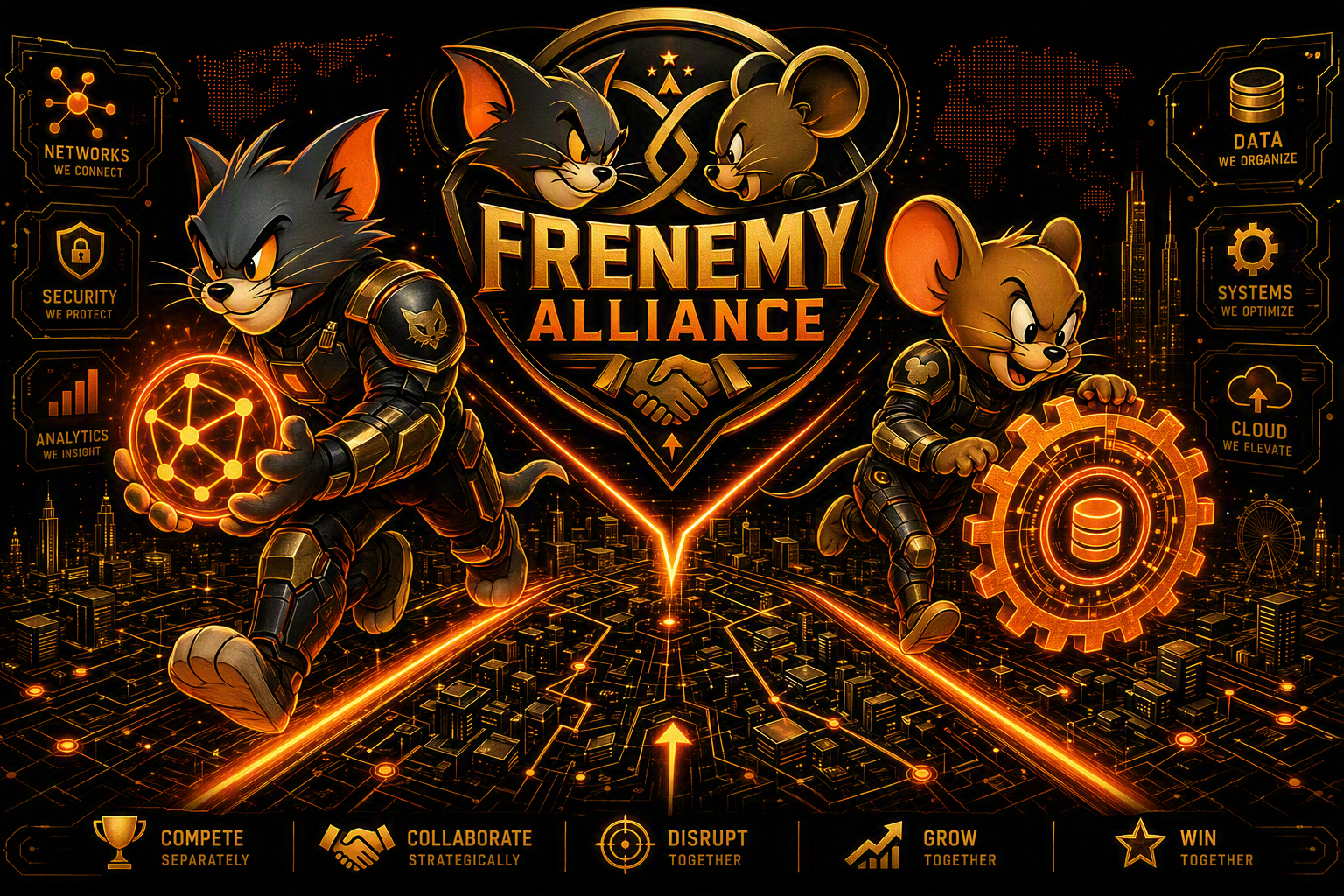
If decades of animated history have taught us anything, it’s that physics are optional 🚀, an anvil to the skull is a minor inconvenience 🔨💥, and your absolute worst enemy is usually just one external crisis away from becoming your ultimate ride-or-die business partner 🤝🔥.
We all know the standard setup. A blue-grey domestic shorthair 🐱 spends 90% of his day trying to turn a brown house mouse 🐭 into a lunchtime snack 🥪. The mouse counters by wiring high-voltage electrical sockets directly to the cat’s tail ⚡🔌. It is a violent, honest living 🧹.
But then, a shadow falls over the yard 😨. Enter Spike the Bulldog 🐕, a terrifying mechanical feline 🤖🐱, or an overzealous human owner 🧹 threatening to throw them both out into the snow ❄️. The chase halts mid-stride 🛑. A brief, wordless nod of understanding passes between predator and prey 👁️👁️. Suddenly, history’s most unstable tactical alliance is born 💣✨.
To truly understand why this trope works—and why it remains the holy grail of physical comedy 🎭—we have to look back at how two legendary animators accidentally revolutionized screen dynamics 🎬.
🎨 The Masterminds Behind the Madness: Hanna and Barbera
In 1939, MGM’s animation studio was struggling to keep up with Disney and Warner Bros 📉. Two young animators, William Hanna and Joseph Barbera, pitched an idea that their producer initially hated: a classic cat-and-mouse chase 🐱🐾🐭.
Barbera brought the visual gag timing and character expressions 🤪, while Hanna brought the rhythmic pacing and story structure 🎼. Their first short, Puss Gets the Boot (1940), introduced a cat named Jasper and a mouse named Jinx 🐾. It was an instant hit, earning an Academy Award nomination 🏆. MGM quickly greenlit a series, renaming the duo Tom and Jerry ✨.
What Hanna and Barbera realized early on was that pure, unending hatred gets boring fast 😴. To keep audiences engaged across over 100 classic theatrical shorts, they had to give their characters depth, emotional range, and, most importantly, a shared ecosystem 🏡. Tom and Jerry weren’t just predator and prey—they were housemates who secretly depended on each other to justify their own existence 🔄.
⚙️ The Dynamics: A Masterclass in Character Synergy
When an outside force threatens their cozy environment, Tom and Jerry’s chaotic dynamic instantly shifts from mutual destruction to high-stakes teamwork 🤜🤛.
[ Traditional War ⚔️ ]
Tom 😼 (Brute Force / Panicked Chaos)  <--- VS --->  Jerry 🐭 (Tactical Genius / Speed)

[ Tactical Alliance 🤝 ]
Spike 🐕 / Bot 🤖 / Human 🧹  <--- TRIPPED BY --->  [ Tom's Strength 💪 + Jerry's Strategy 🧠 ]
1. 🐱 Tom: The Heavily Armed Enforcer
Left on his own, Tom is impulsive, arrogant, and easily panicked 😱. But in an alliance, Tom becomes the muscle 💪. He brings the physical reach, the household hardware 🏏, and the sheer willingness to throw himself into harm’s way 💣.
2. 🐭 Jerry: The Master Strategist
Jerry is the brain of the operation 🧠⚡. Small, fast, and completely fearless, Jerry maps out complex, multi-stage traps 📐. While Tom distracts the threat 🎯, Jerry operates the fine machinery, pulls the levers 🕹️, and delivers the precise final blow 💥.
When they combine Jerry’s galaxy-brain engineering 🧠 with Tom’s brute-force execution 💪, they stop being incompetent slapstick victims and become a military-grade tactical unit 🎖️.
🎬 Classic Cases: When the Truce Hits the Screen
Some of the most iconic episodes in cartoon history relied entirely on this subversion of their rivalry 📺.
The Truce Hurts (1948) 📜: Tom, Jerry, and Spike the Bulldog literally sign a treaty agreeing to live in peace 🕊️. For three magnificent minutes, they share meals 🍗, tuck each other into bed 🛌, and protect one another 🤝. The alliance only crumbles when a juicy steak arrives and none of them can decide how to split it 🥩🔪—proving that peace is fragile, but greed is universal 💸.
Dog Trouble (1942) 🐕🦺: One of the earliest team-up episodes. Spike terrorizes both Tom and Jerry, forcing them to use a needle and thread 🧵 to secretly stitch Spike’s legs to a fence while he sleeps 😴. It’s a flawless demonstration of synchronized slapstick 👏💥.
The Fast and the Furry-ous Dynamics 🤖: In various modern iterations and feature films, whenever a robotic cat or an automated vacuum threatens to make Tom obsolete 🧹⚡, Jerry steps in. Jerry doesn’t want Tom replaced because a robot might actually catch him 😳!
📋 The Anatomy of the Truce: 3 Unspoken Rules
Rule #1: “Only I Get to Destroy You” 😼⚡🐭
This is the core foundation of their relationship. Tom will spend three hours trying to flatten Jerry with a waffle iron 🧇, but the second a stray alley cat walks in trying to eat Jerry, Tom takes it as a personal insult 😾. It’s a bizarre mix of toxic ownership and profound respect 🫡. They’ve invested too much time, energy, and localized property damage into each other to let a newcomer take the credit 💥.
Rule #2: Zero Verbal Communication Needed 🔇👀
Tom and Jerry rarely speak, which means their alliances are forged entirely through visual pantomime 🎭. A widened eye 👁️, a nervous gulp 😰, and a synchronized nod 😏 are all it takes to communicate: “We will deal with our personal issues later; right now, that bulldog needs to be launched into the stratosphere.” 🚀
Rule #3: The Post-Victory Reset 🔄💥
The funniest part of any team-up is the immediate aftermath of victory 🎉. The threat is defeated. The music swells 🎶. Tom and Jerry high-five ✋, hug 🫂, and laugh like battle-tested war heroes 🎖️.
Then comes the quiet beat of realization 🤐.
They look at their joined hands 🤝. They look at each other 👁️👁️. The atmosphere freezes 🧊. Tom slowly reaches behind his back for a frying pan 🍳; Jerry quietly pulls out an oversized wooden mallet 🔨. The truce has expired, the universe rights itself, and the chase resumes at full speed 🏃♂️💨🐱.
🏆 Why the Trope Endures
At its core, the Tom and Jerry alliance works because it taps into a fundamental truth about human nature: shared adversity brings even the fiercest rivals together 🌟. Without Jerry, Tom is just an unemployed pet sleeping on a rug 💤. Without Tom, Jerry is just an ordinary rodent scavenging for cheese scraps 🧀.
They need the game 🎮. And when an intruder tries to break their game, they will tear down the entire house to defend it 🏠💥!