

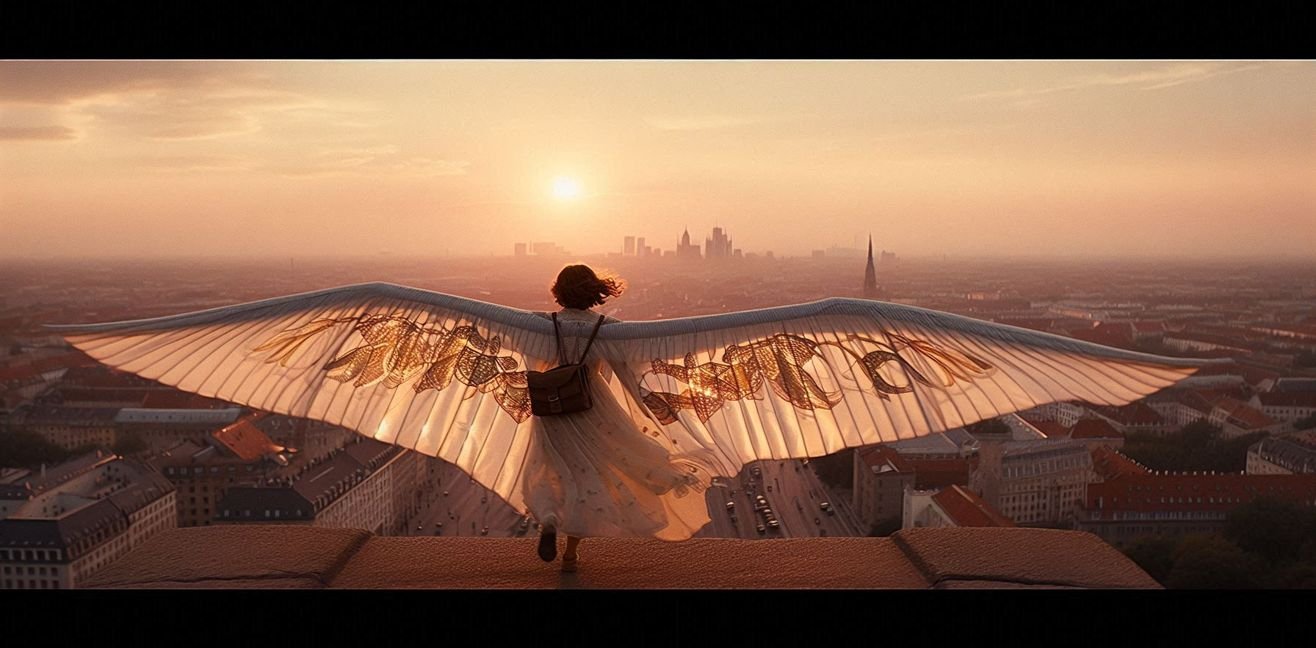
“I placed my wings in the hands of the wind.”
— Otto LilienthalSome people walk on the ground, some rise into the sky but remain tied to the earth.
Otto Lilienthal was not one of them.
He was a man who befriended the wind.
Flying was not just a goal for him—it was a love story.
And that love marked the beginning of humanity taking flight. 🕊️
🪶 1. Berlin’s Mad Engineer or Sky Poet?
19th-century Germany… The Industrial Revolution was running at full speed.
Steam engines, factories, coal smoke—the sky had become “a polluted dream.”
But Otto Lilienthal was crafting a different dream on the outskirts of Berlin:
“What if humans could glide like birds?”As a child, he spent hours with his brother Gustav watching storks and seagulls.
He carefully noted how they spread their wings and the angles they glided at.
These observations later inspired his famous book, Der Vogelflug als Grundlage der Fliegekunst
(“Bird Flight as the Basis of Aviation”).
Otto didn’t just watch birds fly—he measured it scientifically. 📏He analyzed wing curvature, calculated lift versus drag, and formulated principles of flight.
At the time, these ideas were so new that some engineers called him “the man trying to fly.”
But Otto was living the most beautiful definition of science:“Between madness and genius lies a line as thin as the wind.”
🌪️ 2. Dancing with the Wind: The Romance of Trial and Error
Today we have wind tunnels, sensors, and supercomputers.
But Lilienthal’s lab was simple: a hill, some wind, and plenty of courage. 💨Every week, he designed a new glider and tested it on the hills.
Each flight was a scientific experiment.
He used his own body as the control system—leaning, shifting weight, adjusting balance.
This technique is still the basis for modern glider pilots:
👉 “Weight shift control” — balancing by shifting your weight.Lilienthal recorded every flight—the wind speed, glide distance, angles of descent.
He wasn’t just flying—he was writing the physics of flight.But here’s the difference between science and love: science can tolerate mistakes, love cannot. 😄
Every time Otto fell, he broke bones—and got back up.
Once, when he broke his arm, journalists asked, “Will you give up now?”
His reply became legendary:“Birds do not give up. Why should I?” 🕊️
Indeed… Otto really was dancing with the wind.
Even when he lost his balance, a smile remained on his face.
He didn’t fight gravity—he flirted with it. 💃
💔 3. The Final Flight: A Farewell Written in the Sky
August 13, 1896.
Otto climbed the hill in Stölln with the same excitement.
He carried a new glider model—more balanced, more elegant… but the wind was cranky that day.The first flight went well. On the second, a sudden gust threw off his balance.
The glider hit the ground hard.
His neck broke.
The next day, August 14, Otto Lilienthal passed away—forever flying in spirit.But his last words changed humanity’s relationship with the sky:
“Kleine Opfer müssen gebracht werden.”
(“Small sacrifices must be made.”)He made a small sacrifice, yet thanks to him, we discovered the secret of flight.
While he fell, aviation began to rise.
📚 4. Legacy of the Wind: Flying Belongs Not Just to Birds
When Lilienthal died, his notebooks spread across the world.
The Wright brothers studied his calculations line by line.
Years later, Orville Wright said:“Without Lilienthal’s work, our experiments would never have begun.”
Today, the concepts of airfoil shapes, lift coefficients, and aerodynamic curves trace back to Otto’s experiments.
He was not just an inventor—he is one of the fathers of modern aerodynamics.But I believe Otto’s greatest legacy is this sentence:
“Flying is not only physics—it is a matter of faith.”
Every takeoff carries hope, every landing carries humility.And the beautiful thing is: every time a pilot calls “rotate,”
Otto’s spirit rises with the plane. ✈️
😄 5. Humor Break: If Otto Lived Today…
Imagine, my love 😎
If Otto Lilienthal were alive in 2025…
- He’d 3D-print his own wings at home.
- Post a TikTok series called #WindExperiments.
- Upload a YouTube video: “Lilienthal Vlog 126: Wind Was Opposite This Week 😩💨” trending worldwide.
- And of course… he wouldn’t need a Tesla—he’d fly on his own wings. ⚡🕊️
Yet he’d probably still say:
“When the wind changes, don’t change your direction—adjust your wings.”
🌤️ 6. Conclusion: The Man of the Wind, Hero of Our Hearts
Otto Lilienthal taught us not only the techniques of flying, but the responsibility of dreaming.
He gave dignity to the word “experiment.”
Even in falling, he continued to teach.Today, airplanes, jets, and drones fill the skies…
But somewhere, his wind is still blowing. 🌬️
With every takeoff, a voice whispers through the clouds:“Place your wings in the hands of the wind. The rest is taken care of.”
Posted inAviation History
🌤️ Otto Lilienthal: The Man of the Wind

Post navigation
Previous Post
 🌤️ Otto Lilienthal: Rüzgarın Adamı
Next Post
🌤️ Otto Lilienthal : L’Homme du Vent
