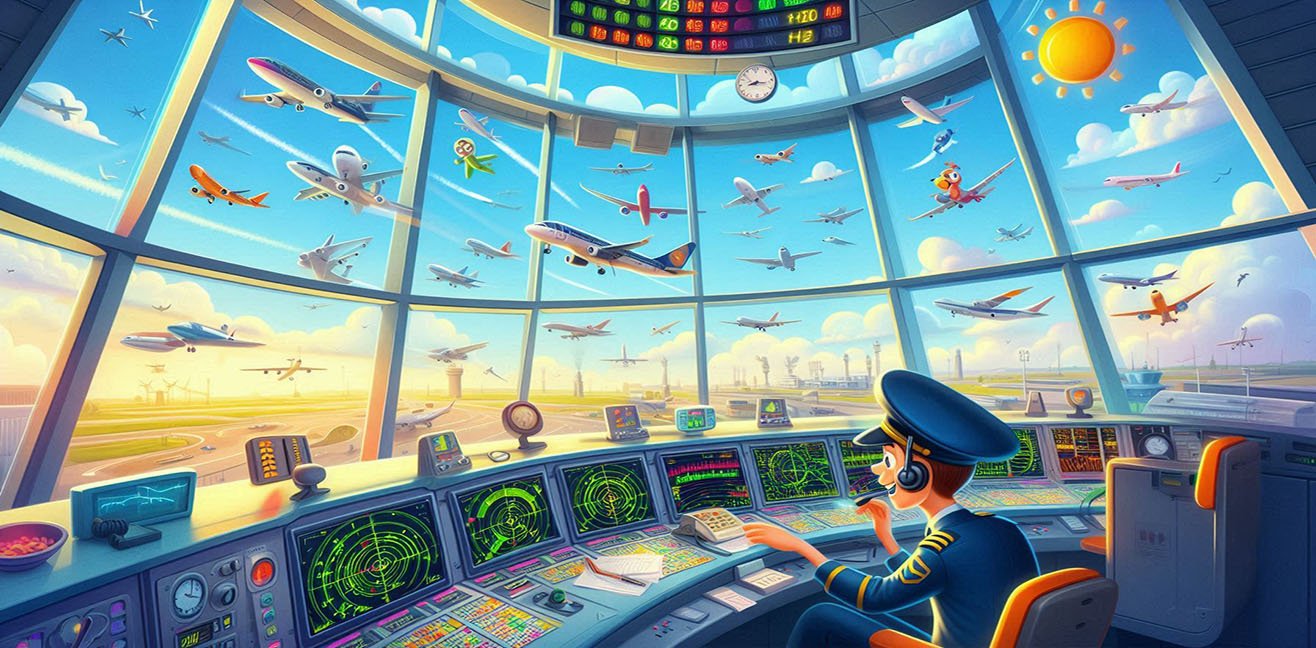
“There is no chaos in the sky, only a controller working better than we can imagine.”
— The secret whisper of every air traffic controller 😎
While planes glide like giant dancing birds in the sky, nobody sees the silent heroes in the towers. Without them, every takeoff would be chaos, every landing a risk. Come on, my love, let’s explore this unseen world together.
⭐ 1) Control Towers: The Heart and History of the Sky
Control towers are the backbone of modern aviation. The first air traffic control systems appeared in the 1920s in the USA. Back then, planes were lighter, piston-powered, and flown visually. Pilots relied on maps for cross-country flights, while towers guided them only via radio signals.
📌 The Geography and Aviation Situation of the Era
- USA: After the Wright brothers’ 1903 flight, aviation developed rapidly. Cities like Chicago and New York had dense airspace.
- Europe: Airports in Paris, London, and Berlin expanded quickly. Commercial flights became common.
- World: The first radar technology was developed during World War II; towers managed airspace via radio and visual observation.
💡 Practical Tip: In the early towers, only one person handled all takeoffs and landings. Today, a single flight at a major airport is managed by 6–10 controllers together.
⭐ 2) The World of Control Towers: Speed, Focus, and Human Stories
A morning routine in a control tower:
- Turn on radar screens
- Check weather reports
- Communicate quickly and clearly with pilots
All of this happens in seconds; one mistake can risk millions of dollars in flight safety.
👩✈️ A Day in the Life
- Pilots connect to the tower for takeoff.
- Weather conditions are constantly monitored: wind direction, fog, clouds, pressure…
- Aircraft are safely guided to the runway.
💡 Practical Tip: Controllers track every flight in seconds. Modern radars update a plane’s position every 4 seconds.
⭐ 3) Busy Airspace: Chaos or Symphony?
Airports are not always orderly. New York JFK, London Heathrow, Istanbul Airport… Thousands of planes are in the air, waiting to land, preparing for takeoff.
Controllers turn this chaos into a symphony:
- Planes are lined up for landing
- Takeoff clearances are given
- Rapid action is taken in emergencies
🎵 Practical Tip: During peak hours, controllers make decisions for multiple planes every second. One wrong decision can trigger chain delays and safety risks.
⭐ 4) Interesting Moments and Anecdotes
- A controller guided a pilot for minutes in heavy traffic to find the correct runway; the pilot waved in thanks. ✋
- A balloon was mistakenly detected on the radar; panic was short-lived. 🎈
- Some towers develop fun tactics like “who takes off first” during busy hours. 😄
💡 Practical Tip: Airspace management may look like a game, but every move is based on data and calculations. Pilots follow tower instructions in milliseconds.
⭐ 5) The Journey of Pilots and Controllers
Pilots may seem free in the sky, but their safety is shaped by the eyes in the tower.
- Pilots follow tower instructions for takeoff and landing
- Controllers continuously analyze airborne traffic
- In emergencies, communication and guidance are vital
💬 A controller once said:
“Nothing in the sky happens by chance. Every plane, every route, every landing is shaped by our touch.”
⭐ 6) Modern Technology and Control Towers
Today, towers have become much more complex with radar, GPS, and air traffic software:
- Automatic flight tracking
- Weather simulations
- International coordination
But the basic principle remains the same: safe takeoffs and landings.
💡 Practical Tip: At a major airport, the tower team usually works 12-hour shifts and manages dozens of flights per shift.
⭐ 7) Remember When You Look at the Sky
On your next flight, when you thank the pilots, send a little whisper to the controllers too:
They are the unseen heroes, conducting the symphony of the sky. 🕹️✈️💙
“There is no chaos in the sky, only unseen heroes.”