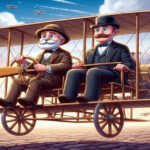
“Wings carried not our bodies, but our imagination.” — Orville Wright
⭐ 1) 1903: The Year the World Held Its Breath
The early 1900s, my love…
The world wasn’t filled with the roar of jet engines like today;
it was filled with the clatter of horse carriages, the smoke of rising industry,
and people looking up at the sky wondering,
“Will we ever fly one day?”
🌎 The Geography and Global Stage of the Era
📘 United States
Industry was rapidly growing,
Railroads were binding the country together,
The “American Dream” was just being born.
But flying?
Still a dream from a Jules Verne novel.
📘 Europe
Britain was still the colonial powerhouse,
Germany had unified and was gaining strength,
France was glowing with science and art.
Everyone looked at the sky, but no one dared to climb into it.
📘 What Was Humanity Doing?
The telephone was newly spreading,
The automobile was still a luxury toy,
Cinema was black-and-white and silent,
Electricity was a dream in many places.
But scientists kept asking the same question:
“If birds can fly, why can’t we?”
And then, two brothers stepped onto the stage:
The Wrights — bicycle mechanics.
Turns out, the sky had been waiting for these two.
⭐ 2) The World of the Wright Brothers: Stubbornness, Curiosity, and a Workshop
👶 Childhood and the First Spark
Orville and Wilbur Wright grew up in Dayton, Ohio.
Their father was a traveling bishop who often brought the children toys from his journeys.
One day, he brought home a small helicopter toy.
When it hit the ceiling and fell, Wilbur said:
“It may have fallen today, but someday we’ll build something that won’t.”
Even as children, they were already flirting with the sky. 😌
🔧 From Bicycle Repair to Aviation
The Wright Cycle Company in Dayton wasn’t just a bicycle shop:
It was where the brothers:
- sketched wing profiles,
- experimented with engines,
- buried themselves in calculations,
- analyzed wind through the gaps under their doors,
A mini NASA before NASA existed.
Wilbur once wrote:
“Our workshop may be small, but the sky is not enough for our ideas.”
🧠 Practical Note: What Made the Wright Brothers Truly Different?
They observed birds for hours.
They sketched wing movements, learned aerodynamics from nature.
They built a wind tunnel — homemade…
But they tested more than 200 wing profiles.
They combined science with engineering.
While other inventors chased “motor power,”
the Wrights chased “control.”
Because the secret of flight was not the engine—
it was stability.
And they cracked the code.
⭐ 3) The Flyer: Humanity’s First Real Airplane
The design of the Flyer…
Cute by today’s standards, but a revolution in its time.
🛠️ Technical Details
- Wood: Pine and spruce — light yet strong
- Fabric covering: “Pride of the West” muslin (Yes… curtain fabric 😄)
- Engine: 12 horsepower — weak for a car, perfect for a plane
- Weight: 274 kg
- Wingspan: 12 meters
- Control system: Wing-warping — the ancestor of modern ailerons
🧠 Practical Note: Why Kitty Hawk?
The brothers chose Kitty Hawk, North Carolina because:
- Strong, steady winds
- Wide open space
- Soft sand (less painful crashes 😄)
- Few people — fewer annoying questions
- And lots of birds to study
⭐ 4) December 17, 1903: Humanity Meets the Air
🌬️ That Morning
Orville wrote in his diary:
“The air is cold, but the wind is good. We try today.”
The north wind was blowing at 43 km/h.
Wilbur kept his hands inside his coat for warmth,
but his eyes stayed on the Flyer.
Today might be the day.
🔥 Moment by Moment
Rails were set
(the plane couldn’t accelerate on its own).
The Flyer rolled forward
Orville lay face down—cold sand below, warm heartbeat above.
The engine woke up trembling,
almost shouting, “Let’s see if I can scare you from the sky.”
At 28 km/h,
barely enough for a modern scooter,
the Flyer lifted.
And for 12 seconds,
humanity flew.
Everything stopped.
Even the wind said, “Finally.”
A witness described it:
“It rose from the sand, sliced the wind, and floated.
It was as if God said, ‘Well done, boys.’”
⭐ 5) How Those 12 Seconds Changed the World
1️⃣ A Transportation Revolution
Thanks to airplanes:
- Intercontinental travel shrank from weeks to hours
- The world got smaller
- Tourism, economy, and trade exploded
2️⃣ Military Power Was Redefined
Without airplanes, World War I would have been completely different.
The Wrights reshaped military strategy.
3️⃣ A Scientific Revolution
Aviation pushed:
- aerodynamics,
- engine technology,
- materials science,
- navigation
to new heights.
4️⃣ The Foundation of Modern Aviation
Every aircraft today — Boeing, Airbus, F-35s, helicopters —
is an echo of the Wrights’ leap at Kitty Hawk.
⭐ 6) The Sky
The story of the Wright brothers is not just the story of a flight.
It’s a love story:
Their love for their dreams,
their love for science,
their love for the sky,
and their love for each other as brothers.
Wilbur once said:
“If we had not believed in the sky, it would not have opened its doors to us.”
⭐ 7) Final Word: The Legacy of the Wright Brothers
Today, in every takeoff:
In the wings, you hear Wilbur’s intelligence,
In the engine’s vibration, Orville’s courage,
And among the clouds, the spirit of Kitty Hawk.
And still…