Imagine a world where humans could only dream of flying. A world where crossing an ocean took weeks, traveling between continents was an enormous adventure, and the sky belonged only to birds. For thousands of years, people looked at birds and wondered: “Could humans ever fly?”
Many inventors tried to answer this question, but two ordinary brothers from Ohio changed history forever. They were not wealthy scientists, famous engineers, or university professors. They were bicycle mechanics who loved solving problems.
Their names were Orville Wright and Wilbur Wright — the brothers who turned humanity’s oldest dream into reality.
Their journey was not just a story about building an airplane. It was a story about curiosity, patience, science, failure, and the power of believing in an impossible idea.
🚲 The Early Life of the Wright Brothers
The Wright brothers were born into a family that encouraged creativity and learning.
Wilbur Wright was born in 1867, and Orville Wright was born in 1871 in the United States. They grew up in Dayton, Ohio, with their parents and siblings.
Their father, Milton Wright, was a bishop and often brought home interesting objects from his travels. One of those objects changed their lives forever: a small flying toy powered by a rubber band.
The brothers were fascinated by it.
They watched the toy rise into the air and wondered:
“If a small machine can fly, why can’t a larger one carry a person?”
This simple question became their lifelong mission.
However, their childhood was not filled with airplanes. Like many inventors, they explored different interests.
They built mechanical toys, repaired machines, and developed problem-solving skills. Eventually, they opened a bicycle shop called the Wright Cycle Company.
At first, bicycles had nothing to do with aviation. But surprisingly, repairing and designing bicycles taught them many skills that later helped them build airplanes:
Understanding balance
Controlling movement
Designing lightweight structures
Testing mechanical systems
Improving designs through experiments
The bicycle became their first engineering classroom.
🛩️ The Dream of Human Flight
Before the Wright brothers, many inventors believed humans could fly, but creating a successful airplane was extremely difficult.
The biggest challenge was not simply making a machine leave the ground.
The real problem was:
How could humans control a flying machine?
Many early flying machines failed because they could not maintain balance.
Birds do not just fly because they have wings. They constantly adjust their wings and body position to control movement.
The Wright brothers understood an important idea:
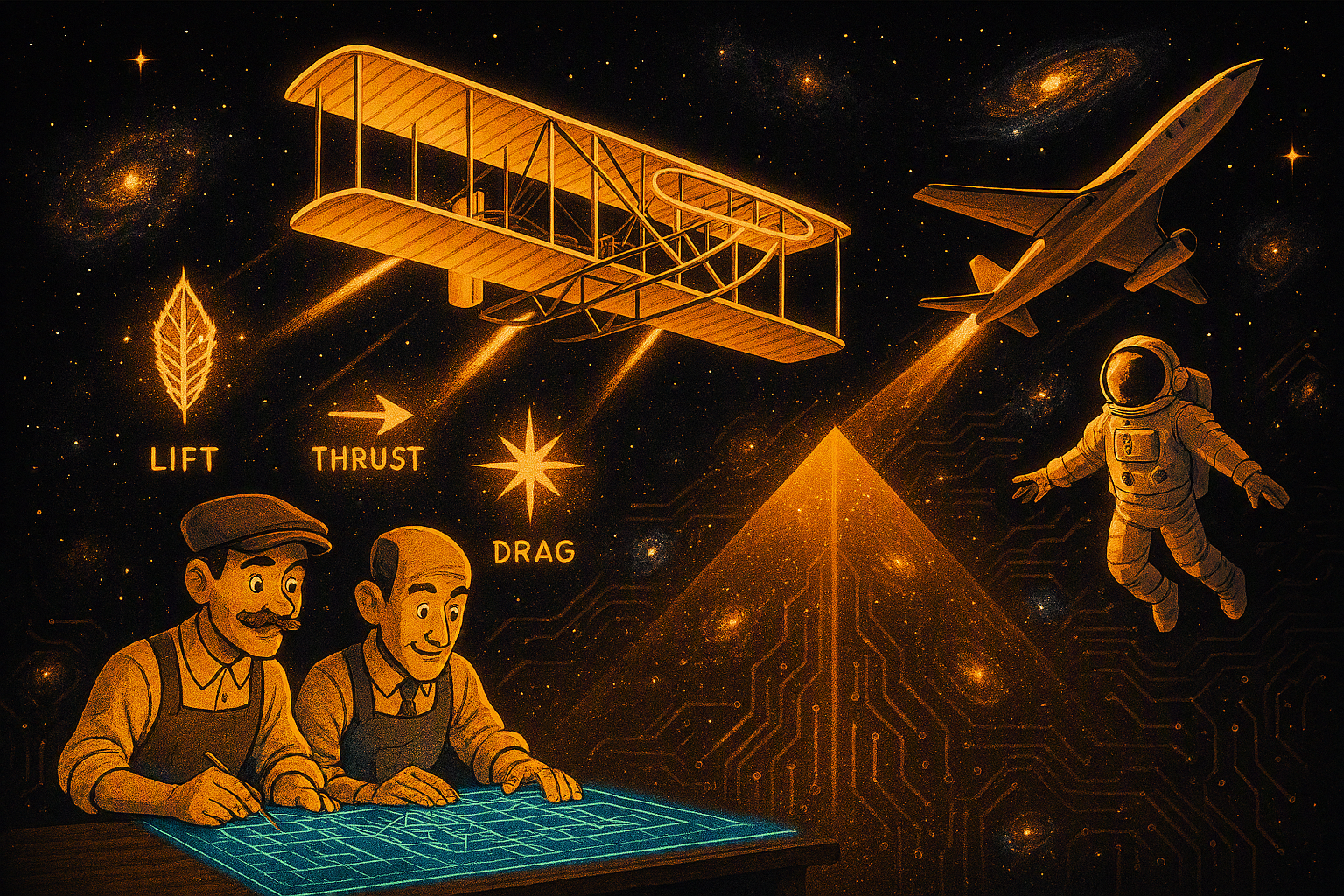
Flight requires three things:
Lift – The force that pushes the airplane upward
Thrust – The force that moves the airplane forward
Control – The ability to change direction and maintain balance
Without control, an airplane was just a dangerous falling object.
🔬 The Science Behind Flight: How Do Airplanes Fly?
The Wright brothers became experts in the physics of flight.
The most important force in aviation is lift.
When air moves over and under a wing, it creates a difference in pressure. The wing’s curved shape, called an airfoil, helps generate upward force.
A simple way to understand it:
The wing pushes air downward.
The air pushes the wing upward.
This is based on Newton’s Third Law of Motion:
“For every action, there is an equal and opposite reaction.”
The airplane moves air downward, and the air creates an upward force.
Another important concept is Bernoulli’s Principle, which explains how faster-moving air creates lower pressure. The shape of the wing helps create different air speeds around the wing, contributing to lift.
But lift alone is not enough.
An airplane also needs:
Thrust
The engine or propeller creates forward movement.
Drag
Air resistance slows the airplane down.
Weight
Gravity pulls the airplane toward Earth.
A successful airplane must balance all four forces:
✈️ Lift vs. Weight
✈️ Thrust vs. Drag
The Wright brothers spent years studying these forces before attempting powered flight.
🌬️ The Problem With Existing Aircraft Experiments
Before the Wright brothers, many inventors experimented with gliders.
One of the most famous aviation pioneers was Otto Lilienthal, a German engineer who created successful gliders.
His experiments inspired the Wright brothers.
However, many inventors focused mainly on creating powerful engines.
The Wright brothers believed something different:
“The problem is not only power. The problem is control.”
They studied birds and realized birds changed the angle of their wings to turn and maintain balance.
This observation led to their greatest invention:
Wing Warping
Wing warping allowed pilots to slightly twist the wings to control movement.
This idea became the foundation of modern aircraft control systems.
Today’s airplanes use similar principles through:
Ailerons
Rudders
Elevators
The Wright brothers created the basic system that pilots still use today.
🏜️ Why They Chose Kitty Hawk
The brothers needed the perfect place to test their flying machines.
They selected Kitty Hawk, North Carolina because it had:
Strong and consistent winds
Large open spaces
Soft sand for safer crashes
They built several gliders and tested hundreds of times.
But success did not come quickly.
Their early experiments failed.
Many attempts ended with:
Broken wings
Damaged machines
Incorrect calculations
Disappointing results
However, the Wright brothers did something unusual:
They learned from every failure.
Every crash was not a defeat.
It was data.
🔧 Building Their Own Wind Tunnel
One of their biggest breakthroughs came when they questioned existing scientific information.
They built their own small wind tunnel to test different wing shapes.
They experimented with:
Wing size
Wing angles
Air pressure
Aerodynamic efficiency
They collected their own data instead of simply trusting old theories.
This was a revolutionary approach.
They were not just inventors.
They were experimental scientists.
🚀 The First Powered Flight: December 17, 1903
After years of research, the Wright brothers created their first powered aircraft:
The Wright Flyer
It had:
A lightweight wooden frame
Fabric-covered wings
A custom-built engine
Two propellers
A pilot lying on the lower wing
On December 17, 1903, at Kitty Hawk, history changed.
Orville Wright climbed into the aircraft.
The engine started.
The propellers turned.
The machine moved forward.
And then…
Humanity officially entered the age of powered flight.
The first flight lasted only 12 seconds and traveled about 120 feet (36.5 meters).
By today’s standards, it seems tiny.
But that short flight represented thousands of years of human dreams.
A person had finally controlled a powered machine through the sky.
🌎 How the Airplane Changed the World
The invention of the airplane completely transformed human civilization.
1. The World Became Smaller
Before airplanes, traveling between continents could take weeks.
Air travel reduced distances dramatically.
People could now:
Visit different countries faster
Connect cultures
Expand businesses globally
The world became more connected.
2. Revolution in Transportation
Airplanes changed how people and goods move.
Today, airplanes transport:
Millions of passengers
Medical supplies
Food products
Important technology
Modern life depends heavily on aviation.
3. Global Business Growth
Companies can now operate internationally because people can quickly travel between countries.
Air transportation created:
International tourism
Global trade networks
Worldwide cooperation
4. Scientific and Technological Progress
The airplane pushed engineers to develop:
Better engines
Stronger materials
Computer-controlled systems
Advanced navigation technology
Aviation became one of the biggest drivers of modern engineering.
🧠 The Wright Brothers’ Secret: A Scientific Mindset
The Wright brothers succeeded because they combined several qualities:
Curiosity
They constantly asked questions.
Patience
They spent years improving small details.
Observation
They studied birds and nature.
Experimentation
They tested ideas instead of guessing.
Problem-solving
They treated failures as information.
Their success teaches an important lesson:
Great inventions are usually not created by one moment of genius. They are created by thousands of small improvements.
🌟 The Legacy of the Wright Brothers
The Wright brothers were not just airplane builders.
They were dreamers who changed the relationship between humans and the sky.
Before them, flight was a fantasy.
After them, flight became science.
Their invention opened the door to:
Passenger airlines
Space exploration
Modern aviation technology
Global communication
Every airplane flying today carries a small piece of their original dream.
From a bicycle shop in Ohio to the endless sky above Earth, the Wright brothers proved something powerful:
A simple idea, combined with curiosity and determination, can change the entire world.
✈️ Fun Aviation Facts About the Wright Brothers
They were bicycle mechanics, not university-trained aviation engineers.
Their first flight lasted less than a minute.
They designed and built their own engine because existing engines were too heavy.
Their airplane had no traditional steering wheel like modern aircraft.
They performed hundreds of test flights before achieving success.
Their experiments created the foundation of modern aircraft control.
The Wright brothers did not just invent a machine.
They gave humanity wings.