Next time you pop on your noise-canceling headphones 🎧, lean back in 35A 💺, and watch a movie 🍿 while cruising at 36,000 feet, take a second to thank the 1920s and 30s! 🙏☁️
We often think of early aviation as wood-and-canvas biplanes 🛩️ puttering over farmland 🌾. But between World War I and World War II—a brief 21-year window known as the Golden Age of Aviation 🌟—flying transformed from a daredevil circus trick 🎪 into the backbone of global travel! 🗺️✨
Without the wild breakthroughs 💡, risky airmail bets ✉️, and engineering leaps ⚙️ of the interwar era, today’s flight maps would look radically different. Here is how those two chaotic decades built the skyways we fly on today! 🚀
1. The Airmail Boom: How Snail Mail Built Flight Networks 📬✈️
Before passengers were a profitable business, mail was king 👑.
After WWI, governments ended up with surplus military planes 🛩️ and thousands of trained pilots 👨✈️ looking for work. The US Postal Service launched the Airmail Service in 1918 📬, pioneering transcontinental routes like New York 🗽 to San Francisco 🌉.
Why it matters today:
The Air Commerce Act of 1926 📜: The US government contracted private companies to fly mail. These small airmail operators grew into modern giants like United Airlines 🇺🇸, American Airlines 🦅, and TWA ✈️.
Night Flying & Beacons 🚨: To deliver mail overnight 🌙, pilots needed navigation. The solution? A literal highway of light—thousands of lighted rotating beacons 🚨 placed every 10 miles across America. That ground network laid the groundwork for modern air traffic control corridors! 🛰️
2. The Transatlantic Craze: Lindbergh & The Power of Prizes 🏆🌊
In 1927, Charles Lindbergh flew non-stop from New York to Paris 🗽➡️🗼 in the Spirit of St. Louis, snagging the $25,000 Orteig Prize 💰 and instant global fame ⭐. But Lindbergh wasn’t just a lucky soloist; he triggered what historians call the “Lindbergh Boom.” 📈💥
Fun Fact 💡: Within 12 months of Lindbergh’s flight, US aviation stocks soared 📈, application rates for pilot licenses tripled 👨✈️📝, and passenger air traffic jumped by over 300%! 🛫🔥
That single flight proved ocean-spanning routes weren’t science fiction 🧪—they were commercial opportunities waiting to happen! 💸🌍
3. From Flying Boats to Metal Monoplanes 🛥️➡️✈️
How did we go from noisy, freezing, timber-frame planes 🪵 to sleek aluminum airliners 🥈? Two major technological shifts redefined passenger comfort:
The Era of “Flying Boats” 🌊⚓
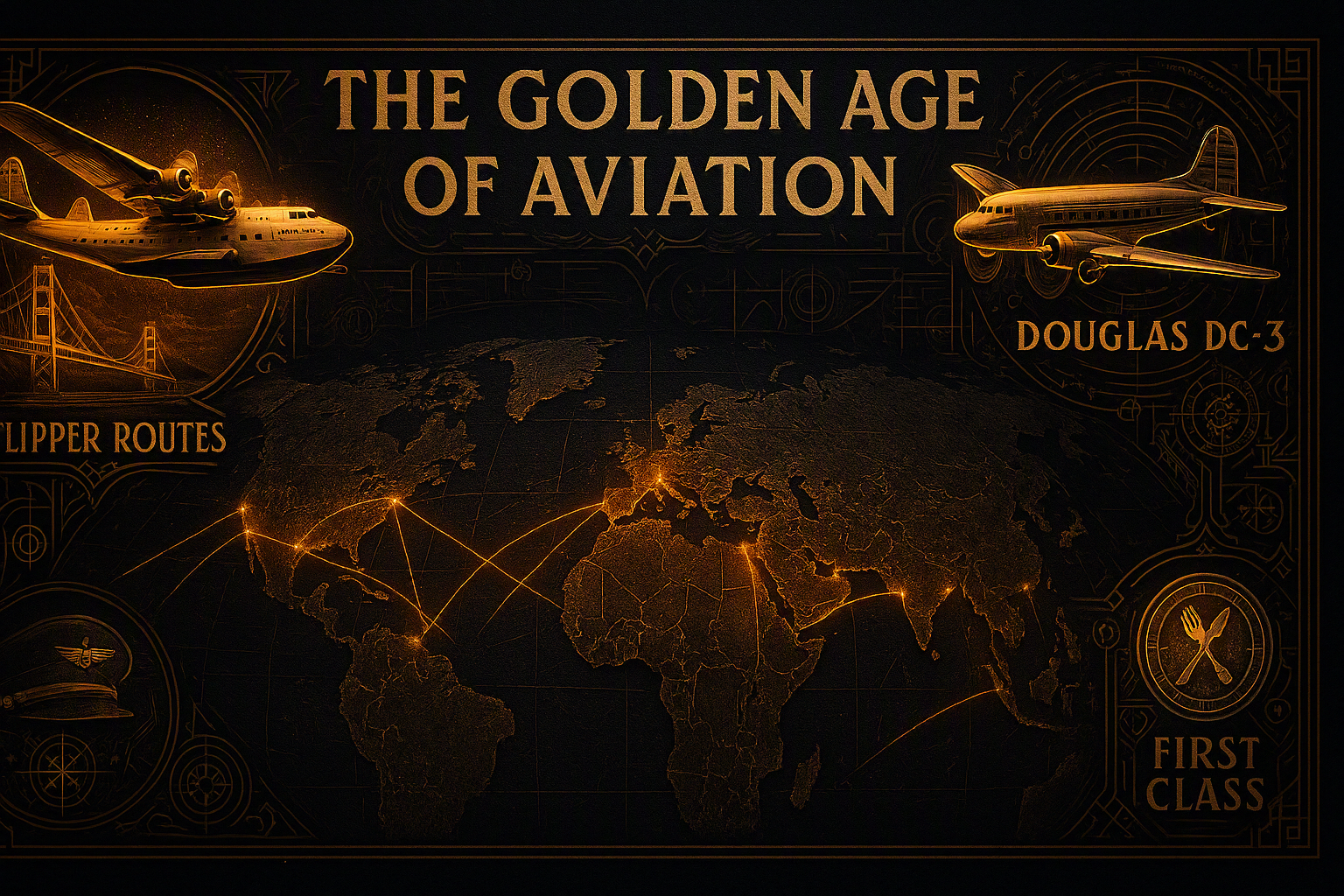
Before long paved runways existed worldwide, airlines turned to the oceans! 🌊 Giant sea-planes like the Pan Am Boeing 314 Clipper 🛳️✈️ acted as flying luxury hotels 🏨. They featured dining saloons 🍾, private dressing rooms 🛋️, and gourmet meals 🍽️, forging pioneer routes across the Pacific and Atlantic.
The Metal Revolution: Douglas DC-3 🛠️✨
Introduced in 1936, the Douglas DC-3 changed everything:
All-Metal Construction 🪙: Lightweight aluminum hulls made planes safer, stronger, and faster.
Profitability 💵: It was the first airliner that could make money carrying just passengers 🧳, without relying heavily on mail subsidies.
Cabin Pressurization 🎈: Planes like the Boeing 307 Stratoliner began pressurizing cabins 🌬️, allowing flights to fly above bad weather instead of through it! 🌤️⚡
1918: First US Airmail Route ✉️
May 1918
Military pilots launch regular airmail services between Washington D.C., Philadelphia, and New York.
1927: Lindbergh Crosses the Atlantic 🏆
May 1927
First solo transatlantic flight inspires massive global investment in commercial aviation infrastructure.
1935: Pan Am Clipper Opens Transpacific Routes 🌊
Nov 1935
The China Clipper flies from San Francisco to Manila, creating the first regular transpacific air route.
1936: Enter the Douglas DC-3 🛩️
June 1936
The DC-3 enters commercial service, setting the standard for airliner design and passenger comfort.
4. Quick Takeaways: Interwar Inventions You Still Use Today 🛠️🧰
| Golden Age Innovation 🌟 | How It Works ⚙️ | Modern Equivalent 📡 |
| Radio Direction Finding 📻 | Pilots used ground radio signals to track their location | Modern VOR & GPS Navigation 🧭 |
| Instrument Flying (Blind Flying) 🥽 | Jimmy Doolittle proved in 1929 you could take off & land using only gyroscopes/altimeters | Instrument Landing Systems (ILS) 🛬 |
| Flight Attendants 👩✈️ | Ellen Church (a nurse) became the first stewardess in 1930 to reassure nervous flyers | Cabin Crew Safety & Service ☕🥪 |
| Paved Runways 🛣️ | Heavy metal airliners required smooth concrete instead of grass fields | Modern Airport Hub Infrastructure 🏙️ |
The Legacy: The Blueprint for Modern Travel ✈️🌐
The interwar era proved that the sky wasn’t an obstacle 🌤️—it was a shortcut! 🛣️ When you track a flight today heading across the Atlantic ✈️🌊 or landing in fog using automated instruments 🌫️🛬, you’re experiencing technology pioneered by 1930s aviators wearing leather goggles 🥽 and grease on their hands 🔧!