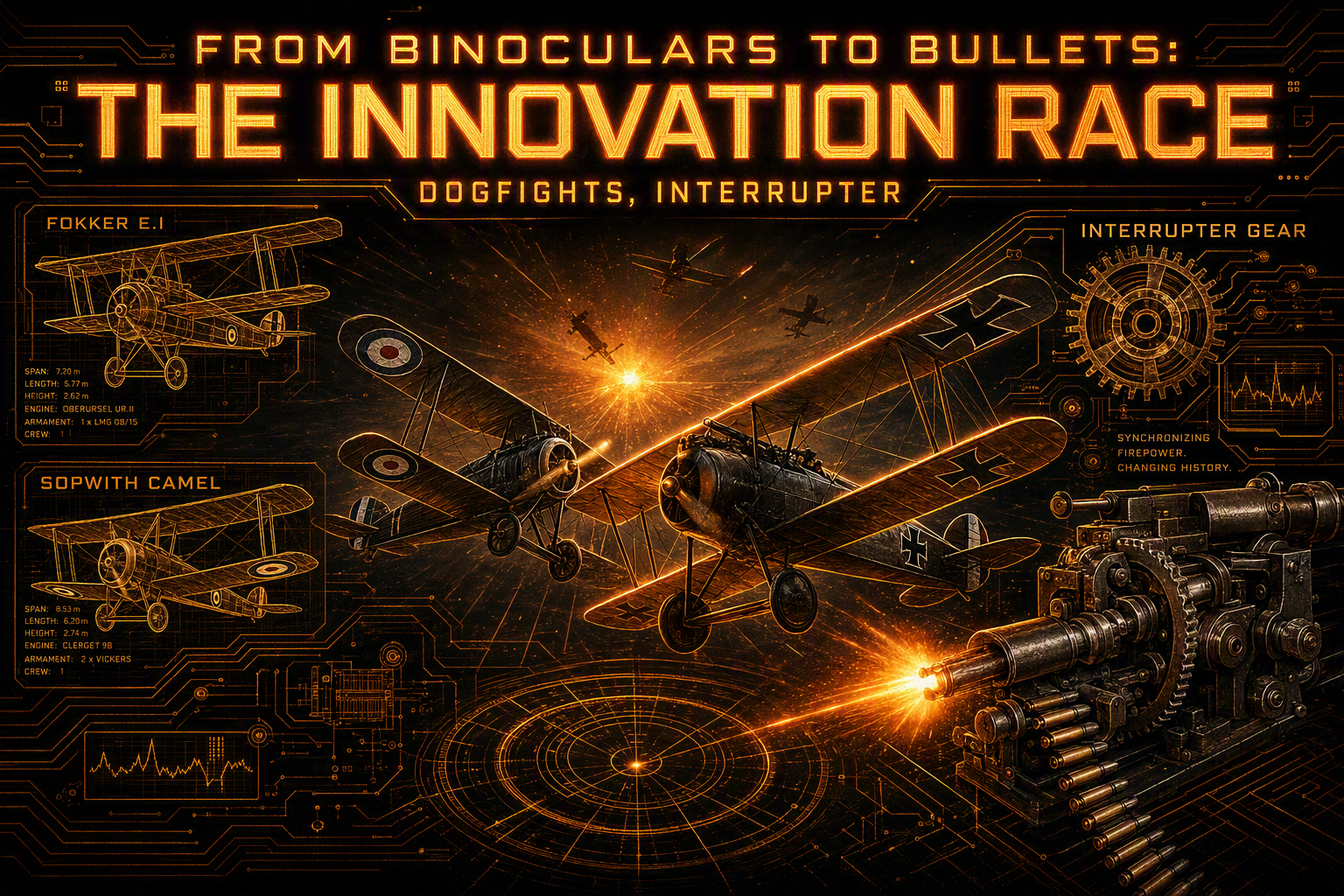
When World War I broke out in August 1914, aviation was barely a decade old 🐣. The Wright brothers had conquered the sky in 1903 ☁️, but military commanders across Europe still viewed airplanes as fragile, noisy toys 🧸. Generals preferred cavalry horses 🐎 and hot-air balloons 🎈. Fast-forward just four years to 1918, and sky battles were deciding ground campaigns 🎯, ace pilots were international celebrities 🌟, and the modern fighter jet’s ancestry was officially born 🦅.
How did aviation jump from passive observation to high-stakes aerial combat in less than half a decade? ⏳ Grab your leather flight goggles 🥽 and let’s dive into the wild engineering race that changed aviation forever! 🛠️⚡
🛑 Phase 1: The “Gentlemen’s Club” Era (1914) 🎩🥂
At the start of the Great War, airplanes weren’t weapons—they were binoculars with wings 👁️✈️. Biplanes were sent above the Western Front strictly for reconnaissance: mapping enemy trenches 🗺️, spotting artillery fire 💥, and tracking troop movements 🎖️.
Because flying was an elite and dangerous sport, early pilots shared an unwritten honor code 🤝. When a French pilot passed a German pilot thousands of feet in the air, what did they do? They waved. 👋😄
That gentlemanly courtesy didn’t last long 😬. Military commanders quickly realized: “If that enemy pilot is mapping our positions, maybe we shouldn’t let him get back home!” 🛑
Pilots started bringing personal gear into the cockpit to harass each other: 🤼♂️
Bricks and rocks 🧱 (to throw into the enemy’s wooden propeller!)
Pistols and hunting rifles 🔫 (aiming sideways while flying with one hand 🤲)
Grappling hooks on ropes 🪝 (hoping to snag the other plane’s wings)
It was chaotic, dangerous, and almost completely ineffective 🤷♂️. Sky combat needed a real solution! 💡
🤯 Phase 2: The Propeller Problem ⚙️❌
Mounting a heavy machine gun on a plane seemed like an obvious idea 💡, but engineers hit a massive wall of physics: where do you put the gun? 🔫🤔
If you put the gun behind the pilot, the observer couldn’t aim effectively 🎯. If you put it on the top wing, the pilot couldn’t clear gun jams or reload mid-flight without risking a fatal crash 💥. The absolute best place to mount a machine gun was right in front of the pilot, aligned with their line of sight down the engine nose 👃.
There was just one tiny problem: the spinning wooden propeller. 🪓
Firing a machine gun through a spinning propeller meant you would instantly shoot off your own blades and send yourself plummeting to the ground 🛩️💥🔥.
French aviator Roland Garros tried a daring trick in early 1915 🇫🇷: he attached armored steel wedge deflectors to the back of his propeller blades 🛡️. When bullets hit the steel deflector, they bounced off, while the rest passed safely through ⚡. It worked well enough for Garros to achieve a few quick victories, but the constant bullet impacts put immense stress on his engine crankshaft 😬.
🧠 Phase 3: The Game-Changer – The Interrupter Gear 🎯🔥
In April 1915, Roland Garros was forced down behind German lines 🚨. The Germans captured his plane, examined his crude steel deflectors 🔍, and handed the challenge over to Dutch engineer Anthony Fokker 🇳🇱.
Fokker didn’t just copy the French design—he solved the problem elegantly ✨. Instead of deflecting bullets, he created the synchronization gear (often called the interrupter gear) ⚙️.
Spring 1915: Mechanical Linkage 🛠️ Fokker connected a mechanical cam directly to the plane’s engine shaft. Every time a propeller blade swung in front of the gun barrel, the cam pushed a rod ⚙️.
May 1915: Trigger Interrupt 🛑 The rod briefly locked the machine gun’s firing trigger, preventing it from discharging precisely when the blade was in the way ⚡.
Late 1915: The Fokker Scourge 🦅 Mounted on the Fokker E.I monoplane, the system allowed pilots to aim their whole airplane at the target and fire hundreds of rounds a minute without damaging their own propeller 🎯🔥.
The result was lethal 💀. For nearly a year, German Fokker Eindeckers dominated the skies over Europe—a period Allied forces grimly dubbed “The Fokker Scourge.” 🖤
🐕🦺 The Birth of the Dogfight and the Fighter Ace 🏆⚡
Once both sides developed synchronization gears, air warfare transformed overnight 🔄. Airplanes were no longer just observers; they were purpose-built predatory weapons designed to hunt other planes 🦅💥.
Because early flight controls were stiff and engines produced under 200 horsepower 🏎️, combat meant tight, twisting, close-quarters maneuvers 🌀. Pilots fought like aggressive dogs twisting to bite each other’s tails—giving birth to the term “dogfight.” 🐕🦺🛩️
This era created the legendary Fighter Aces—pilots who shot down five or more enemy aircraft 🎖️. Figures like Germany’s Manfred von Richthofen (The Red Baron 🛑✈️) and France’s René Fonck 🇫🇷 became national icons 🌟. However, the reality behind the romantic myth was grim: average pilot lifespan on the Western Front dropped to just three weeks during peak combat in 1917 ⏳💔.
| WWI Aircraft Generation | Primary Role 📋 | Top Speed 🏎️ | Key Feature 🔑 |
|---|---|---|---|
| 1914 (e.g., Etrich Taube) 🕊️ | Reconnaissance | ~60-70 mph | Unarmed, frail wooden frames 🪵 |
| 1915 (e.g., Fokker E.I) 🦅 | Pursuit / Escort | ~80-87 mph | Interrupter gear, nose-mounted gun ⚙️🔫 |
| 1918 (e.g., Sopwith Camel, Fokker D.VII) 🐝 | Specialized Air Superiority | ~115-130 mph | Twin synchronized machine guns, heavy maneuverability 💥⚡ |
🚀 The Legacy of WWI Aviation 🌍🏆
In just four years of war, aviation leaped forward by decades: 📈
Engine Output: Jumped from ~70 horsepower to over 200–300 hp 🔊🔥.
Airframe Materials: Shifted from canvas-and-bamboo biplanes toward sturdy aluminum structures 🛡️ (pioneered by Hugo Junkers’ J 1).
Tactics: Formed organized squadrons, tactical formations, and specialized roles 👥 (bombers, fighters, ground attack 💣).
World War I proved that whoever controls the sky controls the battlefield below ☁️👑—a principle that still dictates military strategy around the globe today! 🌐✈️⚡