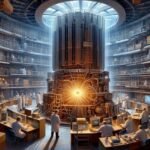
Dear science lovers 💖, today I’m taking you back to December 2, 1942, to the basement of the University of Chicago. Yes, this was the stage for one of the most important milestones in modern physics: the first controlled chain nuclear reaction. Let’s explore this historic event in a way that’s both technical and fun.
🏗️ Scene of the Experiment: University of Chicago Basement
Fermi and his team transformed an ordinary basement into a laboratory to conduct one of the most exciting experiments in the history of science. But this “laboratory” was far from ordinary. Here:
- Uranium blocks played the starring role in the chain reaction.
- Graphite moderator slowed down neutrons, ensuring the chain reaction remained controlled.
- Neutron detectors carefully monitored every step of the reaction.
Fermi’s genius was in balancing these three elements so perfectly that the chain reaction started without spiraling out of control. 🔥
🧩 What Is a Chain Reaction?
To understand a chain reaction, think of it like this:
- A uranium-235 nucleus is split by a neutron.
- This splitting releases 2–3 new neutrons.
- These neutrons collide with other uranium nuclei, continuing the process.
If uncontrolled, this reaction releases explosive energy (think atomic bomb 😳). But Fermi’s team made it controlled: the speed and intensity of the chain could be adjusted with the graphite moderator and boron rods.
- Graphite: Slows down neutrons, increasing the probability of further fission.
- Boron rods: Absorb excess neutrons, controlling the reaction rate.
This is the fundamental principle of modern nuclear reactors! 😎
🧪 Steps of the Experiment and the First Success
Fermi’s team followed several critical steps:
- Reactor construction: 6 meters long, 24 layers of uranium and graphite blocks assembled.
- Neutron measurement: Detectors monitored the start and speed of the reaction.
- Control systems: Boron rods regulated neutron flow.
- Initiation: The first neutrons triggered the chain reaction.
And then it happened: the first controlled chain nuclear reaction in history. Scientists observed the reactor calmly but with excitement. This 28-minute reaction proved that humanity could control the atom. 🌟
🌟 Scientific and Historical Significance
The results of this experiment fundamentally changed modern physics and energy production:
- Nuclear energy revolution: Generating electricity from atoms became reality. ⚡
- Advancement in atomic physics: Critical data on nuclear reactions and neutron behavior were obtained.
- Modern reactor design: Principles of graphite moderators and boron rods became the foundation of today’s nuclear reactors.
- Applications in war and peace: Provided critical knowledge for both energy and military technology.
🧠 Fun Facts and Humorous Notes
- The experiment was conducted in the basement of the University of Chicago, making this historic moment a true “basement adventure.” 😏
- Fermi and his team wore lab coats at the time—but who was more excited, the coats or the scientists themselves? 🥼✨
- The reactor was named Chicago Pile-1. “Pile” refers to a stack—a “pile” of atomic blocks 🧱.
🔮 Conclusion: Modern Physics and Humanity
Dear science enthusiasts 💖, Fermi’s experiment in the Chicago basement marked a turning point, showing that humans could control the atom. The chain reaction laid the foundation for modern nuclear energy and physics. Today, from electricity production to medical radiation, scientists continue their work thanks to this historic achievement.
And we all know that in the world of science, sometimes the biggest revolutions start in hidden basements with small but brave steps. 🕵️♂️💥