

Sure! Here’s your text fully translated into English while keeping the same detailed, engaging, and informative style with emojis:
The Mystery of the Egyptian Pyramids: Secrets Written in Stone Blocks 🏺🪨
Imagine… the morning sun 🌅🌊 reflecting off the calm waters of the Nile River. The desert sands glisten like gold, and before your eyes rise the massive stone structures: the Giza Pyramids 🏰. But wait, these stone blocks are more than tombs; they are silent history books 📜 recording science, engineering, politics, and culture from thousands of years ago.
Egypt stretches along the Nile River in northeastern Africa 🌍. Its geography directly shaped agriculture, trade, and the development of civilization. Without the Nile, pyramids and ancient cities would have been impossible 🛶.
Construction Techniques and Engineering Marvels 🛠️🪨
How were the pyramids built? This question has fascinated historians and engineers for centuries.
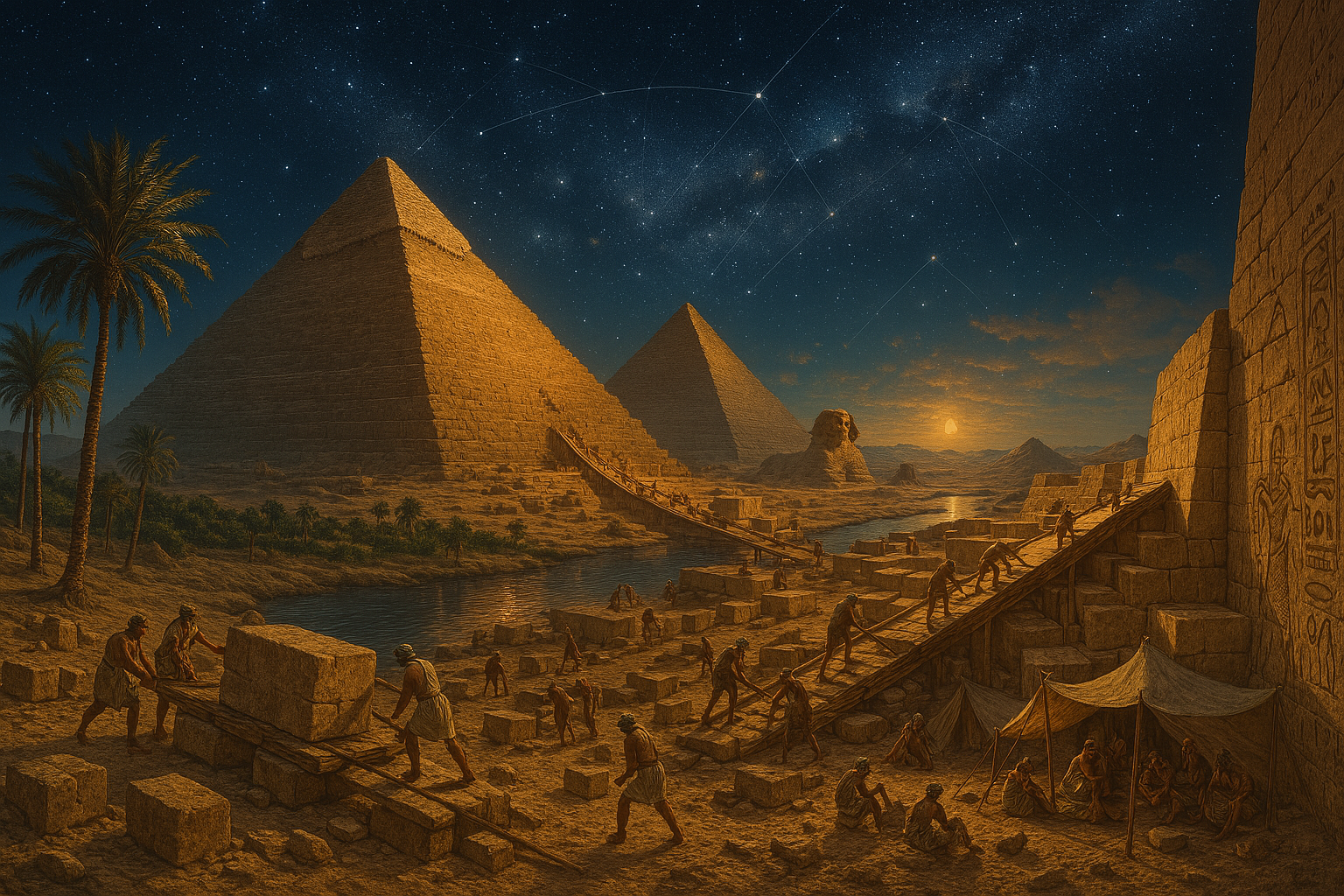
Stone blocks: Averaging 2–2.5 tons each, with some weighing up to 80 tons. Most were limestone, while granite from Aswan was used for special chambers 🏗️.
Ramps and pulleys: Researchers suggest stones were moved using ramps, pulleys, and organized labor 🔄.
Precise geometric calculations: The base of the Great Pyramid is nearly a perfect square and aligned with the North Star 🌌. This is extraordinary evidence of ancient Egyptian astronomical knowledge.
💡 Practical tip: Modern laser scanning and geophysical methods help us explore the internal structures and hidden chambers; these buildings are like engineering laboratories frozen in time.
Worker Life and Social Organization 👷♂️🍞
Pyramids were not built by slaves but by well-fed, organized laborers 😤.
Workers lived in camps at the pyramid base 🏕️, with tents, storage areas, and medical facilities.
Diet: Meat, bread, fish, vegetables, and beer 🍗🥖🐟🍺. Beer was a key energy source.
Professional expertise: Stone masons, engineers, and astronomers supervised work crews 🧱🔭.
😂 Fun fact: Workers held stone-laying competitions; the winner received honor and sometimes had their name inscribed on the pyramid wall ✍️.
Egypt’s Great Pharaohs and the Pyramids 👑🏺
Pyramids, especially during the Old Kingdom (c. 2686–2181 BCE), were not just tombs but symbols of a pharaoh’s divine power and quest for immortality 🌟.
Khufu (Cheops) 🏰
- Reign: 2589–2566 BCE
- Contribution: Initiated the Great Pyramid, which contains about 2.3 million stone blocks.
- Political & economic impact: Strengthened centralized governance, organized labor, and improved logistics along the Nile.
- Cultural effect: Reinforced the pharaoh’s divine authority and the prestige of royalty.
Khafre (Kafre) 🦁
- Reign: 2558–2532 BCE
- Contribution: Built the Middle Pyramid and the famous Sphinx.
- Architectural features: Slightly smaller than the Great Pyramid but remarkable for geometric precision and complex interior chambers.
- Social impact: The Sphinx and pyramid complex served as central spaces for religious ceremonies and demonstrations of royal power.
Menkaure (Mikerinos) 🏺
- Reign: 2532–2504 BCE
- Contribution: Built the Small Pyramid, completing the Giza complex.
- Cultural effect: Its smaller scale preserved the pharaoh’s religious and political significance while optimizing resources.
- Legacy: Menkaure’s pyramid became a reference for later architecture and astronomical alignment.
💡 Tip: Pyramids were not merely tombs; they synthesized Egypt’s administrative system, labor organization, astronomy, and religious beliefs. Each pharaoh etched their ideology, power, and legacy into stone.
Egyptian Innovations and Cultural Impact 🏺🔬
Ancient Egyptians contributed beyond pyramids, pioneering in science and culture.
Mathematics and Geometry 📐
- Pyramids and temples applied advanced mathematics.
- Calculations of area, volume, and block dimensions were precise.
- Fractions and proportional systems were used in daily life and engineering.
Astronomy and Calendars 🌌
- The Nile’s flooding cycle was tracked using star movements for agriculture.
- Pyramids were aligned with stars and the North Pole, integrating astronomy into architecture.
- Observatories and temples were built to study celestial events, aiding both farming and religious ceremonies.
Medicine and Hygiene 🩹
- Worker camps had medical areas and doctors.
- Honey and medicinal plants treated wounds 🌿🍯.
- Dental care, fracture treatment, and minor surgeries were practiced.
- Mummies reflected both religious and medical knowledge, serving as experimental studies of the human body.
Art and Writing ✍️🎨
- Hieroglyphs documented religious rituals, pharaoh achievements, and daily life.
- Temple and tomb murals served both cultural and educational functions.
- Sculptures, reliefs, and decorations combined aesthetic, religious, and political messaging.
💡 Practical tip: Studying hieroglyphs and astronomical alignments in pyramids offers unique insights into Egypt from scientific and historical perspectives.
Economic and Social Influence 💰🎭
- Labor, stone transportation, food, and material supply boosted the local economy 💸.
- Pharaohs and temples strengthened central governance and cultural prestige 🏛️.
- Pyramids solidified Egypt’s influence in the ancient world and highlighted the strategic importance of the Nile Valley 🌍.
🤣 Fun fact: We get frustrated assembling IKEA furniture 😅, yet ancient workers moved multi-ton stone blocks for days—talk about dedication!
Theories and Scientific Mysteries 🕵️♂️🔮
- How were the pyramids constructed—ramps, pulleys, or lost techniques?
- Ancient astronomical knowledge and precise alignments remain unresolved 🌌.
- Laser scans and robotics still cannot fully reveal hidden chambers and tunnels 🤖.
💡 Tip: Modern technology offers unique opportunities to understand both the engineering and cultural intelligence of the pyramids.
Conclusion: History Written in Stone Blocks 📜🪨
The Egyptian pyramids are enduring proof of human intelligence, labor, and culture. Each stone carries the dreams, beliefs, and daily lives of ancient Egyptians.
Who knows? One day, walking on the Giza plateau, you might feel like a worker from thousands of years ago 👣 and realize that history wasn’t written only by kings and wars—but through stone blocks, engineering, and human effort 🗝️✨.

