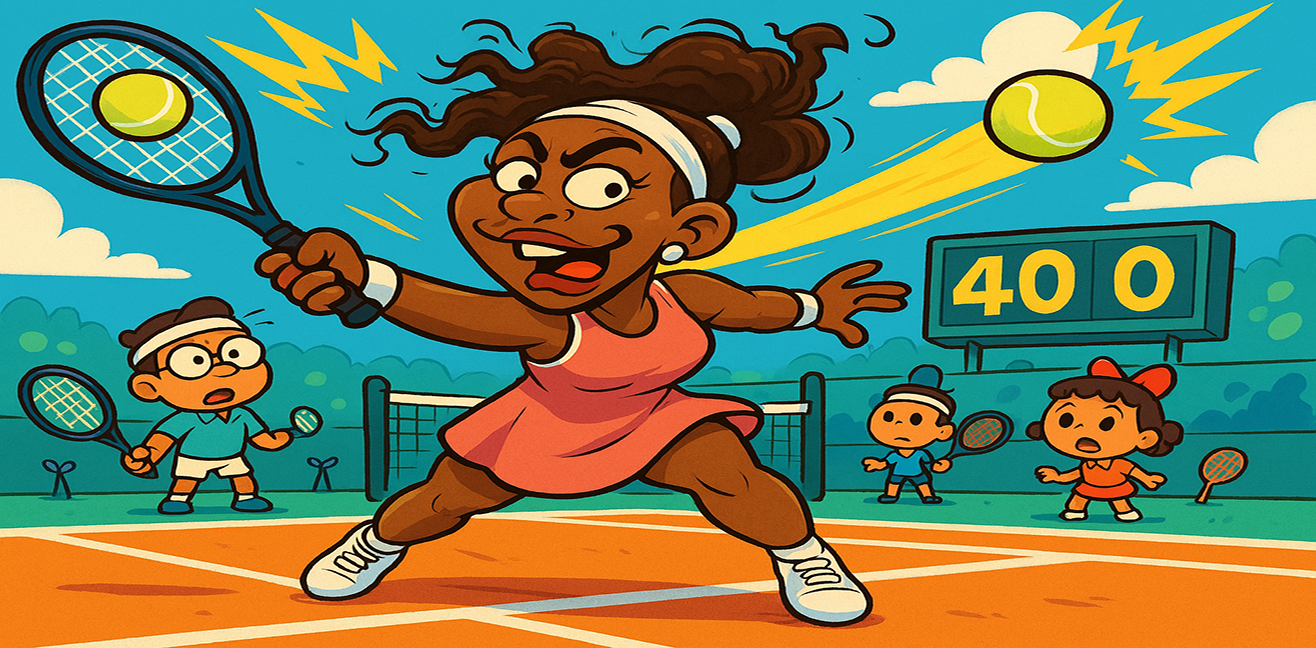
In the history of tennis, some athletes win trophies.
Some others… change the game.
Serena Williams belongs to the second category.
She is not just a Grand Slam champion; she is a revolutionary figure who rewrote the genetic code of women’s tennis with her physique, psychology, presence, and cultural impact. 🎾🔥
In this article, we’ll explore not only Serena herself but also the science of tennis, the anatomy of power, the secrets of mental resilience, and practical tips for amateur players.
1️⃣ From Backyard to Global Stage: A Systematic Dream
Serena’s story is like a Hollywood movie, but its script was written with discipline. Her father, Richard Williams, was not from the tennis world, but he did his research, made a plan, and set goals.
Serena’s career was not a coincidence—it was a project.
Training that began on neighborhood courts included:
- Hours of repetition
- Serving drills
- Footwork exercises
- Mental toughness discussions
🎯 Practical Lesson:
Talent is great, but without a system, it’s not sustainable.
Create a weekly program.
Keep a performance journal.
Every training session should have a purpose.
Success comes from structure, not motivation alone.
2️⃣ The Evolution of Tennis: From Aristocratic Sport to Athletic Battle
Modern tennis originated in 19th-century England. Played on grass courts, it was elegant and controlled.
However, by the late 1990s, the game had sped up. Racket technology improved. Balls moved faster. Court surfaces evolved.
And then Serena arrived.
In women’s tennis:
- Serve speeds increased
- Baseline play became more aggressive
- Physical power became essential
Serena’s serve could exceed 200 km/h. This wasn’t just scoring points—it was establishing psychological dominance.
🎯 Tennis Science:
Serve = kinetic chain
Foot → Hip → Core → Shoulder → Arm → Racket
If any link in the chain is weak, power is lost.
🎯 Tips for Amateurs:
- Practice medicine ball throws
- Add core rotational exercises
- Focus on the legs, not just the arm, when serving
Remember: a serve is not just an arm motion—it’s a full-body symphony.
3️⃣ Anatomy of Power: Serena’s Physical Superiority
What made Serena special wasn’t just her muscular build—it was her ability to use power efficiently.
Key features:
✔ Explosive strength
✔ High anaerobic capacity
✔ Core stabilization
✔ Fast reaction time
In an average tennis rally, players exert maximum effort for 3–5 seconds. This includes sprint + stop + change direction + hit.
🎯 Mini Home Program:
- 30 seconds squat jumps
- 20 seconds plank
- 5 shuttle runs (forward-back sprint)
- 10 medicine ball rotations (if available)
Do 3 rounds. You won’t be Serena, but you’ll be “stronger on the court.”
4️⃣ The Mental Game: The Invisible Muscles of the Court
Even the scoring system in tennis generates psychological pressure: 15-30-40-break point…
Serena’s difference emerged here.
- She managed final-match pressure
- She came back from losing positions
- She handled crowd and media pressure
🎯 Mental Resilience Techniques:
• Pre-match visualization
• Controlled breathing (4-4-4 technique)
• Routine establishment (consistent pre-serve ritual)
Serena repeated the same behaviors between points. Routine creates confidence amid chaos.
Mental fatigue in tennis comes before physical fatigue.
5️⃣ Revolution in Women’s Sports
Serena didn’t just win trophies; she shattered perceptions.
For years, women’s tennis emphasized:
- Slim physiques
- Elegant play
- Technique over power
Serena showed:
Muscularity isn’t unladylike.
Strength isn’t contrary to femininity.
Competitiveness isn’t aggression.
This was more than sport—it was cultural transformation.
6️⃣ Serena’s Playing Style Analysis
Strengths:
🔥 Serve domination
🔥 Aggressive forehand
🔥 Baseline control
🔥 Clutch-point performance
Weaknesses?
Honestly, in her prime, they were hard to find.
Long rallies could test her endurance occasionally.
🎯 Tactical Lesson:
Know your strengths.
Build your game plan around them.
Tennis isn’t about defeating your opponent—it’s about maximizing your own strengths.
7️⃣ Fun Fact: Playing Against Serena
For an average amateur trying to return Serena’s serve:
- You see the serve
- Try to react
- The ball’s already past you
Scientific term: reaction delay.
Common phrase: “Wait… what just happened?” 😄
8️⃣ 7 Ultra-Clear Lessons from Serena
- Don’t fear strength training
- Establish a system and stay disciplined
- Pressure = opportunity
- Know your body
- Train your mind
- Criticism sharpens, it doesn’t diminish
- Power and grace can coexist
9️⃣ The Benefits of Tennis (Scientific Perspective)
Tennis:
✔ Improves cardiovascular capacity
✔ Enhances reaction time
✔ Boosts strategic thinking
✔ Reduces stress hormones
✔ Increases lifespan (studies show regular racket sports are linked to longevity)
Serena may be the pinnacle, but tennis is a powerful life tool for all levels.
Conclusion: Not Just the Queen of the Court, But One of Its Architects
Serena Williams didn’t just play the game.
She expanded its boundaries.
Tennis no longer fears power.
Physical dominance in women’s sports became normalized.
Mental toughness became a priority.
And perhaps most importantly:
She taught us—
Grace is not silence.
Power is not rudeness.
When combined, they create legend. 🎾🔥