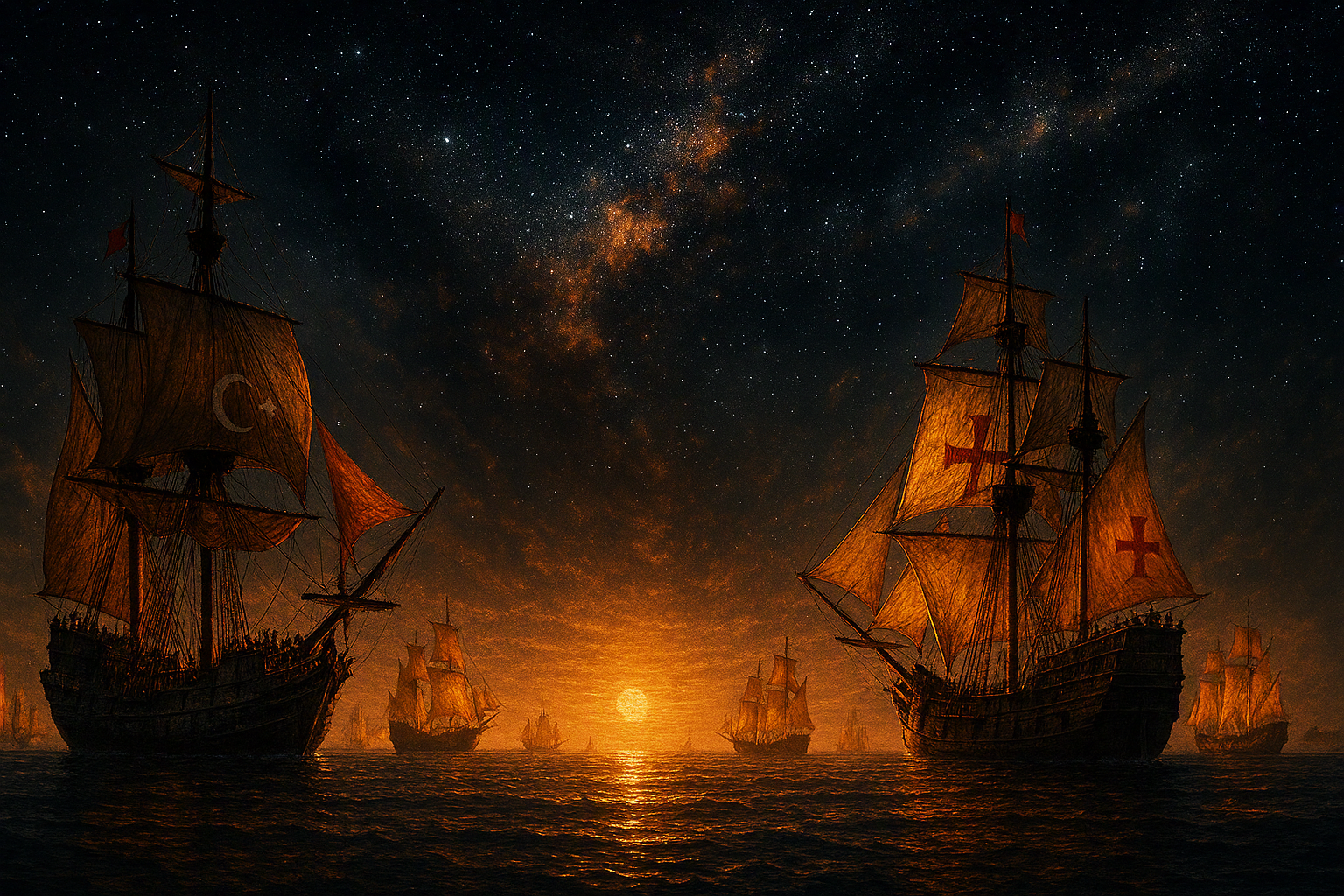
1560… The Mediterranean sparkled under the sun, gentle winds blew, and seagulls squawked… But this was no ordinary summer. This was a summer that would be recorded in history books as the victory of the Ottoman fleet and a nightmare for the Crusader states. Welcome to the era and the event: the Battle of Djerba.
1. Historical Context and Ottoman-European Relations 🌍📜
In the early 1560s, the Ottoman Empire, especially under the reign of Suleiman the Magnificent, had become a major power in the Mediterranean. The Ottoman navy frequently clashed with powers like Venice, Spain, and Malta.
Meanwhile, Europe was in a state of mild panic. Spain, Venice, and the Papacy formed a massive Crusader fleet to halt the Ottoman rise in the Mediterranean.
In short, the Ottomans were saying, “We are here,” while Europe was trying to say, “No, you stop!” And in the Mediterranean, this diplomatic tension inevitably turned into a clash of cannons, swords, and sails.
2. Before the Battle: Ships, Commanders, and Strategy ⚓🗺️
Ottoman commanders like Piyale Pasha and Turgut Reis prepared their fleet to maneuver in the narrow Mediterranean waters. The ships were not only war machines but also floating strategy centers.
On the Crusader side, fleets from Malta, Venice, and Spain united—but there was a problem: large but poorly coordinated. The Ottomans, however, analyzed their enemies in advance, relying on discipline and experience.
Tips from history:
The Ottomans turned wind and sea currents to their advantage.
The Crusaders carried heavy weapons on large ships but had low maneuverability.
In short: Ottomans were like fast jets, Crusaders like slow tanks… and in the Mediterranean arena, the jets were ready to win. 😎
3. The Climax: Fierce Combat at Djerba ⚔️🌊
September 28, 1560… Near Djerba Island, the battle began. Cannons roared, spears and arrows flew, the sea foamed. The Ottomans split the Crusader lines with winged maneuvers.
It is said that Turgut Reis shouted: “The wind is ours, the sea is ours, the ships are ours… let’s shake the Crusaders a bit!”
Details:
Ottoman ships used speed and agility to encircle the heavier Crusader ships.
The Crusaders relied on their cannons, but Ottoman fire and maneuvers caught them off guard.
The battle lasted a few hours, but the outcome was clear: the Ottomans won, and most Crusader ships were sunk or captured.
Practical insight: In naval warfare, victory depends not just on firepower, but on timing, wind direction, and maneuverability. The Ottomans mastered all three.
4. Aftermath: Rippling Effects of Victory 🌊🏆
The Battle of Djerba was not just a victory; it symbolized Ottoman dominance in the Mediterranean.
Military impact: The Ottoman fleet gained superiority over Europe.
Economic impact: Ottoman ports and trade routes were secured.
Diplomatic impact: European powers remained quiet for a while, acknowledging Ottoman strength.
Moral impact: Ottoman soldiers and citizens celebrated their naval success.
Fun tip: Ottoman sailors may have imagined “catching” Crusader ships like fish when they heard about the victory. 😄
5. Practical History Lessons: Why It Matters 📚💡
Strategy & Planning: Success doesn’t come from numbers alone. Planning, maneuvering, and timing are everything.
Coordination vs. Discipline: The Crusaders had numbers but lacked coordination; the Ottomans were disciplined and organized.
Technology & Innovation: Differences in cannon and ship design determined the outcome.
Key takeaway: History isn’t just stories from the past—it’s a laboratory that teaches the value of strategy, patience, and creativity.
6. Humorous Note: If History Happened Today 😄
Imagine if 1560 had Twitter or Instagram:
Piyale Pasha posting a story: “The wind is ours, the enemy is confused, victory is near 🌊⚓ #DjerbaVictory #OttomanDominance”
The Crusaders analyzing the situation: “Looks like we have a coordination problem 😬 #DisorganizedFleet”
Sometimes history hides its humor even in serious events.
7. Conclusion: Sailing Through the Waves of History 🚤✨
The Battle of Djerba marked a turning point, cementing Ottoman dominance in the Mediterranean and shaking European powers. Today, when you look at the Mediterranean, you can imagine the strategy, courage, and naval brilliance that once played out there.
Tip: If you ever sail these waters, watch the waves carefully; warships may have maneuvered here long ago. But don’t worry—you’ll just need your life jacket, and the history books will stay within reading distance. 😄