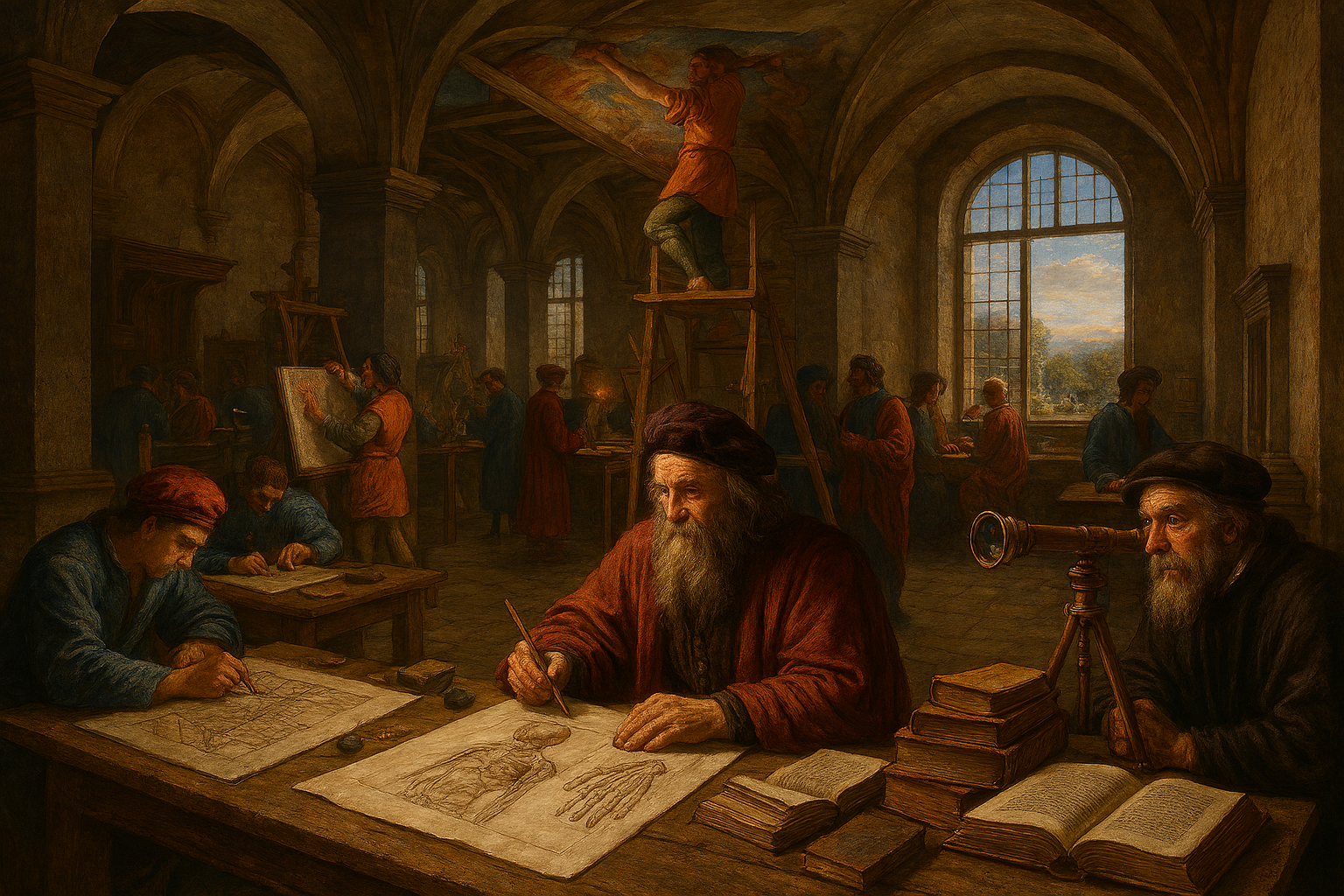
Europe, from the late 14th century to the early 17th century, was experiencing an awakening. The dark, dogma-filled world of the Middle Ages was slowly unraveling, and people were beginning to question, explore, and create ⚡. This is what we call the Renaissance (Rinascimento – rebirth).
But wait, this wasn’t just about beautiful paintings and sculptures; it was also a period of scientific revolutions, social change, individual freedoms, and sometimes even uprisings.
1. The Explosion of Art: From Paintings to the Human Spirit 🖼️🎨
Renaissance art transformed the Middle Ages’ mostly religious, “flat and symbolic” style into a revolution that placed humans and nature at the center.
- Leonardo da Vinci 👨🎨: The mysterious smile of the Mona Lisa, the Vitruvian Man, and flying machines… Leonardo was a painter, inventor, engineer, and scientist. Basically, he was his era’s “multi-talented Instagram influencer” 😎.
- Michelangelo 🏛️: By painting the ceiling of the Sistine Chapel, he immortalized the beauty and dramatic expressions of the human body.
- Raphael and Botticelli: Renaissance portraits now used depth, perspective, and light-shadow techniques, making images lively and realistic.
💡 Practical tip: Renaissance artists developed perspective and used light and shadow to make paintings almost “3D.” Think of it as a VR (virtual reality) experience – the paintings created real depth!
2. Science and Discoveries: Seeing the World Anew 🔭🌍
The Renaissance was the rise of reason and logic. People began to ask: “What is really true, and what is false?”
- Galileo Galilei: Pointed his telescope at the sky and observed that Earth was not the center of the universe 🌌. Astronomy became a scientifically grounded discipline.
- Copernicus: Proposed the heliocentric universe ☀️🌎, shaking the Middle Ages’ belief that “Earth is the center of everything.”
- Anatomy and Medicine: Leonardo’s detailed anatomy drawings were priceless for medical students. The human body was studied realistically, and diseases were better understood 🩺.
- Mechanics and Engineering: Renaissance inventors explored machines and automatic devices to improve productivity.
🎯 Impact: People gained the courage to question dogmatic authorities. Scientific thinking, experimentation, and observation became core pillars of the Renaissance.
3. Social Impact and Individual Freedom ✊📜
The Renaissance wasn’t just art and science; individual freedoms and social awareness were also rising:
- Literature and Philosophy: Dante, Machiavelli, Erasmus, and Thomas More wrote works critiquing society and exploring human nature. People could now think for themselves ✍️.
- Social Movements and Revolts: Knowledge spread, and in some cities, people started small uprisings against feudal oppression. Even a simple printed book could spark a “knowledge revolt” 💥.
- Education and Access to Knowledge: Gutenberg’s printing press made books widespread 📚. Knowledge was no longer limited to the elite; the public had access too.
💡 Practical tip: The impact of the printing press during the Renaissance is similar to the role of social media today: ideas spread quickly, society is influenced, and authorities sometimes panicked 😏.
4. Innovations and Discoveries: Renaissance Touch in Daily Life 🔬⚙️
- Perspective and Optical Art: Paintings became more realistic, gaining depth through light and shadow 🎨.
- Navigation and Exploration: Explorers like Christopher Columbus and Vasco da Gama discovered new continents, shrinking the world 🌎🛶.
- Mechanical Innovations: Clock mechanisms, automatic machines, and water systems improved daily life ⏱️💡.
- Medicine and Science: Anatomy drawings and early microscope-like observations illuminated human health 🩺🔬.
💡 Tip: The Renaissance meant innovation in everyday life too; you could think of it as the birth of the modern “startup culture” 🚀.
5. Benefits and Drawbacks of the Renaissance ⚖️🌿
Benefits:
- Human-centered thinking and humanism rose 🧑🎨🤔
- Art and science experienced a massive boom 🎨🔬
- Questioning authority and individual freedoms increased ✊
- Discoveries and innovations bridged the way to the modern world 🌎
Drawbacks / Risks:
- Conflicts with the Church and reform movements ⛪🔥
- Misunderstood knowledge sometimes led to radical movements 😬
- Some revolts were violently suppressed ⚔️
- Authorities resisting change caused social conflicts 😡
6. Conclusion and Lessons from History 🌟📚
- Curiosity and questioning drive humanity forward 🔍🕰️
- Art and science reflect the spirit of a society 🎨🔬
- Individual freedom and access to knowledge spark social change ✊📖
- The Renaissance shows that a single brushstroke, a telescope observation, or a printed book can change the world 🌪️✨
💡 Humorous view: If Leonardo and Galileo lived today, they’d probably perform experiments on TikTok, apply filters to the Mona Lisa on Instagram, and tweet “Perspective is everything!” on Twitter 😎.