Imagine opening a philosophy book and finding three words that sound less like philosophy and more like the title of a heavy metal album:
“God is dead.”
Dramatic? Absolutely.
Simple? Not even close.
Friedrich Nietzsche’s famous declaration has been quoted in classrooms, movies, songs, internet debates, memes, and probably more than a few unnecessarily intense social-media bios. But it is also one of the most misunderstood statements in Western philosophy.
Nietzsche was not simply celebrating atheism. He was asking a much more disturbing question:
What happens to a civilization when the beliefs that once gave it meaning begin to disappear?
And more than a century later, that question feels surprisingly modern.
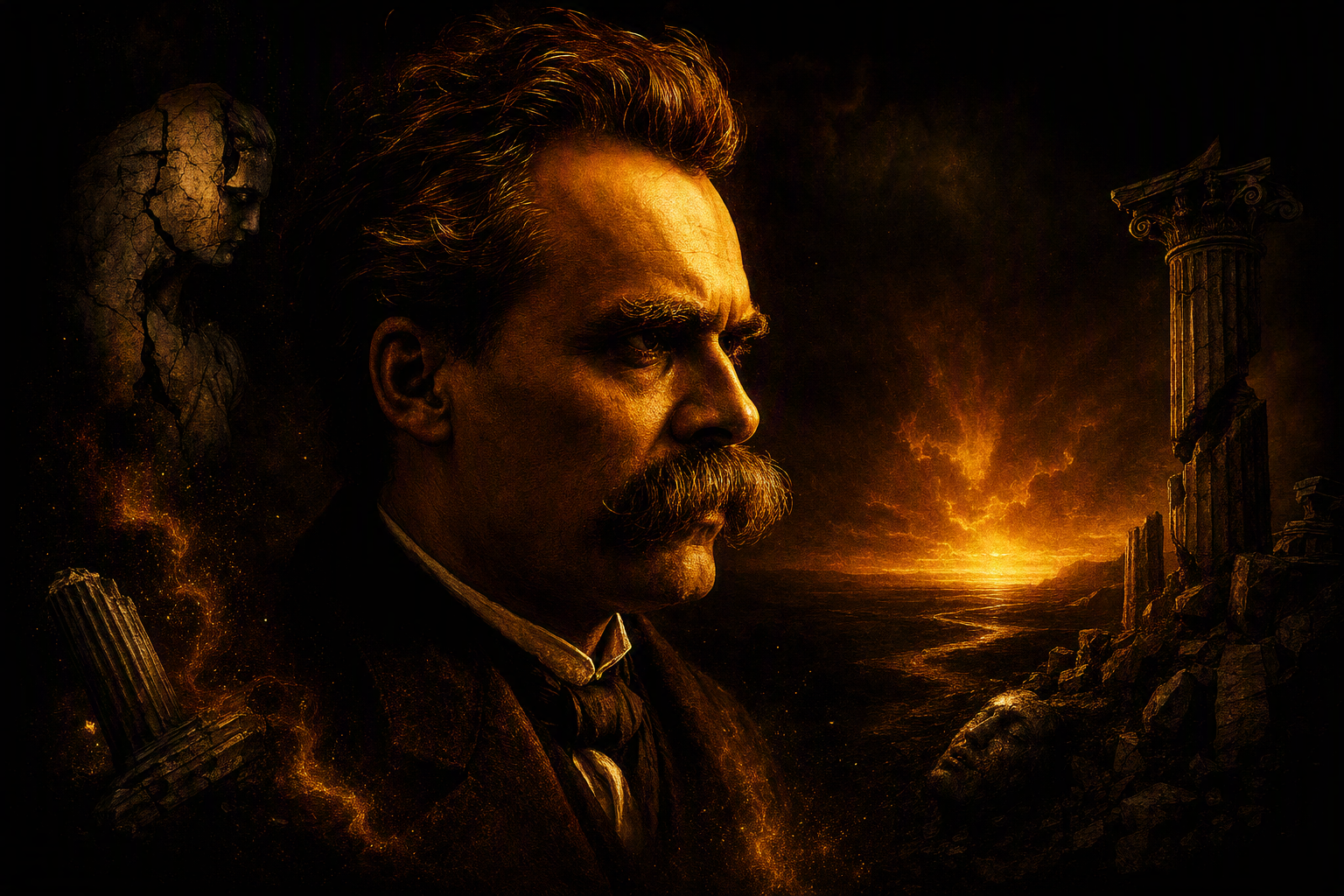
🧔 First, Who Was Friedrich Nietzsche?
Friedrich Nietzsche was born in 1844 in Röcken, Prussia, in what is now Germany.
His father was a Lutheran pastor, and Nietzsche grew up in a deeply religious environment. Interestingly, the man who would later become famous for writing “God is dead” was once expected to follow a fairly traditional religious path himself.
That did not happen.
Nietzsche became a brilliant scholar of classical languages and was appointed professor of classical philology at the University of Basel while still in his twenties.
But his interests quickly expanded far beyond ancient Greek texts.
He wrote about morality, religion, truth, suffering, art, culture, power, individuality, psychology and the strange ways human beings convince themselves that their beliefs are eternal truths.
His major works include 📚 The Birth of Tragedy, The Gay Science, Thus Spoke Zarathustra, Beyond Good and Evil, On the Genealogy of Morality, and Twilight of the Idols.
Nietzsche was provocative on purpose. He did not want readers to sit comfortably and nod.
He wanted to shake the chair.
💀 So… Did Nietzsche Literally Mean “God Is Dead”?
No.
Nietzsche was not suggesting that God had physically existed somewhere in the universe and then suddenly died.
The statement is primarily about culture, belief and meaning.
By Nietzsche’s time, European society was changing dramatically. Scientific discoveries, industrialization, historical criticism and increasingly secular ways of thinking were challenging Christianity’s traditional authority.
For centuries, Christianity had provided much of Europe with a framework for answering enormous questions:
Why are we here?
What is good?
What is evil?
Why should we behave morally?
What happens after death?
Does suffering have a purpose?
Even people who disagreed about the details often lived inside a culture shaped by broadly Christian assumptions.
Nietzsche believed that this framework was losing its power.
And that created a problem.
A very big one.
🕯️ The Madman Who Announced God’s Death
One of the most famous appearances of the idea comes from Nietzsche’s 1882 book The Gay Science.
Nietzsche tells the story of a madman who runs into a marketplace carrying a lantern in broad daylight.
He announces that he is looking for God.
The people around him laugh.
Then the madman tells them:
“God is dead. God remains dead. And we have killed him.”
This is where things get interesting.
The madman isn’t celebrating.
He is horrified.
He asks how humanity could possibly understand the consequences of what it has done.
The metaphor suggests that European civilization has destroyed—or at least seriously undermined—the worldview that supported its traditional morality and sense of purpose.
But society has not yet understood what comes next.
That is the real philosophical explosion hidden inside the phrase.
🧨 “And We Have Killed Him”
This part is often forgotten.
Nietzsche did not merely write:
God is dead.
He added:
We have killed him.
Who is “we”?
Modern civilization.
Scientific thinking, skepticism, historical investigation and Enlightenment rationalism had gradually weakened the authority of traditional religious explanations.
Nietzsche believed humanity had become increasingly capable of questioning ideas that previous generations accepted largely as unquestionable truths.
But destroying an old worldview is much easier than building a new one.
Imagine civilization as a huge building.
Religion has supported parts of the structure for centuries.
Then modern humanity announces:
“Actually, we don’t think we need these pillars anymore.”
Fine.
But Nietzsche immediately asks:
Are you sure the roof will stay up?
🧭 The Real Problem: Where Does Meaning Come From Now?
This is where Nietzsche becomes much more interesting than the stereotype of the angry atheist philosopher.
Suppose you stop believing that morality comes from God.
You still believe murder is wrong.
You still value honesty.
You still believe human life matters.
You still talk about justice, dignity, responsibility and equality.
Nietzsche asks an uncomfortable question:
Why?
Where do those values ultimately come from?
Perhaps humans can create rational, secular foundations for morality.
Perhaps morality comes from empathy, evolution, social cooperation or human flourishing.
Those are possible answers.
But Nietzsche believed Europeans had not fully confronted the problem yet.
They had abandoned—or were abandoning—the metaphysical foundations of Christianity while continuing to live according to many moral assumptions inherited from Christianity.
For Nietzsche, that contradiction could not continue forever.
Eventually humanity would have to confront the empty space left behind.
🌑 Welcome to Nihilism
Nietzsche feared the arrival of nihilism.
Nihilism, in simplified terms, is the belief or feeling that life has no objective meaning, purpose or value.
Imagine removing every traditional answer to the question:
“Why should I live?”
Then imagine having nothing ready to replace them.
That emptiness is what Nietzsche worried about.
Without a shared source of meaning, people might conclude:
Nothing really matters.
Why struggle?
Why sacrifice?
Why create?
Why behave morally?
Why pursue truth?
Why do anything beyond comfort and survival?
Nietzsche saw nihilism as one of the great dangers facing future generations.
And this is where his philosophy becomes strangely prophetic.
📱 Nietzsche Meets the Modern World
Imagine Nietzsche appearing in 2026.
After recovering from the shock of smartphones, airplanes and people photographing their lunch, he might find several things fascinating.
We have access to more information than almost any previous civilization.
We can communicate across continents instantly.
Science explains phenomena that once seemed supernatural.
Technology gives us extraordinary power.
And yet people still ask ancient questions:
Who am I?
What should I do with my life?
Why am I unhappy?
What makes my existence meaningful?
Search engines can tell you the distance between Earth and Mars.
They cannot tell you what your life should mean.
Artificial intelligence can analyze thousands of books.
It cannot simply hand humanity a universally accepted purpose.
Technology can provide possibilities.
It cannot automatically provide meaning.
Nietzsche’s problem survives.
🛋️ The “Last Man”: Nietzsche’s Warning About Comfortable Humans
Nietzsche imagined another disturbing possibility.
What if humanity responded to the crisis of meaning not with tragedy—but with comfort?
In Thus Spoke Zarathustra, Nietzsche introduces the idea of the “Last Man.”
The Last Man does not dream of greatness.
He avoids danger.
He avoids suffering.
He avoids difficult ambitions.
He mainly wants comfort, entertainment and security.
Nietzsche feared a civilization in which people might stop asking:
“What could humanity become?”
and start asking:
“How can I remain comfortable?”
Now imagine telling Nietzsche about endless scrolling, algorithmic entertainment and binge-watching twelve episodes because standing up to find the remote seems exhausting.
He might have… opinions.
But Nietzsche was not simply arguing that pleasure is bad.
His deeper concern was whether comfort could become humanity’s highest goal.
If avoiding discomfort becomes more important than growth, creation or achievement, something important may be lost.
🦸 Enter the Übermensch
If old values collapse, Nietzsche does not simply tell humanity to surrender.
Instead, he introduces one of his most famous—and frequently misunderstood—ideas:
The Übermensch
The German term is often translated as “Overman” or “Superman.”
No, Nietzsche was not predicting a man in a cape shooting lasers from his eyes.
The Übermensch represents an individual capable of overcoming inherited values and participating in the creation of new ones.
Instead of asking:
“What am I supposed to believe?”
this person asks:
“What values can I genuinely affirm and live by?”
Nietzsche wanted humans to become creators rather than merely followers.
That requires responsibility.
If nobody hands you the meaning of your life, you cannot simply complain that the instruction manual is missing.
You may have to write part of it yourself.
🔨 Nietzsche’s Philosophy of Self-Overcoming
One of the recurring ideas in Nietzsche’s philosophy is self-overcoming.
Human beings should not necessarily treat their current identity as something permanent.
We can struggle against our weaknesses.
Question our assumptions.
Transform ourselves.
Create.
Learn.
Fail.
Try again.
Nietzsche was deeply interested in becoming rather than simply being.
This helps explain why struggle plays such an important role in his philosophy.
His famous line:
“What does not kill me makes me stronger.”
is often printed on motivational posters as if Nietzsche were running an unusually aggressive fitness account.
But his broader philosophy is more complicated.
Nietzsche did not claim that every painful experience automatically improves us.
Suffering can destroy people.
His point is closer to the idea that hardship can sometimes become material for transformation.
The important question becomes:
What can you create from what happened to you?
🎨 Life as a Work of Art
One of the most beautiful ways to understand Nietzsche is to think about life as something that can be shaped.
A painter receives colors.
A musician receives sounds.
A writer receives words.
Human beings receive circumstances.
Some are wonderful.
Some are terrible.
Most are outside our control.
Nietzsche’s challenge is not simply to accept everything passively.
It is to transform experience into something that can be affirmed.
Your life becomes less like a script you discover and more like a work you participate in creating.
That does not mean pretending suffering is pleasant.
It means refusing to allow suffering to have the final word.
🔁 Would You Live Your Life Again?
Nietzsche developed one of philosophy’s greatest thought experiments:
Eternal Recurrence
Imagine that one night a mysterious being tells you:
Everything you have experienced will happen again.
Every friendship.
Every mistake.
Every embarrassing message.
Every heartbreak.
Every boring Monday morning.
Every moment of happiness.
Every terrible decision you made at 2:17 a.m.
Everything.
And after finishing your life, you will repeat it again.
Forever.
Would that idea terrify you?
Or would you eventually be able to say:
Yes. Let it happen again.
Nietzsche used this idea as an extreme test of affirmation.
Could you live in such a way that you would be willing to choose your life again?
That is a much more demanding question than simply asking:
“Am I happy?”
❤️ Amor Fati: Love Your Fate
Another important Nietzschean idea is amor fati, Latin for:
“Love of fate.”
Notice the wording.
Not merely:
Accept your fate.
But:
Love it.
That is radical.
It means attempting to embrace life—including difficulty, failure and uncertainty—as part of the total experience that made you who you are.
Again, this does not mean enjoying tragedy.
Nietzsche’s idea is closer to refusing to spend your entire existence wishing reality had been another way.
The past cannot be rewritten.
But your relationship with it can change.
⚠️ Was Nietzsche Against All Religion?
This requires nuance.
Nietzsche was one of Christianity’s fiercest critics, especially of what he regarded as its attitudes toward guilt, suffering, weakness and the denial of earthly life.
But reducing his philosophy to:
“Religion bad.”
would miss most of the interesting part.
Nietzsche recognized that religion had performed enormous cultural and psychological functions.
It gave communities shared stories.
It created moral frameworks.
It offered explanations for suffering.
It connected individual lives to something larger.
His concern was what happens when those functions disappear while humanity pretends nothing important has changed.
So “God is dead” is not simply an attack.
It is also a diagnosis.
🧠 Nietzsche’s Challenge to You
Suppose Nietzsche is right that traditional sources of meaning can lose their authority.
What happens next?
There are several possibilities.
You could fall into nihilism:
Nothing matters.
You could blindly inherit somebody else’s values:
Just tell me what to believe.
Or you could attempt something much harder:
Examine your values and consciously decide what deserves your commitment.
That raises difficult questions.
Why do you want what you want?
Did you choose your ambitions?
Or did society choose them for you?
Would you still want your lifestyle if nobody could see it?
Do you believe something because you examined it—or because everyone around you believes it?
If money, status and approval disappeared tomorrow, what would still matter?
Those are extremely Nietzschean questions.
And they are not comfortable ones.
📲 Nietzsche vs. The Instagram Life
Imagine someone building their entire identity around external approval.
Likes.
Followers.
Money.
Job titles.
Brands.
Status.
Recognition.
Then imagine all of it disappearing.
Who remains?
Nietzsche would probably ask whether this person ever created an identity—or simply collected reflections from other people.
Modern culture constantly tells us what success should look like.
Earn this.
Buy this.
Look like this.
Travel here.
Become important.
Be productive.
Be admired.
Nietzsche’s response might be:
Who decided these values were yours?
That question may be even more important than “God is dead.”
🤔 The Strange Irony of “God Is Dead”
Here is the irony.
People often quote Nietzsche’s statement triumphantly:
“God is dead!”
But Nietzsche’s actual message is much darker.
If God is dead, humanity does not automatically become free, rational and happy.
Instead, humanity inherits an enormous responsibility.
We must confront questions previously answered by religion.
Where does morality come from?
What makes life valuable?
What should civilization aim toward?
What is worth suffering for?
What makes a good human life?
Nietzsche did not believe these questions would disappear.
He believed they would become more urgent.
🌌 More Than a Century Later…
Nietzsche died in 1900, just as the twentieth century was beginning.
He never saw smartphones, social media, nuclear weapons, modern neuroscience, globalized consumer culture or artificial intelligence.
Yet his central problem remains recognizable.
Modern humanity possesses extraordinary knowledge.
But knowledge and meaning are not the same thing.
We know more about the universe than Nietzsche could have imagined.
We know galaxies contain billions of stars.
We understand evolution.
We can examine the human brain.
We can communicate instantly across the planet.
But science cannot make one final decision for us:
What should we do with our existence?
That remains our problem.
⚡ Final Thought: Maybe Nietzsche Was Asking a Question
“God is dead” sounds like a conclusion.
Perhaps it is better understood as the beginning of a question.
If the old answers no longer convince you…
What will replace them?
If life does not arrive with a universally accepted instruction manual, will you become hopeless?
Will you distract yourself?
Will you borrow somebody else’s purpose?
Or will you accept the terrifying freedom of participating in the creation of meaning?
Nietzsche does not offer an easy answer.
That may be exactly why people are still reading him.
More than a century after his death, the uncomfortable philosopher with the legendary mustache is still sitting across the table from us, asking:
What do you actually believe?
Why do you believe it?
And perhaps most importantly: