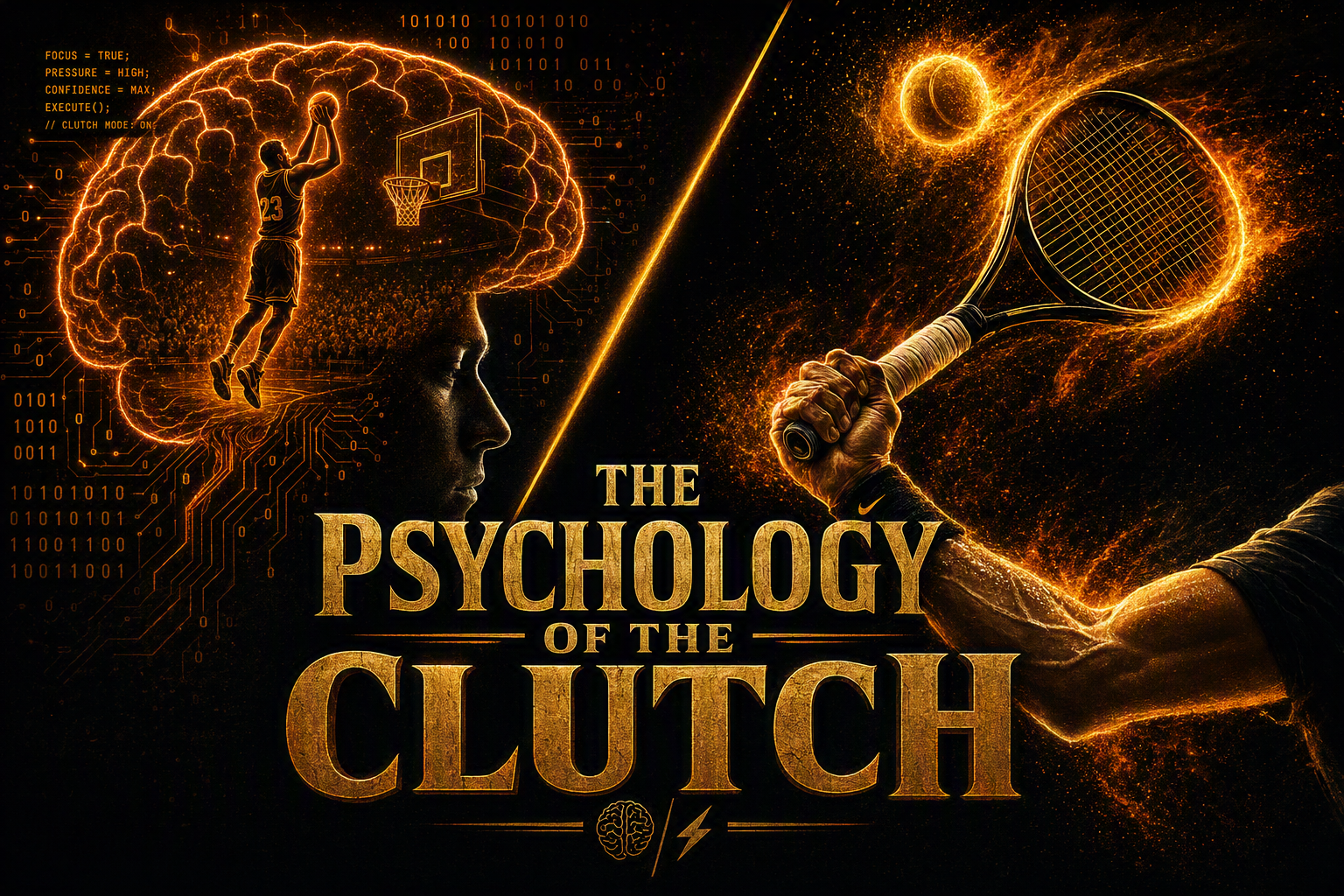
Picture the scene: Three seconds remaining on the clock ⏱️🏀, your team is down by a single point, and a hostile away crowd is roaring at a decibel level capable of shattering glass 🏟️🗣️. Or imagine facing match point down in a Grand Slam tennis final 🎾 against an opponent who has brilliantly returned your hardest serves all afternoon. To ninety-nine percent of humanity, this precise moment triggers a massive spike in cortisol 🧬, an uncomfortably dry mouth, and an overwhelming biological urge to hide under a cozy blanket 🛌. Yet, to a rare, elite breed of human beings—athletes like Michael Jordan sinking the iconic 1998 NBA Finals jumper or Novak Djokovic turning seemingly impossible break points down into championship-winning roars 🦁—this exact furnace of pressure is where they truly come alive ⚡.
Welcome to the fascinating, high-stakes science and soul of the “clutch gene.” 🧬🧠
The Neuroscience of Grace Under Fire 🔬
For generations, sports commentators and fans chalked up clutch performances to some mystical, unquantifiable magic ✨ or a gift bestowed only upon the chosen few. Modern neuroscience, however, tells a much more compelling and actionable story 📚. When average individuals face extreme stress, our sympathetic nervous system triggers the classic evolutionary “fight or flight” response 🏃♂️💨. The amygdala hijacks the brain 🧠, blood rushes away from the prefrontal cortex—the exact region responsible for complex decision-making, emotional control, and fine motor skills—and suddenly our hands shake, our vision tunnels, and our muscles tighten up 🥶.
Athletes routinely labeled as “chokers” 📉 are essentially victims of paralysis by analysis—overthinking mechanics that should otherwise be entirely automatic ⚙️.
Clutch performers like Jordan and Djokovic, on the other hand, have trained their brains to experience a deeply optimized neurological state often described as “super-focus” or the flow state 🌊🎯. Through thousands of hours of intense, deliberate repetition, their core athletic skills (shooting a fadeaway jumper or striking a backhand cross-court) are permanently hardwired into procedural memory 💾. When pressure peaks and the world expects them to crack, their prefrontal cortex actually quiets down 🤫. This neurological down-regulation prevents overthinking, allowing deeply ingrained muscle memory to take over completely unfiltered by self-doubt 🛡️.
The Michael Jordan Blueprint: Manufactured Pressure and Obsession 🐐🏀
Michael Jordan didn’t merely wait passively for high-pressure moments to find him on the hardwood; he actively manufactured intense pressure inside his own mind on a daily basis 🧠💥. If a teammate dared to trash-talk him during a casual Tuesday practice, Jordan would often invent an elaborate, entirely fictional slight from an opposing player just to give himself a ruthless personal vendetta for that night’s televised game 🎬🔥.
This behavior is a masterclass in psychological framing 🖼️. Jordan constantly transformed external stakes and ordinary matchups into intense internal fuel ⛽. By treating a standard mid-winter regular-season game like Game 7 of the NBA Finals 🏆, those monumental, high-pressure moments on the global stage ultimately felt familiar and manageable to him. When sports journalists later asked him about the crushing weight of historic games, he could easily laugh it off 😂, because the difficult mental movie he had already played out in his own head a thousand times was infinitely harder than reality 🎞️.
The Novak Djokovic Mindset: The Art of Mental Erasure 🎾👑
If Jordan represents the fiery competitor who manufactures internal fuel from conflict 🔥, Novak Djokovic is the ultimate psychological fortress of modern tennis 🏰. Think back to the legendary 2019 Wimbledon final against Roger Federer, where Djokovic faced two championship points against him on Federer’s own serve ⚠️. The Centre Court crowd was overwhelmingly, almost deafeningly, rooting for his beloved opponent 🗣️👥.
Instead of panicking or fighting the hostile environment, Djokovic deployed a brilliant technique rooted in advanced mindfulness and emotional self-regulation 🧘♂️. In various interviews over the years, he has frequently spoken about acknowledging the noise and the natural fear 🌪️, but deliberately refusing to feed them emotional energy 🛑. When the stadium crowd chanted “Roger! Roger!”, Djokovic’s brain would actively translate that echoing sound into “Novak! Novak!” 🔄🎧.
He practices precise tactical breathing 🫁 and extreme emotional compartmentalization right in the middle of intense matches 🧩. By shrinking the massive, intimidating arena down to just the yellow tennis ball 🎾 and the strings of his racket, he treats match point down with the exact same emotional detachment as a standard 30-30 point in the opening game ⚖️. That rare ability to wipe the slate completely clean—instantly forgetting a previous unforced error, a blown call, or the staggering magnitude of the score 🧽—is the true secret weapon of the modern clutch athlete 🗝️.
Translating the Clutch Mindset into Daily Life 🚀💼
You certainly do not need to win an NBA championship ring or hoist a Wimbledon trophy to harness the profound psychology of the clutch. Whether you are walking into a high-stakes corporate boardroom presentation 📊, stepping up to take a pivotal academic exam 📝, or tackling a difficult, emotionally charged personal conversation 💬, you can successfully steal pages directly from the playbook of these legends 📖:
Embrace and Protect Your Routine: 🔄 Jordan had his meticulous pre-game stretching rituals; Djokovic bounces his tennis ball an exact, consistent number of times before every single serve 🎾. External consistency creates internal calm 🧘. When the brain recognizes a familiar, predictable routine in the middle of chaos, it dials down the panic response 📴.
Reframe the Panic: ⚡ Stop telling yourself, “I am so nervous I can’t breathe.” Instead, consciously tell your brain, “I am genuinely excited for this challenge.” 🚀 Physiologically speaking, anxiety and excitement are identical twins—both feature an elevated heart rate, quickened breathing, and heightened alertness 💓. Simply relabeling the feeling as excitement tricks your brain into a performance-ready state 🎭.
Shrink the Field: 🔍 When the pressure around you becomes deafening, radically narrow your immediate focus to the micro-task right in front of your face 📏. Do not think about the final outcome, what people will say if you fail, or the grand consequences 🚫. Just focus entirely on executing the very next step with precision ✔️.
At the end of the day, true champions are never born entirely without fear 🦁. They simply teach their magnificent brains how to dance gracefully right in the middle of the storm 💃🌪️.
How do you usually handle high-pressure moments in your own daily life—do you lean into a strict routine 🗓️, or do you try to block everything out 🎧?