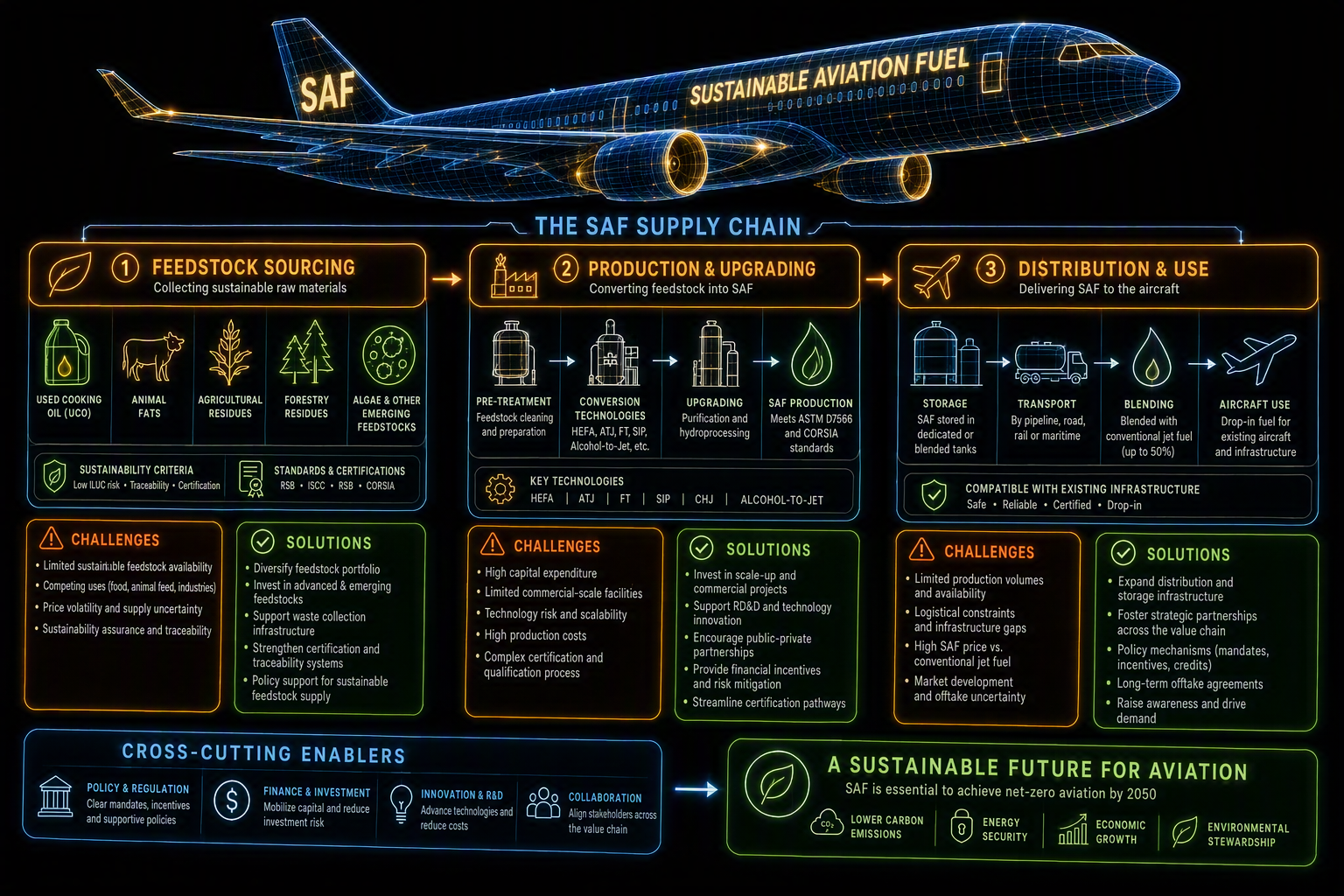
Commercial aviation is caught in an existential crossfire 🎯. On one side sit ambitious net-zero carbon targets for 2050 🌍; on the other sits a harsh, bottlenecked reality. Sustainable Aviation Fuel (SAF) accounts for a meager 0.8% of total global jet fuel consumption. Even as production climbs to an estimated 2.4 million tonnes, the industry is nowhere near the volume required to replace fossil fuels at scale.
Transitioning from PR-friendly net-zero declarations to massive industrial execution reveals how infrastructure hurdles, intense feedstock competition, and high-stakes refinery economics are testing the resilience of major airlines 📉.
1. 🍳 The Feedstock Scramble: The Battle for Kitchen Grease and Fats
The vast majority of today’s SAF relies on HEFA (Hydroprocessed Esters and Fatty Acids). In plain English? Used cooking oil, animal tallow, and industrial food waste 🍟🐖.
The Supply Ceiling 🛑: There is only so much leftover cooking oil on the planet. Aviation is fighting a fierce cross-industry war with road transport (renewable diesel producers tap into the exact same feedstock pools), driving up acquisition costs.
Geographic Imbalances 🗺️: Supply is heavily fragmented. While North America and parts of Europe dominate early adoption, other high-traffic aviation hubs lack local collection networks, forcing raw materials or finished fuels to be shipped across oceans—incurring a heavy carbon footprint of their own before a commercial flight even burns it.
2. ⛽ The Infrastructure and Blending Gridlock
Chemically, SAF is a “drop-in” fuel, meaning it can mix seamlessly with conventional Jet-A/Jet-A1 without requiring engine retrofits. Physically getting it into the aircraft, however, is an operational maze 🌀.
Dedicated Logistics 🏗️: Most major hub airports rely on centralized hydrant systems fed by shared pipelines. Introducing SAF requires either dedicated storage tanks or rigorous batch-tracking to prevent contamination and verify green credentials.
The e-SAF Reality Gap 🧪: While future-looking mandates—such as those in the EU and UK—demand specific percentages of synthetic e-SAFs (fuels synthesized from captured carbon dioxide and green hydrogen) by 2030, operating and under-construction production capacities are lagging significantly behind target goals. Scaling e-SAF requires cheap renewable electricity and massive industrial-scale electrolyzers that are still waiting on final investment greenlights.
3. 💰 Refinery Capital Economics and the Price Premium
Building a dedicated green refinery or retrofitting an old fossil-fuel processing plant requires hundreds of millions of dollars in upfront capital expenditure 💸.
The Margin Trap 📉: SAF regularly trades at a substantial premium—sometimes two to four times the cost of conventional fossil jet fuel. For low-margin network carriers already pressured by fluctuating oil prices, absorbing these costs natively is nearly impossible.
The FID (Final Investment Decision) Hesitation ⏳: Private lenders and energy firms are cautious. Without long-term government price floors, tax credits (such as those under the U.S. Inflation Reduction Act), or guaranteed offtake contracts, securing multi-billion-dollar project financing remains high-risk.
Strategic Plays: How Airlines Are Evolving Past Traditional Buyers 🤝✈️
Major global carriers are no longer sitting back waiting for fuel suppliers to solve the crisis; they are aggressively reshaping the supply chain:
Direct Equity and Co-Investing 💡: Airlines are acting as venture capitalists, pouring funds directly into next-generation tech startups focusing on Alcohol-to-Jet (AtJ) (converting agricultural waste or industrial ethanol into jet fuel) and Power-to-Liquid (PtL) systems.
Forward Offtake Agreements 📝: Forward-thinking airlines are locking in multi-year, multi-billion-dollar purchase agreements years before construction on refineries even begins. This provides the revenue predictability that fuel developers need to secure bank loans.
Book-and-Claim Accounting Frameworks 💻: To navigate localized supply deficits, the industry relies on “book-and-claim” carbon accounting. This allows an airline to purchase the environmental attributes of SAF poured into an airport’s grid on one continent, even if their actual physical aircraft flies out of a hub lacking local green fuel access.
The Road Ahead: Practical Takeaways 🚀🔮
Regulatory Compliance Driving Cost ⚖️: Ticket prices will inevitably reflect the cost of transition. With statutory mandates ratcheting up across Europe, North America, and Asia through 2030, SAF is transitioning from a voluntary corporate social responsibility (CSR) metric to a mandatory operational compliance cost.
Diversification is Mandatory 🌱: The future belongs to advanced pathways utilizing municipal solid waste, forestry residues, and carbon capture rather than just kitchen grease. Until these alternative feedstocks achieve true industrial parity, aviation’s green flight path will remain tethered to the speed of refinery construction.
What specific avenue of this transition should we analyze next—the policy mechanics of global blending mandates or the engineering limits of alternative e-fuels?
An Update on Sustainability in Aviation from IATA’s AGM
This video provides a helpful overview of the global production estimates and scaling priorities facing the aviation sector today.