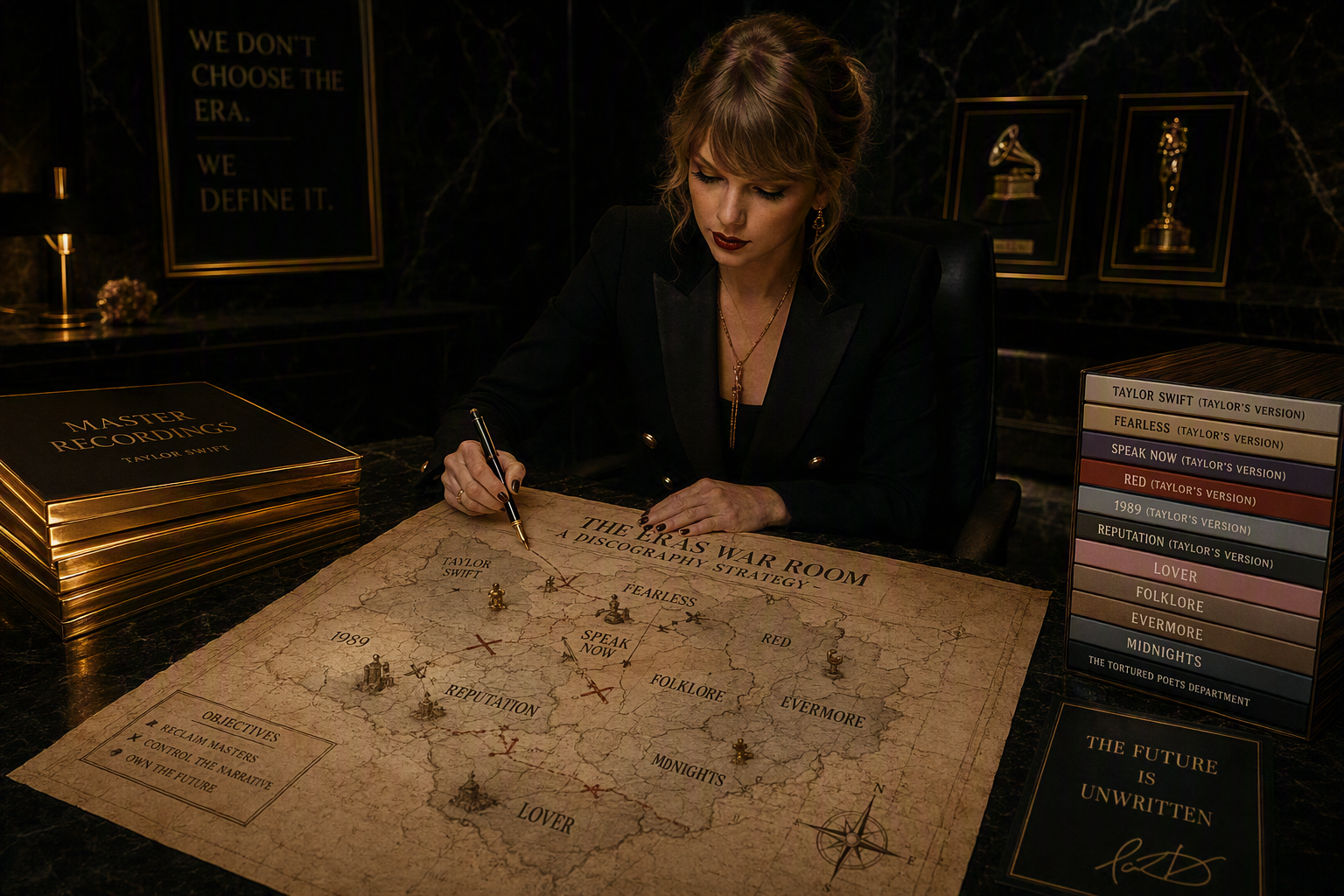
If you’ve been anywhere near the internet in the last few years, you’ve probably noticed two things: stadiums shaking across the globe 🌍🎸 and the words “(Taylor’s Version)” attached to songs you swore you learned by heart back in 2012 🎧❤️.
When Taylor Swift announced she was re-recording her entire back catalog, skeptics thought it was a petty stunt or an impossible logistical nightmare 🤯. Instead, it turned out to be one of the most brilliant, high-stakes business moves in modern music history 💼🔥.
Let’s dive into how Taylor Swift turned a music industry nightmare into an unprecedented victory for artist ownership—and redefined what an “era” means along the way 🐍👑.
📜 The Origin Story: Why Re-Record in the First Place?
To understand the genius of the re-recordings, we have to go back to the root of the problem: master recordings 🎙️.
In simple terms, every song has two types of rights:
✍️ Publishing Rights: The composition itself (lyrics, melody, chords).
💽 Master Rights: The actual original sound recording (the physical or digital file played on Spotify, radio, etc.).
In 2005, a 15-year-old Taylor signed with Big Machine Label Group 🎸. Standard industry practice dictated that the label owned her master recordings for her first six albums—from her 2006 self-titled debut all the way through 2017’s reputation 🖤.
Fast forward to 2019: talent manager Scooter Braun bought Big Machine (and Taylor’s original masters) for a reported $300 million 💰. Taylor called it her “worst-case scenario,” expressing heartbreak over not being given the chance to buy her own life’s work 💔.
Enter legendary music executive Kelly Clarkson, who tweeted a simple idea 💡: Why not just re-record the songs you own the publishing rights to? 🗣️
Taylor took that advice and turned it into an art form 🎯.
🎨 The Re-Recording Blueprint: “(Taylor’s Version)”
Re-recording six full-length studio albums isn’t just about singing the same notes. It’s an exercise in forensic musicology 🔍🎶. To make the new masters effective replacements, Taylor and her team had to replicate every single instrument, vocal inflection, and production detail from the originals—while subtly enhancing the audio quality ✨🎧.
Original Master Owned by Others  ───>  Devalued by Fans & Brands 📉
                  │
                  ▼
   Taylor Writes & Owns Publishing ✍️
                  │
                  ▼
Re-Records & Enhances track-for-track 🎙️
                  │
                  ▼
  New Master Owned by Taylor Swift  ───>  Licensing & Streaming Profit 📈
🗝️ The Secret Weapons Behind the Re-Recordings:
🔐 The “From the Vault” Tracks: Taylor didn’t just re-release old tracks; she unlocked unreleased songs written during those specific album eras 🗝️✨. Adding 5 to 6 brand-new tracks per album made the re-recordings an absolute must-listen for fans, rather than a mere duplicate.
🧣 The 10-Minute Masterpiece: On Red (Taylor’s Version), she dropped the mythic 10-minute version of “All Too Well.” It broke the record for the longest #1 song in Billboard Hot 100 history 🏆 and came with a self-directed short film starring Sadie Sink and Dylan O’Brien 🎬🍿.
🛑 Devaluing the Originals: By licensing only “Taylor’s Version” tracks to TV shows, movies, and commercials, and encouraging her massive fanbase to stream exclusively her owned versions, she effectively rendered the original master recordings far less valuable to investors 📉💵.
🏟️ The Eras Tour: A Victory Lap That Broke Records
While the re-recordings reclaimed her past, The Eras Tour contextualized it into a cultural phenomenon 💎🎆.
Instead of touring just a single new record, Taylor designed a 3+ hour spectacle structured as a journey through her distinct musical chapters—from country prodigy (Fearless) 🤠 to pop royalty (1989) 🏙️, synth-goth brooding (reputation) 🐍, and indie-folk storyteller (folklore / evermore) 🌲🕯️.
| Album / Era | Signature Vibe & Aesthetic 🎨 | Iconic Re-Release Highlight 🌟 |
| Fearless 💛 | Yellow dresses, golden acoustic guitars, teenage wonder 🎸 | First re-record release, setting the gold standard ✨ |
| Red 🧣 | Autumn scarves, heartbreak anthems, pop perfection 🍂 | The 10-minute “All Too Well” phenomenon 🎬 |
| 1989 🩵 | Polaroid aesthetics, city skylines, synth-pop powerhouses 📸 | Vault tracks featuring Jack Antonoff’s signature production 🎹 |
| reputation 🖤 | Snakes, dark leather, heavy bass, zero media interviews 🐍 | High-anticipation vault tracks reclaiming her narrative 🔥 |
By celebrating every era simultaneously on stage, she reframed her discography not as old music vs. new music, but as a continuous, living universe 🌌💫.
🎼 Why This Matters for the Music Industry
Taylor’s strategy wasn’t just a win for her bank account; it reshaped how the music industry operates 🏗️⚡.
✊ Empowerment for Young Artists: New creators are now far more cautious about signing away their masters. “Owning your work” has become the primary goal for up-and-coming musicians 📜🛡️.
📝 Record Labels Striking Back: Major labels have begun tweaking standard contract terms, extending the time an artist must wait before they can legally re-record their songs (sometimes up to 10–30 years) ⏳🛑.
🤝 The Power of Fan Culture: The entire strategy relied on one critical element: trust between the artist and the audience. Swifties didn’t switch to “Taylor’s Version” because they were forced to; they did it because they were invested in her narrative of ownership 💖🫂.
👑 The Takeaway
Taylor Swift took a situation designed to strip her of control and turned it into the ultimate masterclass in branding, legal savvy, and creative freedom ♟️✨.
By taking back her music piece by piece, she proved that an artist’s relationship with their work—and their audience—will always be more powerful than a corporate contract 👑🎶.