Imagine walking into an ice cream shop that serves 50 different flavors, but you insist on ordering vanilla every single time. 🍦 Vanilla is great, sure—it’s safe, reliable, and goes with everything. But what if you’re missing out on salted caramel or mango sorbet? 🥭✨
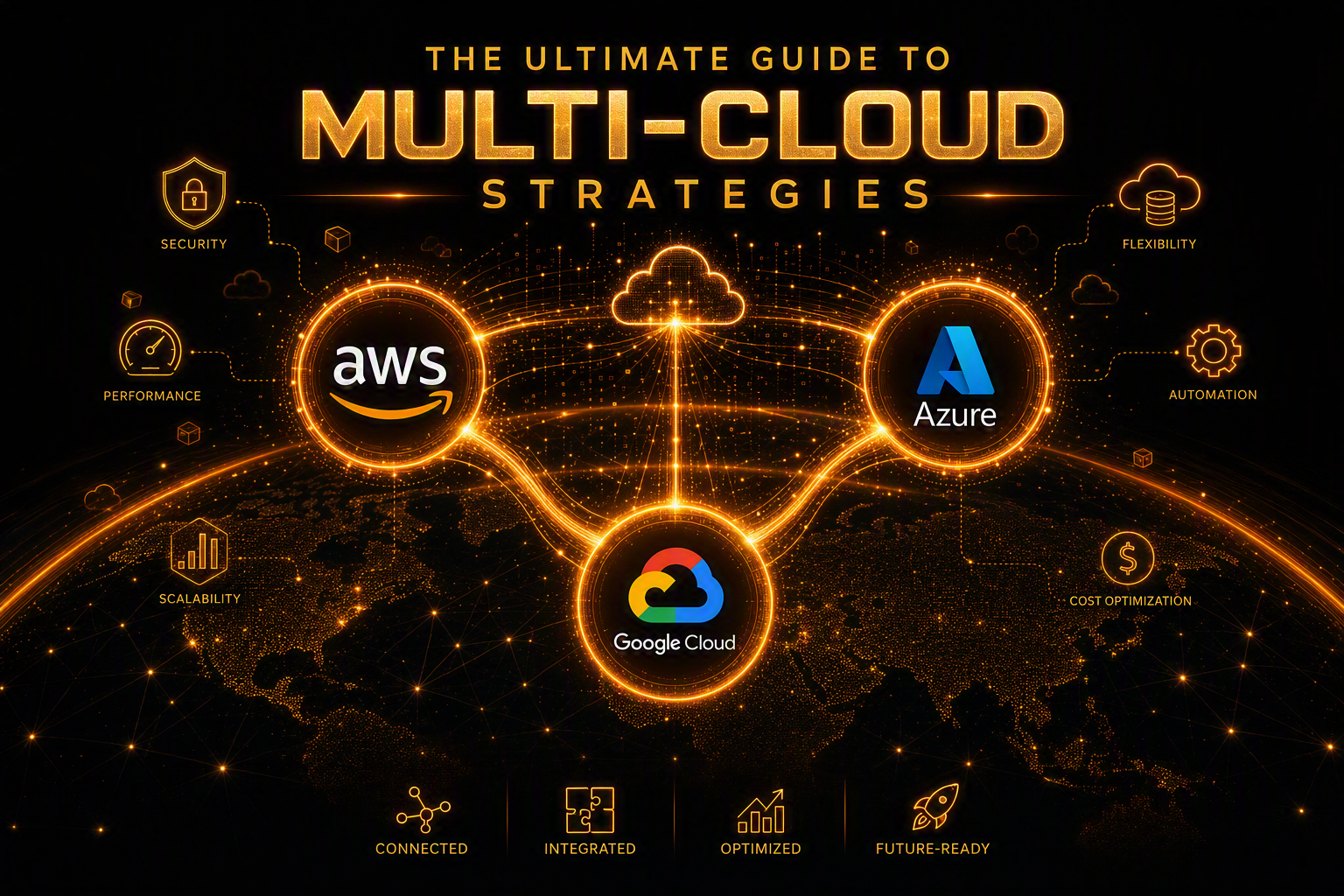
That’s pretty much what sticking to a single cloud provider feels like. For years, businesses picked one cloud giant, moved all their workloads there, and called it a day. 😴 But in today’s tech landscape, putting all your digital eggs in one basket is a risky game! 🧺💥 Enter the world of Multi-Cloud Strategies—the art of mixing and matching AWS, Microsoft Azure, and Google Cloud Platform (GCP) to build an unstoppable tech stack. 🛠️⚡
Let’s demystify what multi-cloud actually means, break down the Big Three cloud providers, explore why you should care, and share practical tips to master this setup without losing your sanity! 🧠💡
🧐 What on Earth is a Multi-Cloud Strategy?
In plain English: A multi-cloud strategy means using cloud services from more than one public cloud provider at the same time. 🌐🔀
Instead of relying solely on Amazon Web Services (AWS) for everything, you might host your core databases on AWS 💾, run your enterprise Windows apps on Microsoft Azure 🪟, and leverage Google Cloud for machine learning and heavy data analytics 📊🤖.
Think of it like assembling an all-star sports team. 🏆 You don’t draft 11 quarterbacks; you pick the best player for each specific position. Multi-cloud is simply drafting the best cloud services for your specific workloads! 🏈🏀
👑 Meet the Big Three: The Heavyweights of Cloud Computing
To build a solid multi-cloud setup, you need to know who brings what to the potluck. 🧺 Dynamic duo or powerhouse trio? Let’s look at the titans ruling the skies: 🌤️
               +-------------------------------------------------+
               |             YOUR APPLICATION STACK 🏗️           |
               +-----------------------+-------------------------+
                                       |
        +------------------------------+------------------------------+
        |                              |                              |
        v                              v                              v
+---------------+              +---------------+              +---------------+
|   A W S  🟠   |              |   A Z U R E 🔷|              |   G C P  🔴   |
+---------------+              +---------------+              +---------------+
| • Compute 💻  |              | • Active Dir.🗝|              | • BigQuery 🔍 |
| • Global Scale🌍             | • MS Ecosystem🏢              | • Kubernetes 🐳|
| • EC2 & S3 📦 |              | • Enterprise 👔|              | • AI / ML 🧠  |
+---------------+              +---------------+              +---------------+
1. 🟠 Amazon Web Services (AWS): The Veteran Pioneer
The Vibe: The trailblazer who started it all back in 2006. 🏛️ If cloud computing were a university, AWS would be the Ivy League school with the biggest library. 📚
Key Strengths: Unmatched breadth and depth. AWS offers over 200 fully featured services! 📈 Need a specialized database, serverless architecture, or global reach across dozens of geographic regions? AWS has it. 🌐
Best For: Scale, general-purpose computing, web applications, and expansive infrastructure requirements (EC2, S3, RDS). 🧱
2. 🔷 Microsoft Azure: The Enterprise Favorite
The Vibe: The smooth operator with direct access to corporate IT departments. 💼 If your organization already lives inside Microsoft 365, Active Directory, or Windows Server environments, Azure feels right at home! 💻
Key Strengths: Seamless integration with legacy enterprise software and hybrid cloud capabilities. 🔄 Microsoft makes it remarkably easy to connect on-premises servers to cloud workloads. 🏢⚡
Best For: Enterprise businesses, .NET/C# applications, identity management, and hybrid deployments. 🛡️
3. 🔴 Google Cloud Platform (GCP): The Innovation & Data Powerhouse
The Vibe: The brilliant scientist focused on cutting-edge research, massive datasets, and open-source innovations 🧪🔬 (fun fact: Google created Kubernetes! 🐳).
Key Strengths: Industry-leading data analytics, AI/ML tools, and container management. 🤖 Tools like BigQuery allow you to analyze petabytes of data in seconds! ⚡
Best For: Artificial intelligence, machine learning, containerized microservices, and big data analysis. 🧠📊
##🎯 Why Go Multi-Cloud? (The Big Payoffs 💰)
Why juggle three different vendor accounts instead of one? Because the strategic benefits are enormous:
🚫 No Vendor Lock-In: When you build your architecture with flexibility in mind, you aren’t held hostage by a single vendor’s pricing hikes, terms of service, or platform limitations. 💸
🧰 Picking the Best Tool for the Job: Use GCP’s BigQuery for analytics 📊, Azure for your enterprise Active Directory authentication 🔑, and AWS for global compute nodes 🌍. Why settle for average when you can have the best of all worlds? 🌟
🛡️ High Availability & Disaster Recovery: Outages happen—even to tech giants! 💥 If AWS experiences a localized failure, your traffic can instantly route to redundant services on Azure or GCP, keeping your business online 24/7. 🛑➡️🟢
🏷️ Cost Optimization: Different cloud providers offer distinct pricing models, spot instance discounts, and committed-use savings. 📉 A smart multi-cloud approach allows you to place workloads where they run cheapest! 💵
📖 The Practical Playbook: How to Actually Manage Multi-Cloud
Multi-cloud sounds fantastic on paper 📄, but if managed poorly, it can turn into an operational nightmare of fragmented bills and security gaps! 😱 Here are practical strategies to keep things running smoothly: ⚙️
1. 📜 Embrace Infrastructure as Code (IaC)
Never configure your cloud resources manually through web consoles! ❌ Use tools like Terraform or Pulumi. 🛠️ Terraform lets you declare and manage infrastructure across AWS, Azure, and GCP using unified, human-readable code files. 💻
2. 🐳 Containerize Everything
If your app is locked to AWS-specific server environments, moving it elsewhere is painful! 🛑 By wrapping your services in Docker containers and managing them with Kubernetes, your applications become portable. 🧳 A containerized app runs virtually identically whether it rests on AWS EKS, Azure AKS, or Google GKE! 🚢
3. 📊 Centralize Your Observability and Security
Monitoring three separate cloud dashboards is a recipe for headache! 🤯 Adopt multi-cloud monitoring and security solutions like Datadog, Grafana, or Palo Alto Prisma Cloud to get a single, unified view of your entire network health, performance logs, and security compliance. 🎯👀
4. 💸 Watch Out for Data Egress Fees!
Here’s a hidden trap: Cloud providers often let you transfer data in for free, but charge you money to move data out 📤 (egress fees). Sending massive files back and forth between AWS and GCP continuously will spike your monthly bill! 🚨 Keep bandwidth-heavy applications and their data sources inside the same cloud region whenever possible! 📍
🌟 Final Thoughts: The Future is Sky-High 🌤️
Building a multi-cloud architecture isn’t about using every cloud service just because it exists—it’s about intentional choice, resilience, and flexibility. 🧠✨ By combining the raw power of AWS, the enterprise integration of Azure, and the data intelligence of Google Cloud, you build an IT backbone ready for whatever the digital world throws at it! 🛡️⚡
Are you running a single cloud setup, or have you already taken the multi-cloud plunge? 🪂 Let’s chat in the comments! 👇💬