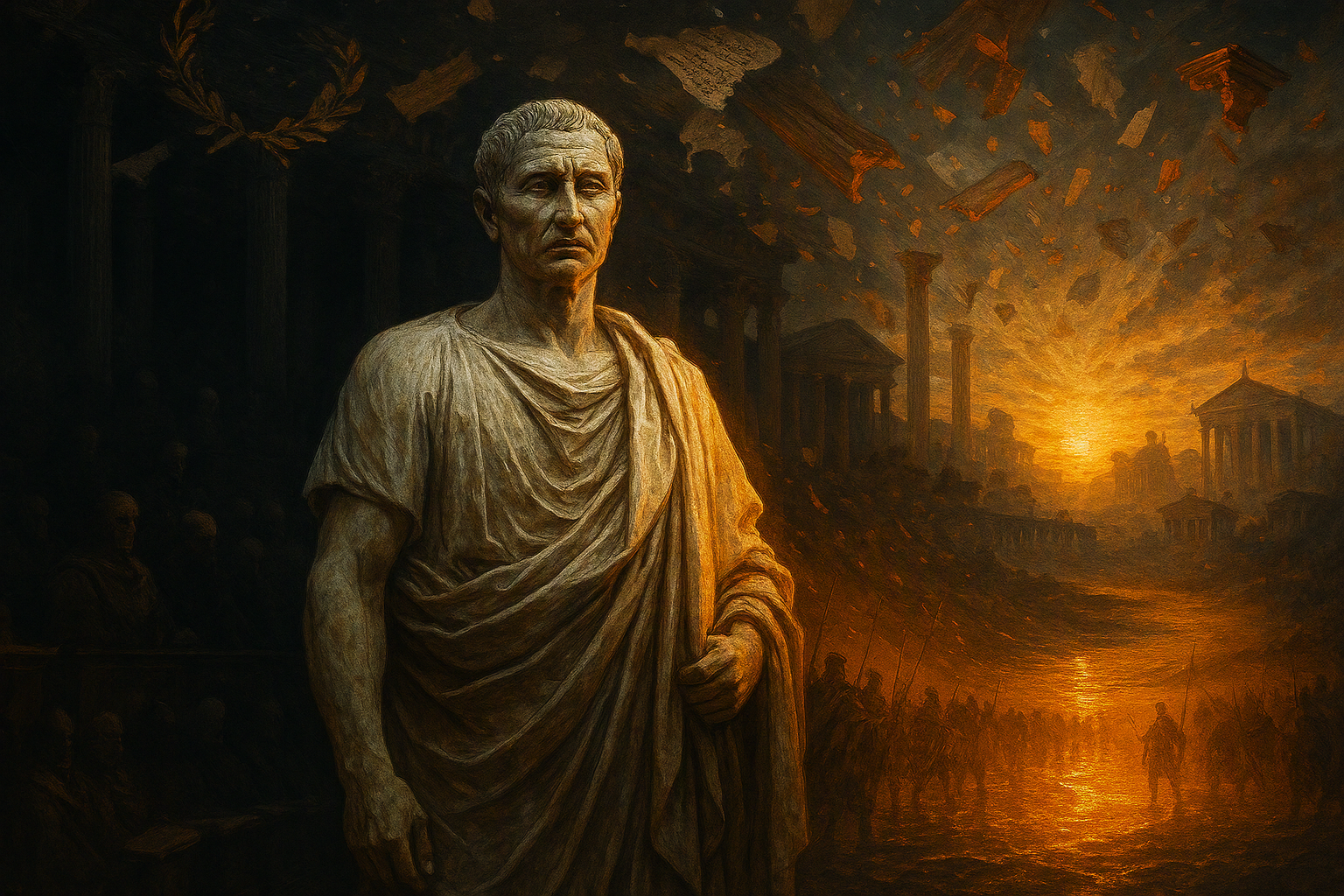
Ancient Roman history is not only the rise of an empire; it is also a laboratory for observing how political systems collapse.
At the center of this laboratory stands one name:
Julius Caesar
To understand him is not simply to understand a leader.
It is to understand why a republic transforms into an empire.
🏛️ The Silent Collapse of the Republic: Structural Roots of the Crisis
The Roman Republic crisis was not the result of a single event but of centuries of accumulation.
The Roman Republic was, in theory, a complex but balanced system:
The Senate represented the aristocratic class
Popular assemblies allowed limited participation
Consuls managed executive authority
However, from the 2nd century BC onward, this structure began to deteriorate.
📉 Key structural causes of collapse:
1. Economic inequality
Small farmers were displaced by large landowners
The latifundia system (large estates) expanded
Slave labor undermined free citizen labor
2. Military transformation
The army ceased to be a “citizen army”
It became a professional force loyal to generals
Loyalty shifted from the state to commanders
3. Political corruption
The Senate evolved into an oligarchy protecting elite interests
Reform attempts were violently suppressed
Under these conditions, the Republic was no longer a “government of the people,” but a system of elite power struggles.
⚔️ Caesar’s Rise: Reformer or Strategist?
When Julius Caesar entered the stage, Rome was already internally fragmented.
His rise was based on three main strengths:
📌 1. Military genius
Expanded Rome’s northern borders through the Gallic Wars (58–50 BC)
Strengthened personal authority over the army
Shifted loyalty from the state to the commander
📌 2. Political intelligence
Adopted the populares (people’s faction) stance
Leveraged popular support against the senatorial elite
Actively used propaganda and written narratives
📌 3. Social reforms
Reduced debt burdens
Expanded citizenship rights
Implemented urban development policies
🧠 Academic interpretation:
Caesar’s politics were not simple populism, but rather
an attempt to recentralize a state in crisis.
⚖️ The Paradox of the Republic: Destroying to Save
This is where Caesar’s greatest historical contradiction emerges.
While attempting to save the Republic:
He weakened the Senate’s authority
Made dictatorial powers permanent
Centralized political competition
In modern political science, this is explained as:
“When centralization increases during crises, attempts to defend democracy may lead to authoritarian outcomes.”
Caesar is the historical embodiment of this paradox.
🌊 Crossing the Rubicon: A Symbolic Turning Point
In 49 BC, Caesar crossed the Rubicon River with his army.
This act violated Roman law.
The meaning of this action:
A Roman general was forbidden from bringing an army into Italy
It was effectively a declaration of civil war
It marked the moment when military force replaced legal order
Historically, this event is not only military but also
the point at which the legal boundaries of the Republic effectively collapsed.
🗡️ The Assassination: A Rescue Attempt for the Republic?
The Assassination of Julius Caesar is one of the most dramatic political events in Roman history.
The assassins (Brutus, Cassius, and others) described themselves as:
“Defenders of Libertas (freedom)”
📌 However, the historical outcomes were:
The Republic was not restored
Civil war intensified
A power vacuum created a new authority
🧠 Academic analysis:
The assassination was not an act of restoration, but rather
a panic reaction of a collapsing system.
👑 The Birth of the Empire: The Age of Augustus
After Caesar’s death, the power vacuum was filled by Augustus.
With Augustus:
The res publica (Republic) continued symbolically
But real power became centralized
The Roman Empire effectively began
📌 Key transformation:
The Republic survived in name,
but ended in substance.
🌍 Caesar’s Impact on World History
Caesar’s influence extends far beyond Rome.
📌 1. Political impact
The concept of charismatic authority emerged
Foundations of modern authoritarian leadership analysis were laid
📌 2. Linguistic impact
“Caesar” → Kaiser (Germany)
“Caesar” → Tsar (Russia)
This demonstrates his transformation into a symbolic imperial figure.
📌 3. Institutional impact
Strengthening of centralized state models
Fusion of military and political leadership
⚖️ Benefits and Drawbacks (Balanced Analysis)
✔️ Benefits
Provided stability during crisis periods
Relieved social tensions through reforms
Expanded Rome’s territorial reach
❌ Drawbacks
Weakened republican institutions
Eliminated political competition
Paved the way for one-man rule
🧠 Philosophical Perspective: Power and Legitimacy
Caesar’s story raises a fundamental question:
“Does legitimacy come from law, or from outcomes?”
If a leader:
saves the system but breaks its rules
is that leader still legitimate?
This question remains central to modern political theory.
🧭 Alternative History: What If Caesar Had Lived?
If Julius Caesar had not been assassinated:
Possible scenarios:
A controlled monarchy might have emerged
The Senate could have become symbolic
Civil wars might have been shorter
However, the risk:
A more immediate and absolute dictatorship could have formed
🧩 Conclusion: More Than One Man
Julius Caesar was neither simply a savior nor merely a destroyer.
He was:
a stabilizer of a collapsing system
and simultaneously the force that irreversibly transformed it
A threshold figure in history.
🧠 Final assessment:
Caesar was not the last leader of the Republic;
he was the first architect of the imperial age.