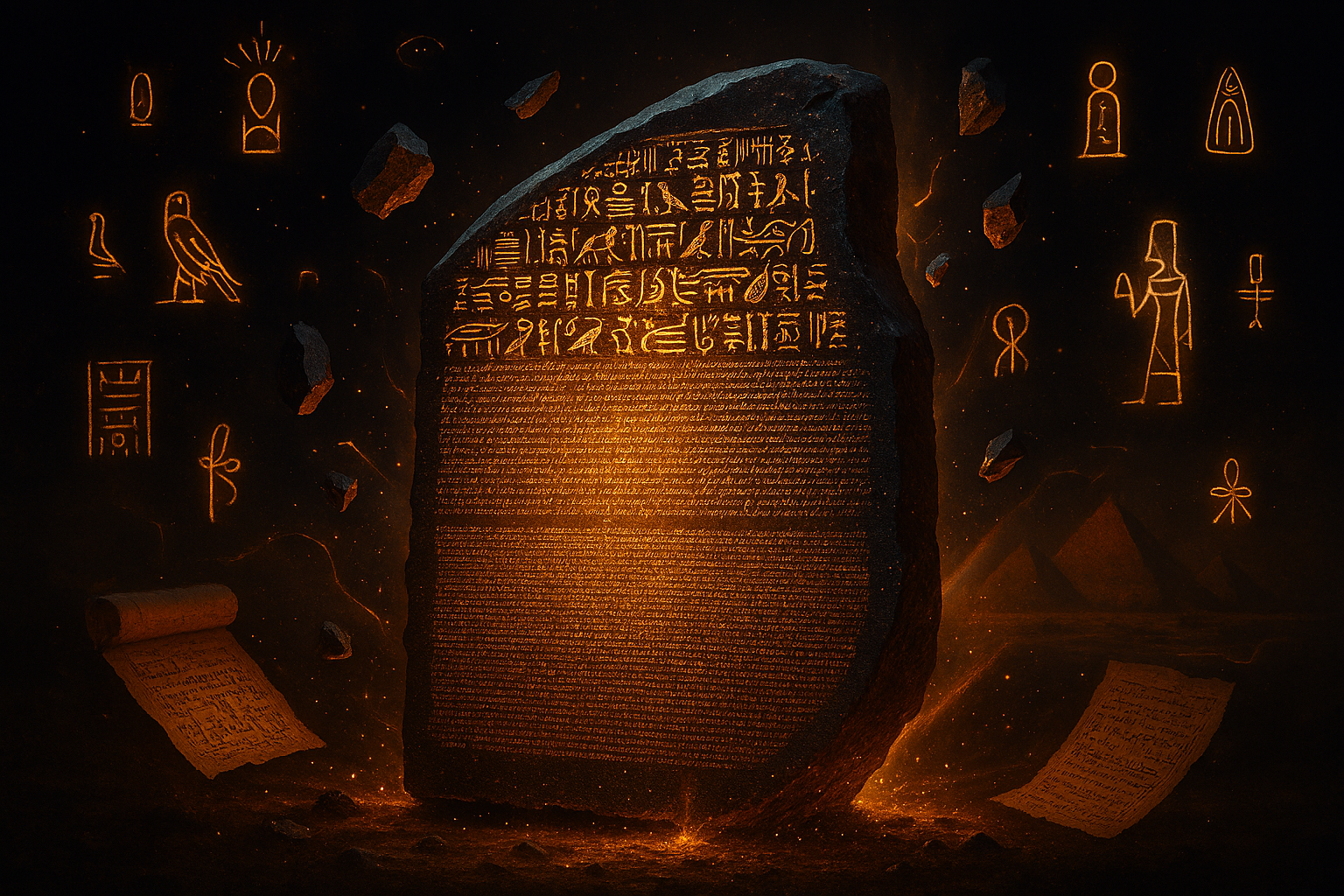
Historical studies are often associated with wars, shifts in political power, and the rise and fall of empires. However, one of the most valuable layers of history emerges in silent documents, archaeological findings, and inscriptions that preserve the cultural and intellectual heritage of societies. The Rosetta Stone is not merely an archaeological artifact; it represents a critical turning point in human history regarding the production and transmission of knowledge. This stone provided the opportunity to decipher the language and writing systems of ancient Egyptian civilization, which had remained silent for thousands of years, thereby reshaping paradigms in modern linguistics and archaeology.
The Rosetta Stone: Discovery and Structural Features 🪨
In 1799, during Napoleon Bonaparte’s Egyptian Campaign, French soldiers discovered a granite stele in the town of Rosetta. The stone measured approximately 114 cm in height, 72 cm in width, and 28 cm in thickness.
The inscription on the stone was written in three different scripts:
Hieroglyphs 🏺
The sacred and ceremonial writing of ancient Egypt.
Used for pharaohs, gods, and religious rituals.
Comprised complex ideograms, pictograms, and phonetic signs.
Functioned to reinforce both religious and political authority.
Demotic 📜
The script used in the daily life and administrative documents of the Egyptian population.
Simpler and more phonetically oriented, widespread among the populace.
Utilized in social records, tax documents, and daily administrative operations.
Served as a bridge between the language of the people and the administrative language of the state.
Ancient Greek 🇬🇷
Still used as the administrative language in Egypt at the time.
Its previously deciphered and relatively accessible nature provided researchers with a reference text.
Thanks to the Greek inscription, Champollion and other linguists were able to systematically decode both hieroglyphs and Demotic.
This tripartite structure functioned as an ancient translation key. The text described the accession of Ptolemy V to the throne and related administrative laws, offering both cultural and historical information.
Hieroglyphs and the Academic Significance of Decipherment 🧩
Ancient Egyptian writing—hieroglyphs—was not merely a system of symbols but a highly sophisticated linguistic structure combining pictorial, phonetic, and ideographic layers. This multi-layered system served both to reinforce religious and political authority and to transmit cultural identity.
Pictorial Symbols (Pictograms) 🖼️
The primary visual elements of hieroglyphs, directly representing objects or concepts.
For example, a bird symbol not only represents a “bird” but can also be associated with certain deities or spiritual concepts.
Used extensively in religious texts and temple inscriptions, enabling symbolic communication between the populace and clergy.
Phonetic Signs 🔤
Certain hieroglyphs represent specific sounds.
Crucial for writing names, locations, and specialized terms.
Pharaohs’ names, for instance, were typically composed using combinations of phonetic signs, demonstrating that hieroglyphs functioned as both a visual and phonetic language tool.
Ideograms ⚖️
Symbols representing concepts or ideas directly.
Used in political and religious texts to convey complex abstract ideas such as “kingdom,” “justice,” or “god.”
Ideograms provide meaning not only for the reader but also for observers in ritualistic and ceremonial contexts.
Political and Cultural Functions 🏛️
Hieroglyphs, beyond their aesthetic function, were employed as political instruments.
Pharaohs regarded hieroglyphs as the language of the gods, consolidating legitimacy and reinforcing religious and political control over the populace.
Meanwhile, Demotic served as a practical tool for daily communication, bridging the administrative and popular spheres.
Champollion and the Revolution in Decipherment 🧠
In 1822, Jean-François Champollion successfully deciphered the phonetic and symbolic structure of hieroglyphs using the Greek text on the Rosetta Stone as a reference.
Champollion’s method was not limited to converting symbols into letters or words; it involved a systematic analysis of ancient Egyptian language structure, grammar, and phonetics.
This decipherment marked a turning point for modern linguistics, epigraphy, paleography, and archaeological methodology.
Champollion opened new research avenues for millennia-old written records and laid a scientific foundation for understanding the political, religious, and social structures of ancient Egypt.
Academic Importance
Deciphering hieroglyphs is essential for accurately interpreting ancient texts; incorrect translations can distort historical and cultural analyses.
Modern history and archaeology have adopted interdisciplinary approaches referencing Champollion’s methodology.
Decipherment has provided deep insights into ancient Egyptian governance, religious rituals, and social order.
Historical and Geopolitical Context 🗺️
The discovery of the Rosetta Stone was not merely an archaeological coincidence; it was closely tied to Napoleon’s Eastern Mediterranean strategy:
Napoleon aimed to conquer Egypt to establish a strategic base against the British and expand France’s influence in the Mediterranean.
French scientists promoted archaeological and linguistic research during the campaign, combining military success with cultural and scientific prestige.
The Rosetta Stone functioned both administratively and propagandistically within this strategic context.
Geographically, the town of Rosetta was located in a critical position in the Nile Delta, providing easy access to both inland regions and Mediterranean ports. This strategic location made the discovery of the stone far from coincidental.
Social and Economic Impacts 👥💰
The decipherment of the Rosetta Stone extended beyond linguistics and archaeology to create significant social and economic effects:
Social Impact: Egyptian cultural heritage and historical awareness were rediscovered, strengthening the population’s connection to their past.
Economic Impact: Ancient Egyptian artifacts and archaeological research generated substantial European interest, creating economic value through museum collections, academic publications, and cultural tourism.
Educational and Academic Impact: University courses in Egyptology, epigraphy, and archaeology expanded, and language decipherment catalyzed the development of modern academic disciplines.
Philosophical and Intellectual Effects 🧠
The Rosetta Stone initiated philosophical discourse on the continuity of knowledge and culture:
Demonstrated that human knowledge is not permanently lost and can be recovered with the correct methodology.
Highlighted the power of language and symbols in preserving cultural heritage and bridging past and future.
Emphasized the central role of scientific methodology, interdisciplinary work, and historical criticism in maintaining cultural identity.
Conclusion: A Small Stone, a Great Scientific and Cultural Revolution 🏺✨
The Rosetta Stone transmitted the silent history of ancient Egypt to the modern world, breaking millennia of silence and reinforcing cultural memory.
Historically: It clarified ancient Egyptian governance, religious structures, daily life, and political organization, expanding the scope of historical science.
Scientifically: It enabled revolutionary progress in linguistics, archaeology, epigraphy, and historical methodology.
Socially and Economically: Cultural heritage, academic research, and tourism contributed to modern economic and social cycles.
The Rosetta Stone allowed a civilization that had remained silent for thousands of years to be understood once again by modern humanity, strengthening both the academic and cultural dimensions of historical scholarship.