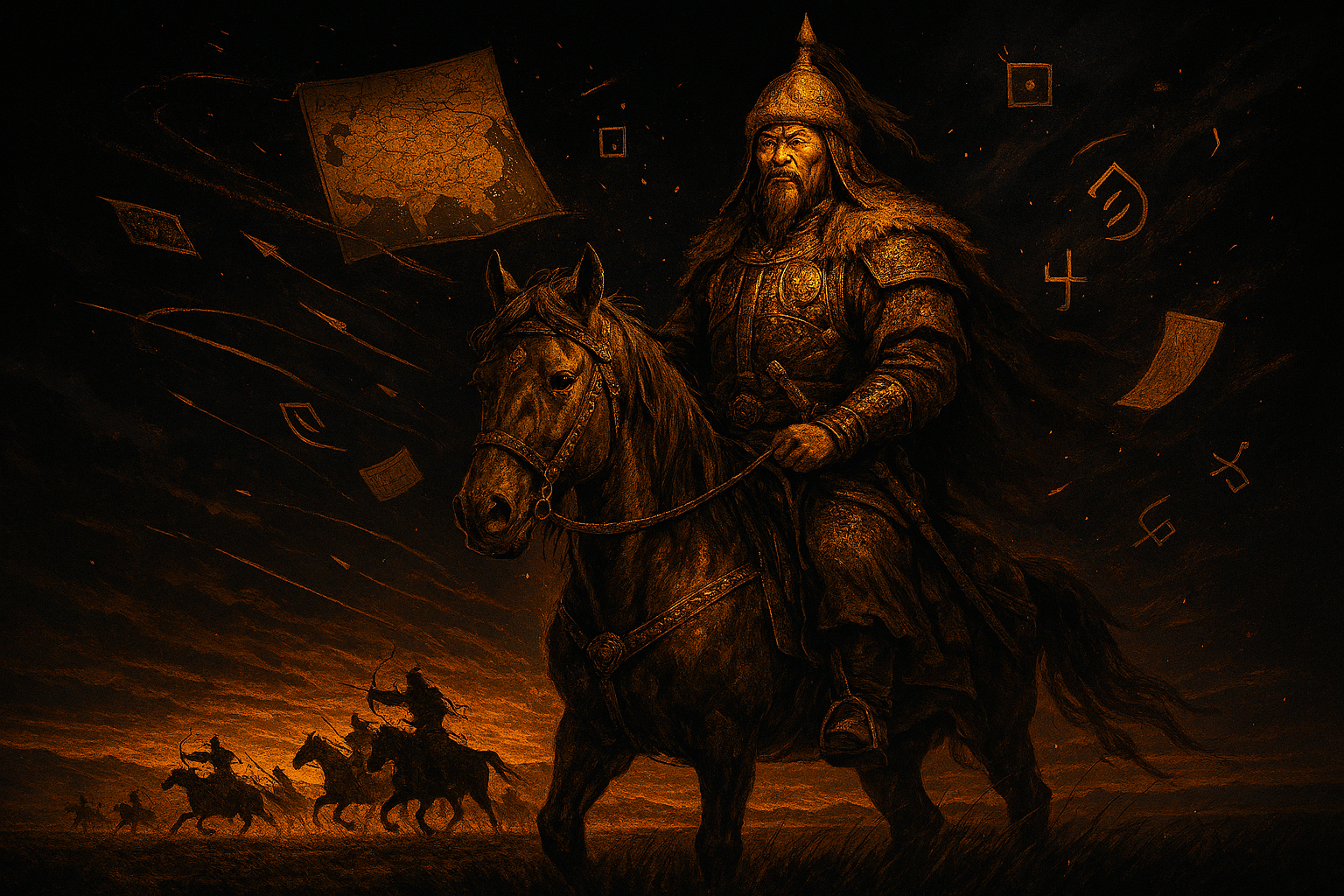
The early 1200s… The steppes were alive with the wind, the hooves of horses echoed in the distance, and one man, Genghis Khan, had an idea: “I’m going to unite the world under one roof.”
This was no ordinary idea; it was the foundation of an empire that would change the course of history. Today, we’ll explore how that empire was built, its effects, and the lasting impact of the Mongol horsemen.
1. Hero of the Steppes: Who Was Genghis Khan? 🐎💡
Genghis Khan, born as Temüjin in 1162 on the Mongolian steppes, lost his father at a young age and had to survive in the midst of tribal conflicts, developing leadership skills early in life.
Key points:
🐎 Childhood hardships: Temüjin’s family faced constant challenges, teaching him strategy and diplomacy from an early age.
🐎 Leadership: As a child, he began uniting small tribes—laying the groundwork for a vast future empire.
🐎 Social intelligence: He could motivate people and unite different tribes under one vision.
Fun fact: A small steppe child essentially created a strategic laboratory that would one day reshape the world. 😎
2. How the Mongol Empire Was Founded 🏰🌾
During his youth, Genghis Khan formed alliances between tribes and either forced or defeated enemies one by one. In 1206, he united the Mongols and was officially given the title Genghis Khan, marking the official foundation of the Mongol Empire.
Details:
🏰 Disciplined army: Mounted archers and light cavalry, famous for fast attacks and tactical retreats.
🏰 Legal code: The “Yassa” laws created a shared legal system for all tribes.
🏰 Intelligence network: Spies and guides provided advance reports on enemy movements.
Tip: The Mongol Empire was built not just with brute force, but with intelligence, discipline, and organization. Strategy was everything.
3. Campaigns and Conquests: Horsemen Shaking the World ⚔️🌍
Genghis Khan launched campaigns to expand the empire:
⚔️ China Campaigns: Achieved tactical dominance over the Jin Dynasty in northern China.
⚔️ Iran and Central Asia: Secured vital trade routes.
⚔️ Eastern Europe: Quickly brought Russian cities and the Kipchak steppes under control.
More details:
⚔️ Each campaign involved not only fighting but also intelligence gathering, psychological warfare, and diplomacy.
⚔️ Villages and cities were selected strategically—some secured, some burned as warnings.
⚔️ The mobility of the Mongol army left enemy forces stunned.
Fun tip: Mounted archers often feigned retreats and then returned to attack, playing a sort of “chase me if you can” game with their enemies. 😄
4. Cultural Impact and Trade: Beyond Destruction 🌏📚
The Mongols’ influence wasn’t limited to battlefields:
⚔️ Silk Road security: Trade routes became safer, and goods and information flowed more freely.
⚔️ Religious tolerance: Muslims, Buddhists, Christians, and shamans alike were respected.
⚔️ Science and art: Scholars and artists from different regions were welcomed under Mongol rule.
Tip: The Mongol Empire was not just about conquest—it also acted as a cultural bridge. And yes, they were famous for their love of horse milk and tea. ☕🐎
5. Benefits and Drawbacks ⚖️
Benefits:
⚖️ Revival of global trade.
⚖️ Cultural and scientific exchange.
⚖️ Advancement of new military strategies and organizational methods.
Drawbacks:
⚖️ Massive destruction and loss of life during conquests.
⚖️ Cities burned and populations decimated.
⚖️ Social disruption in some regions.
Summary: The Mongol Empire was both terrifying and instructive, a laboratory of strategy and cultural impact.
6. Lessons from History: Strategy, Discipline, and Leadership 📚💡
Genghis Khan’s story teaches us:
📚Leadership: Uniting diverse tribes under one banner.
📚 Strategy: Speed, maneuverability, and psychological advantage.
📚 Innovation: Using communication and intelligence networks to outsmart enemies.
📚 Cultural vision: Interaction can be as important as conquest.
Practical takeaway: History isn’t just battle stories—it’s a laboratory of strategy, patience, and creativity.
7. Humorous Note: Horseback Selfies and Jet Speed 😄
Imagine if there were social media in the 1200s:
😄 Genghis Khan tweeting: “Redrawing the world map 🏹 #MongolPower #FastAndFuriousOnHorse”
😄 Enemies texting: “Mounted archers are everywhere! 😬 #WhereAreThey”
History can be serious and humorous at the same time!
8. Conclusion: The Steppes That Reshaped the World 🌏✨
Genghis Khan and the Mongol Empire didn’t just build a massive power—they shaped world history, trade, culture, and military strategy. Today, when looking at a map, you can imagine the wind-swept horsemen racing across the steppes.
Tip: If you ever visit the steppes, the horsemen are gone, but history is there, whispering in the wind. 😄