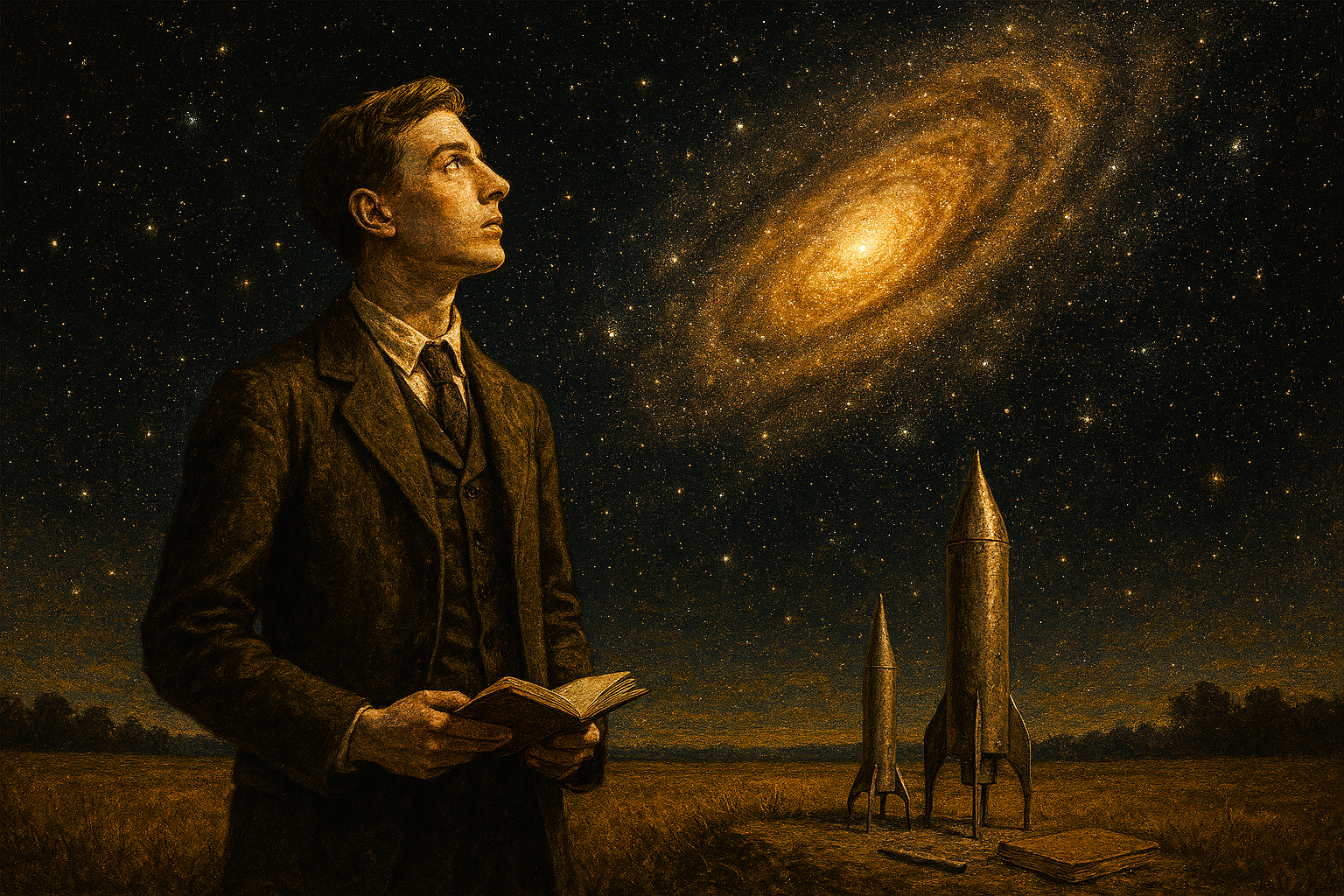
Imagine this: the early 1900s…
The sky was still a mystery 🌌. People were still looking at the stars thinking, “Could we actually get there?” Airplanes were just starting to take off ✈️, but space? That was still pure fantasy!
At that time, there was a man with a simple but revolutionary idea: “Why can’t humans go to the sky?”
Enter the inventor:
Robert H. Goddard 👨🔧, the father of rocket science, a determined genius chasing his dreams.
And his invention?
The liquid-fueled modern rocket 🚀, the revolutionary first step in carrying humans to the Moon and beyond.
🌌 Historical Background: The Early 1900s and Sky Dreams
Back then, the scientific community was very skeptical about rockets. People laughed when they heard Goddard’s ideas:
“Rockets can fly? Are you crazy?” 😂
In the early 1900s:
Aviation was still in its infancy ✈️
Space existed only in science fiction books 📚
World conflicts were approaching, and technological developments were limited ⚙️
But Goddard didn’t give up. He combined imagination with science and embarked on an adventure that would change the course of history 🌟.
🔬 Robert Goddard: Inventor, Revolutionary, or Dreamer?
Born in 1882 in Massachusetts 🎂. From a young age, he was fascinated by the sky, stars, and the possibility of rockets 🌠.
At 17, he conducted his first simple rocket experiments ⚡. Yes, a teenage inventor!
Patient and determined: he failed hundreds of experiments, rockets exploded, caught fire 🔥, but he never gave up.
At that time, many scientists dismissed his ideas, but in the 1920s, his theories laid the foundation for NASA and space programs 🚀.
Goddard’s achievement was not just building rockets—it was merging imagination with engineering 💡.
⚙️ What is a Rocket and How Did Goddard’s Invention Work?
Goddard’s rockets laid the foundation of modern space technology. The basic principle: thrust = fuel combustion + guidance.
Components:
Fuel 🚀: Liquid rocket fuel (hydrogen + oxygen)
Engines 🔥: Burn fuel to create enormous thrust
Control Mechanism 🎛️: Guides the rocket for stable flight
Body and Aerodynamic Design 🏗️: Reduces air resistance
When he launched the first liquid-fueled rocket in 1926, it stayed in the air for only 12 seconds 🕛 and reached 2.5 meters high 🏗️. Short, but revolutionary!
Practical tips and fun details:
Rockets needed flat, open fields to launch 🏞️
Fuel mixture ratio and pressure were critical for successful flight ⚖️
Early rockets had cameras 🎥 to document flights—a kind of 1920s “YouTube video”! 😄
Many rockets exploded during experiments 💥, but Goddard used each failure as a lesson for the next design.
🌍 Benefits and Impacts of Rocket Science on Humanity
Goddard’s invention was more than just a rocket; it was a key 🔑 that opened the door to the Space Age.
✅ First modern rockets 🚀: Completely changed flight science
✅ NASA and Apollo Program 🌕: Goddard’s theories formed the basis for Moon missions
✅ Military and civilian space technology ⚙️: Satellites, Mars missions, communication tech
✅ Science and education 📚: Rocket science opened new horizons for engineering and physics education
Without Goddard, Moon landings and Mars missions could have been delayed by decades.
🤓 Interesting and Fun Facts
In 1920, a newspaper mocked Goddard’s ideas, saying, “This guy is crazy!” 😅
His rockets’ first flight lasted only 12 seconds but made a huge impact on the scientific world 🌟
Goddard paid attention to small but important design details: nose cone shape, stabilizers, fuel tank insulation ⚙️
He used his laboratory like a “space workshop” 🔬
🎯 Conclusion: The Sky is Not the Limit
Robert Goddard proved:
Dreaming big and daring to experiment can make the impossible possible 🌌✨.
A 12-second flight was the first step in a journey that would take humanity to the Moon and beyond 🚀🌕.
Lesson:
“You don’t need superpowers 🦸♂️ to invent. Just notice a problem, dream, and never stop experimenting.” 🌟