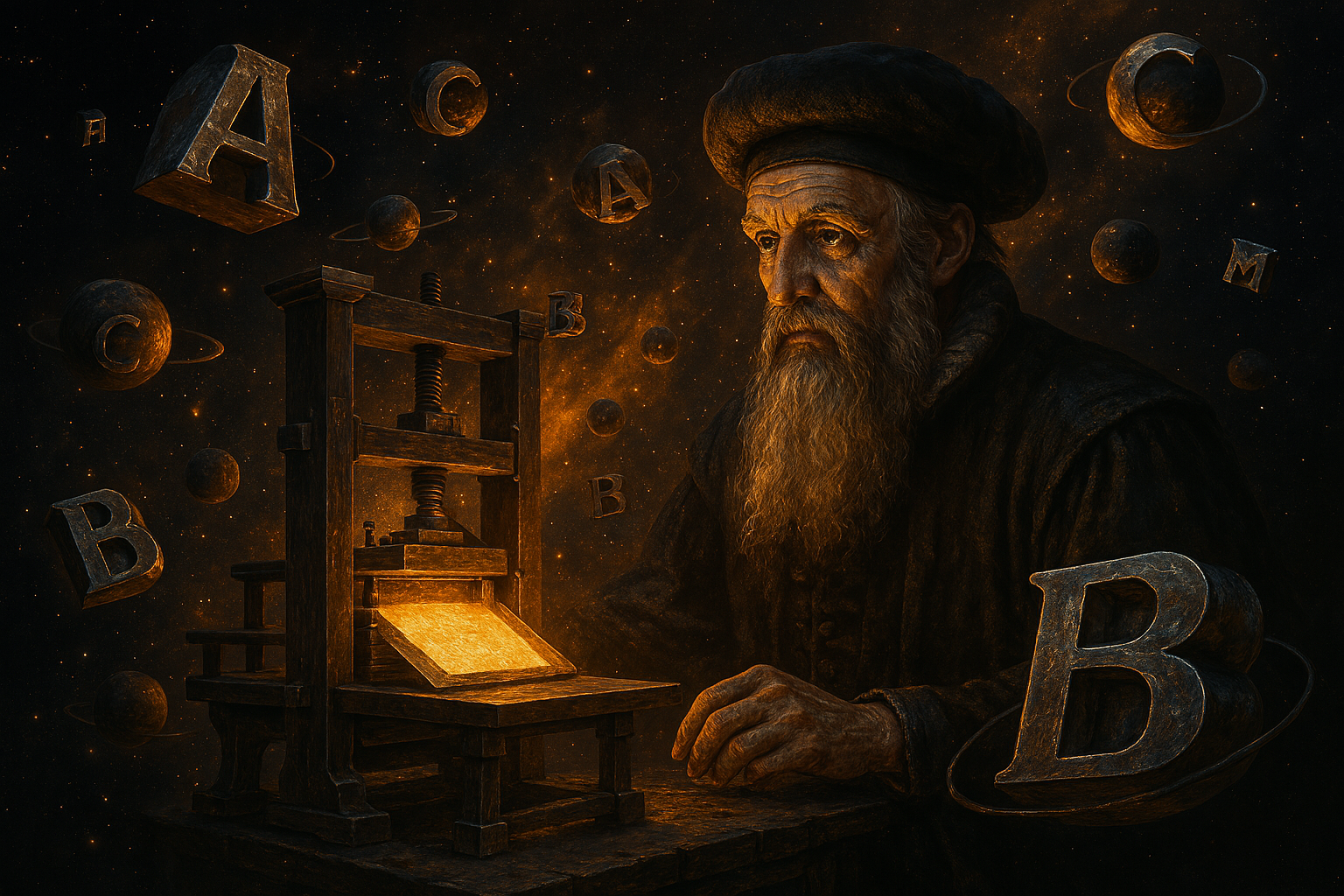
Imagine a machine…
It doesn’t smell like gunpowder 💣
It doesn’t clang like swords ⚔️
Yet it raises the pulse of kings 👑💥
Makes churches frown ⛪😠
And opens the eyes of ordinary people 👀✨
Under the spotlight:
🎩 Johannes Gutenberg
This isn’t just the story of an invention.
It’s the story of a mindset revolution 🧠
A technology startup before startups existed 🚀
A financial risk 💰
And a cultural explosion 💥📚
If you’re ready… let’s pull the press down. 🔧⬇️
📜 The World Before the Printing Press: Knowledge in the VIP Lounge 🎟️📖
In the 15th century, owning a book…
Was like owning a luxury sports car today 🚗💨
📖 A single book took months to copy by hand.
✍️ Scribes were highly trained specialists.
🕯️ They worked patiently by candlelight.
💰 Sometimes a book cost as much as a house.
Knowledge?
👑 In the hands of aristocrats
⛪ Controlled by clergy
🏰 Guarded by royal courts
Literacy rates in Europe were below 10% 📉
Imagine this:
You come up with a brilliant idea 💡
But you can’t reproduce it.
No Twitter ❌
No blogs ❌
No PDFs ❌
Knowledge = Power 💪
But power = Exclusive 👥
👤 Johannes Gutenberg: From Metalworker to Architect of Knowledge 🔨✨
Born in Mainz, Johannes Gutenberg was skilled in:
🔩 Metalworking
💍 Goldsmithing
🔥 Casting techniques
What made him different?
🔍 He approached problems with a craftsman’s logic
📦 He applied mass production thinking to writing
💸 He took huge financial risks (and struggled for it)
He realized something radical:
“Writing may be sacred… but the production process is painfully inefficient.”
For the Middle Ages, this idea was explosive 💥
Gutenberg was essentially one of history’s first media-tech entrepreneurs 🎬📚
⚙️ The Technical Revolution: A Mechanical Symphony 🎼🔧
Gutenberg’s success wasn’t just one invention.
It was a powerful combination of three breakthroughs.
1️⃣ Movable Metal Type 🔠
Each letter was cast individually using an alloy of:
Lead + tin + antimony
Why this mix?
✔️ Durable 💪
✔️ Reusable ♻️
✔️ Sharp, clean impressions 🖤
Fun fact 🧠:
A single page contained around 2,500–3,000 characters.
Every single one arranged by hand.
Think of it as a keyboard ⌨️
But physical.
And if you made a mistake… no backspace 😅
2️⃣ Oil-Based Ink 🖋️
Water-based ink wouldn’t stick to metal ❌
Gutenberg developed a thick, oil-based ink using linseed oil.
The result?
🖤 Darker text
📄 Longer-lasting prints
📚 A more professional appearance
Modern print quality?
It traces its roots back to this innovation.
3️⃣ The Screw Press Mechanism 🍇
Inspired by wine presses 🍷
The system worked like this:
📄 Place the paper
🔡 Position the inked type
🔧 Pull the press
⬆️ Lift it
🔁 Repeat
It could print about 250 pages per hour ⏱️
Hand copying?
Maybe 3–4 pages per day… if you were lucky 😬
Efficiency gap = Revolution 💥
📖 The Gutenberg Bible: History’s First Major Product Launch 🚀
Around 1455, Gutenberg printed the famous 42-line Bible.
It wasn’t just a book.
It was a technological statement ✨
Features:
📚 1,282 pages
🔠 Gothic typeface
🎨 Hand-decorated initials
Mass production…
Without sacrificing beauty.
This was a bold announcement:
“I have arrived.”
😱 Why Did Knowledge Suddenly Become Dangerous?
Because control began to slip 🎯
Before the press:
📚 The Church interpreted
👑 Kings dictated
After the press:
🧑🌾 People read
🧠 People thought
❓ People questioned
For example:
In 1517, Martin Luther published his 95 Theses.
Without the printing press, they might have remained local.
Instead, they spread across Germany within weeks 🌍
The result?
The Protestant Reformation 💥
One machine…
Shook religious and political foundations.
🔬 The Acceleration of Science 🚀🔭
The printing press supercharged science.
Galileo Galilei
Isaac Newton
Their works were reproduced 📚
Errors were corrected ✏️
Ideas were debated 🧠
Knowledge became cumulative.
It wasn’t about memorizing anymore.
It was about progressing 📈
🧠 Psychological & Sociological Impact 🌍
The printing press changed:
✔️ Individual thinking 🧠
✔️ Critical analysis 🔍
✔️ Standardized national languages 🌐
✔️ The birth of public opinion 🗣️
People no longer just listened.
They read.
They reflected.
They responded.
The ancestor of social media?
Yes… the printing press 📱➡️📖
💰 Economic Reality: Does the Inventor Always Win?
Gutenberg didn’t become enormously wealthy 😔
He was sued by his investor Johann Fust ⚖️
The invention changed the world.
But its creator struggled financially.
Entrepreneurship lesson:
💡 A great idea isn’t enough
📊 Financial management matters
🤝 Partnerships are crucial
🛠️ Everyday Impact 📚
Because of the printing press:
📚 Textbooks multiplied
🗞️ Newspapers were born
📖 The novel flourished
📜 Legal texts became standardized
Today’s:
🏫 School systems
🎓 Academic publishing
🏛️ Libraries
All descendants of Gutenberg’s machine.
🌍 Chain Reaction: Revolutions Began with Words ✊📖
The Enlightenment 💡
The French Revolution 🇫🇷
The American Declaration of Independence 🇺🇸
Ideas were printed.
Read.
Debated.
Weapons came later.
Words came first.
🚀 The Digital Grandchild of the Printing Press 💻📲
Today:
📱 Social media
🖥️ Blogs
📲 E-books
All follow the same principle:
Multiply knowledge.
Spread it.
Accelerate it.
The printing press…
Was the analog internet 🌐
🎯 Conclusion: One Press, One Revolution
The printing press taught us:
📚 When knowledge multiplies, power is shared.
⚖️ When power is shared, systems change.
And sometimes…
To change the world,
You don’t need an army.
You need a well-designed mechanism 🔧✨
Now tell me—
If you were living in 1450…
What would be the first book you’d print? 😏📚