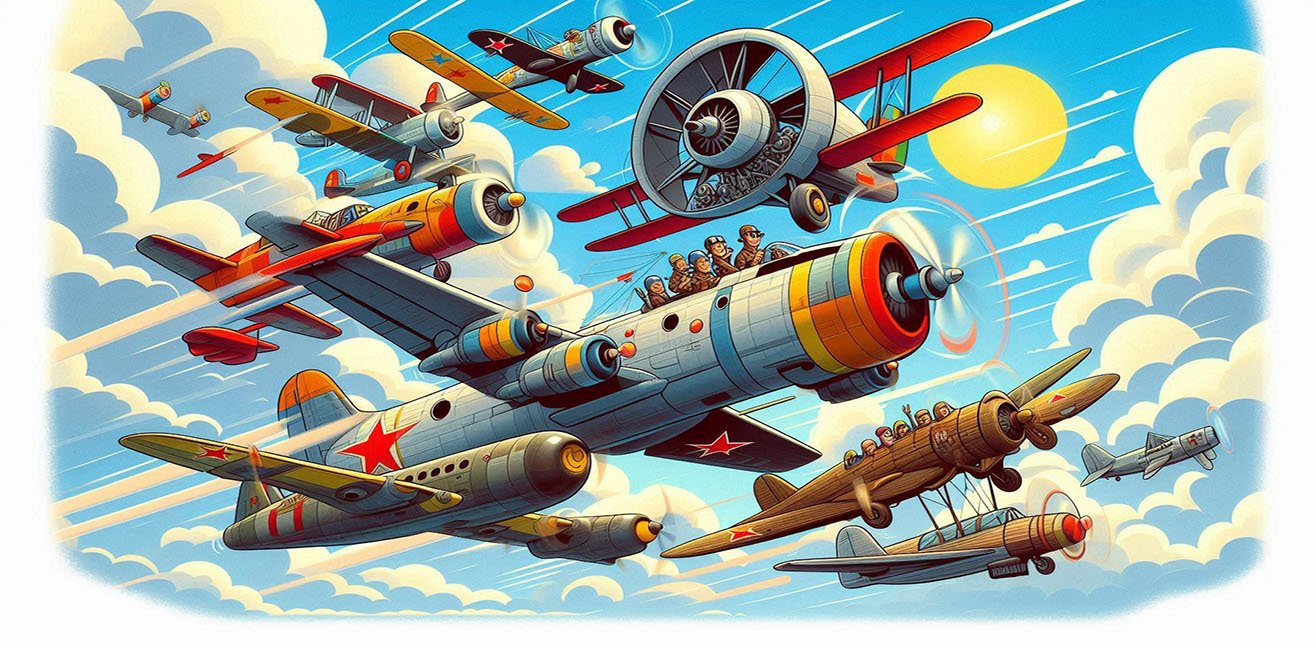
The sky… a canvas where human imagination knows no bounds. But sometimes, engineers don’t stop at speed, power, and aerodynamics—they also add creativity and a touch of madness. Here are some of the most unusual airplanes in history, who designed them, their purpose, technical specifications, and first flight experiences!
1. Blohm & Voss BV 141 – Germany’s Asymmetrical Marvel 🛩️🔄
- Designer: Richard Vogt, German Blohm & Voss company
- Time & Place: During World War II, 1940s, Germany
- Purpose: Designed as a reconnaissance aircraft. Aimed to provide a wider field of view and better weapon placement.
- Technical Specifications:
- Asymmetrical design with one fuselage on the left and wing on the right
- Pilot cabin shifted to the left, engine and wing on the right
- Maximum speed: 460 km/h, range: 1,000 km
- First Flight: Initial tests in 1938
- Fun Note: Pilots often asked, “Is this a plane or a modern art piece?” 😅 Some sketches are even displayed in art galleries today!
2. Mikoyan-Gurevich MiG-105 “Spiral” – Soviet Space Dream 🌌🚀
- Designer: Mikoyan-Gurevich design team, USSR
- Time & Place: 1960s, Soviet Union
- Purpose: Designed for low-speed and high-atmosphere testing; experimental platform for future spaceplanes.
- Technical Specifications:
- Disc-shaped fuselage, no conventional wings, aerodynamic curves instead
- Single pilot, limited maneuverability, optimized for high-altitude gliding
- First Flight: Only ground tests and short glides; no full flight
- Fun Note: Designers sometimes joked, “We need a pilot brave enough to fly this!” 😎 Pilots had to constantly ask themselves, “Can I really control this?”
3. Convair XFY-1 Pogo – Vertical Takeoff Jet Aircraft 🦘💨
- Designer: Convair Aircraft Corporation, USA
- Time & Place: 1950s, USA
- Purpose: Developed as a fighter aircraft capable of vertical takeoff and landing from aircraft carriers.
- Technical Specifications:
- Vertical takeoff and landing capability
- Rotating wings like a helicopter
- Tested up to 965 km/h
- Challenging for pilots due to balance and maneuvering
- First Flight: 1954; test pilots experienced a massive “flying kangaroo” adventure 😅
- Fun Note: Landing carried a risk of flipping over; it was almost like a circus act in the sky!
4. Hughes H-4 Hercules “Spruce Goose” – Wooden Giant 🌲🛩️
- Designer: Howard Hughes, USA
- Time & Place: 1947, USA
- Purpose: Massive transport aircraft during World War II, designed to carry troops and materials.
- Technical Specifications:
- Entirely made of wood (due to strategic material shortages)
- Wingspan: 97.5 meters
- Engines: 8 piston engines
- Maximum speed: 370 km/h, payload: 30 tons
- First Flight: November 2, 1947, only flew once but glided like a masterpiece
- Fun Note: Hughes reportedly said, “One flight is enough,” and he was right; this wooden giant went down in history!
5. Northrop Flying Wing – Wingless Wing 🕊️
- Designer: Jack Northrop, USA
- Time & Place: 1940s, USA
- Purpose: To reduce radar visibility and improve aerodynamics; the foundation of modern stealth technology.
- Technical Specifications:
- Fuselage and wings almost one piece
- Engines hidden inside the fuselage
- Maximum speed: 870 km/h
- First Flight: 1942, successful test flights
- Fun Note: Pilots had a hard time getting used to the wingless concept; it looked like a “flying ghost” in the sky 😎
Fun Practical Facts & Mini Notes 🥳
- Most of these airplanes were experimental projects, meaning pilots were part test pilot, part artist.
- Every flight was an adventure; some ended in success, others in disaster.
- Open cockpits or unusual designs challenged pilots physically and mentally.
- These aircraft were designed not just to move, but to push the limits of human creativity.
Conclusion: Planes and Art ✨
Dear reader, the next time you look up at the sky, remember: some airplanes weren’t just built for travel—they were designed to dream, challenge limits, and blend engineering with art.
The sky is a canvas, and pilots are the artists holding the brush. Sometimes the craziest ideas become works of art in the air. 🌤️🎨🛩️