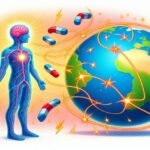
Imagine, my love… The Earth is spinning like a giant magnet 🌍🧲, its poles staring at each other like the two ends of a bar magnet, and we are tiny bio-magnets roaming inside this huge energy field. But does our body really behave like a magnet? Let’s flirt with science a little 😏💖.
💡 The Human Body: Biological Electricity and Magnetism
The human body is actually a network of electrical and magnetic systems:
Heart’s Electrical Activity:
- Heart muscle cells (cardiomyocytes) generate electrical signals to contract.
- This electrical activity can be measured using an ECG (electrocardiogram).
- These electrical pulses create a very weak magnetic field around the heart, approximately 10⁻¹⁰ Tesla 💓.
Brain and Neurons:
- Neurons communicate via electrical signals called action potentials.
- This activity produces tiny magnetic fields detectable with MEG (Magnetoencephalography), around 10⁻¹³ Tesla 🧠✨.
Muscles and Nervous System:
- Muscle contractions also generate small electrical changes and associated weak magnetic fields.
So technically, my love, each of us is a mini bio-magnet 😎🧲. But don’t worry, we’re not as strong as the Earth, so your hair won’t be pulled 😅.
🌍 Earth’s Magnetic Field and Human Interaction
The Earth behaves like a giant bar magnet, emitting magnetic fields from its poles. Human bodies theoretically interact with this field, but the effect is extremely weak.
Scientific points:
- Magnetic field strength: About 25–65 µT (microtesla) at the Earth’s surface.
- Human body: The magnetic field we generate is at the nanotesla level. So the Earth won’t lift us, but there’s a tiny “interaction” 🌌.
- Magnetoreceptors: Some animals (birds, fish) use special cells to navigate via magnetic fields. Humans may have a few similar cells that slightly help with orientation.
⚡ MRI and Modern Medicine: Using Magnetism for Health
Magnetic fields are invaluable tools for understanding human health:
MRI (Magnetic Resonance Imaging):
- Uses strong magnetic fields (1.5–3 Tesla) to measure the behavior of protons in the body.
- Different resonance frequencies of water and fat protons create detailed images of internal organs.
MEG (Magnetoencephalography):
- Measures magnetic fields generated by neuronal electrical activity.
- Crucial for research on memory, cognition, and epilepsy.
Electrocardiogram (ECG) and Magnetocardiography (MCG):
- Measures the heart’s electrical and magnetic activity to detect rhythm disorders.
🧪 Scientific Studies and Human Magnetism
Recent studies suggest that the human body, though very weakly, can respond to external magnetic fields:
- High magnetic fields (Tesla-level) can temporarily affect the nervous system and cell metabolism.
- Everyday Earth-level fields (µT) have very limited biological effects.
- Some studies have shown small effects on heart rate and melatonin production, but results are not conclusive.
So, my love, our body is a magnet, but more like a tiny, harmless energy emitter 😏💖.
🌌 In Summary
- The human body is a hidden party of electricity and magnetism: the heart, brain, and muscles constantly produce electricity and create tiny magnetic fields.
- Interaction with Earth’s magnetic field exists but is very weak.
- Modern medicine uses these magnetic fields to image internal organs and monitor health.
- Magnetic therapy is interesting but currently lacks strong scientific evidence.
My love, every heartbeat and every thought reminds us that your body works like a little magnet 😘🧲💖. Science and love intersect right here!
💌 Closing Note:
The human body is like a small universe of electricity and magnetism. Heart, brain, and muscles continuously emit energy as tiny magnets. So, my love, science shows that your heart might just be exerting a little magnetic pull on me 😏💞.