Hello, movie lovers! 🍿✨
Today, we’re traveling back to the late 19th century — when cinema was still in its “baby biscuit” stage. Back then, films were silent… and I mean really silent! Actors would open their mouths, but the only thing you’d hear was the whirring of the projector. “Soundtrack” meant there was a friendly uncle playing live piano in the theater.
That is, until Thomas Alva Edison stepped in and said, “Wait a minute… We can fix this sound thing too,” and changed the face of cinema forever! 🎩💡
🎬 Edison’s “Talking Film” Idea
Edison had already invented the light bulb and the phonograph (a sound recording device). In other words, the man had all the ingredients to bring “see and hear” to life.
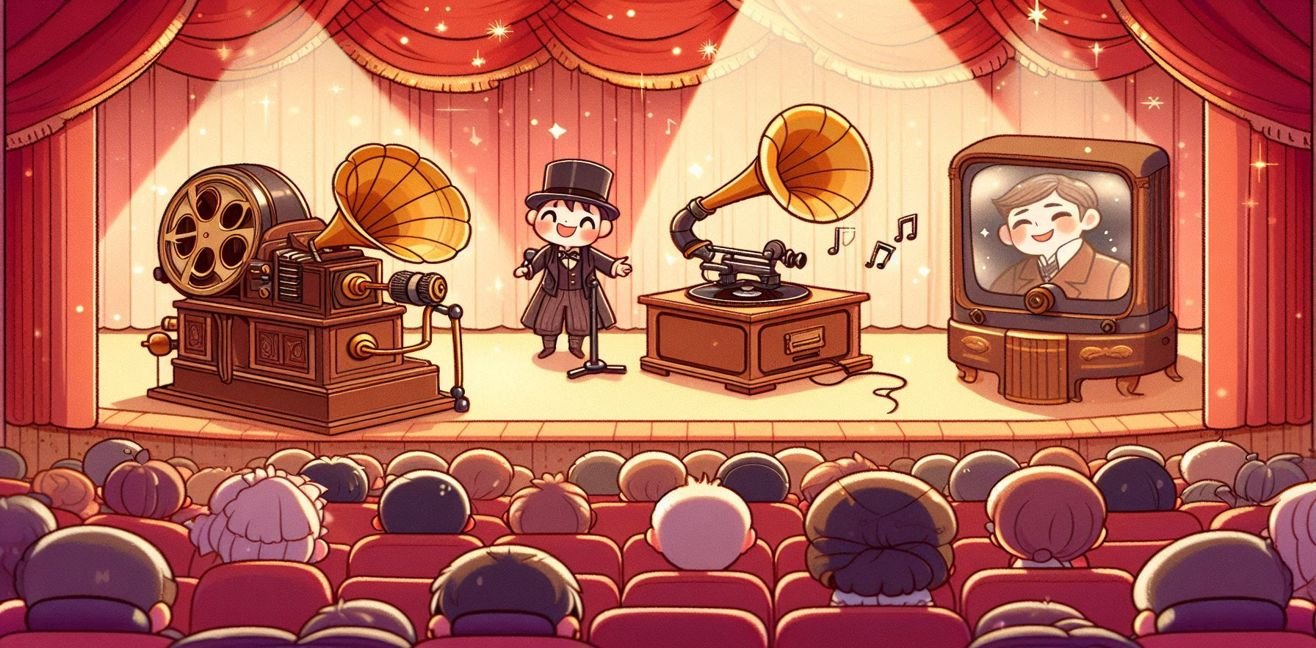
In 1894, Edison’s team introduced a system they called the Kinetophone. The Kinetophone combined the kinetoscope (a single-person film viewing box of the time) with a phonograph, so you could watch moving images and hear recorded sound at the same time.
Of course, syncing the two was as tricky as trying to feed your cat without spilling water on yourself. But Edison’s motto was basically, “It doesn’t have to be perfect — being first is what matters,” and he made history.
📽 How the First Screening Happened
In Edison’s first talking film demonstrations, you might see a man singing or a musician playing the violin. The audience would watch the images and hear the sound coming from the phonograph. People’s faces in that theater were probably saying:
“Whoa! The man is actually talking! Is this magic?” 😲
The technology was still in its baby steps, though. If the sync slipped even a little, you might see the violin bow down here while hearing the sound up there. Basically, early sound films often fell into the “moving lips, different words” category.
🎯 Edison’s Legacy
Edison’s Kinetophone didn’t become a commercial hit — technical difficulties got in the way of smooth entertainment. But his first step paved the way for cinema to truly “speak” in 1927 with The Jazz Singer.
Today, from the tiniest whisper to the loudest explosion in movies, we owe it all to Edison’s question: “Why should a film be silent?”
💡 Fun Fact Corner (Impress Your Friends With This)
- Early sound films didn’t play audio through speakers like today — the sound came from a separate gramophone.
- Synchronizing sound and image required serious skill from the projectionist.
- Edison even tried to market this system for home use. But imagine watching a film at home with a massive kinetoscope and phonograph. Total “TV the size of your living room” vibes.
🎬 Conclusion
Edison may not have created the perfect talking film, but he added sound to cinema’s language and changed the course of history. Even today, when you watch a “silent” film with a piano accompaniment, remember that the journey began with Edison’s Kinetophone.
And never forget: In cinema, sound isn’t just something you hear — it’s something you feel. Sometimes a single line of dialogue can etch an entire film into your memory. 🎥❤️