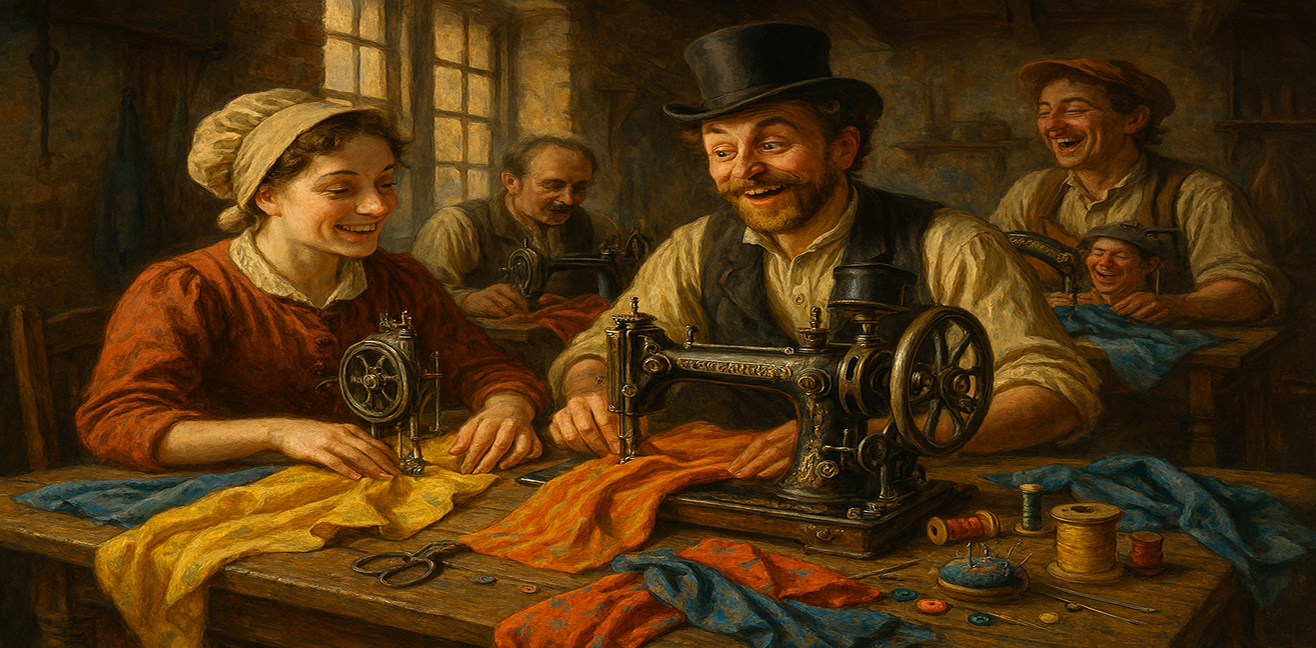
Once upon a time, producing clothing was a serious test of patience. Joining fabrics together could take hours, sometimes days; needles pricked fingers, eyes tired, and patience wore thin. But one day, two inventors arrived and turned this test of endurance into seconds: Elias Howe and Isaac Singer.
The sewing machine was more than just a tool—it was a silent hero of the Industrial Revolution and modern fashion. Today, we can press a button and finish stitching in seconds, thanks to their intelligence and determination.
🕰️ From Prehistory to the Industrial Revolution: Why Humanity Needed the Sewing Machine
In the 18th and 19th centuries, hand stitching was slow and laborious. Special occasion garments took weeks; everyday clothes, days.
Challenges of the era:
- Textile production was growing rapidly, but human labor couldn’t keep up.
- Clothing was mostly accessible to the wealthy; ordinary people had limited choices.
- Factories needed solutions for mass production and division of labor.
It was in this environment that a revolutionary idea emerged: “What if a machine could speed up human labor?”
And thus, the sewing machine was born.
👨🔬 Elias Howe: The Inventor Who Revolutionized with a Simple Needle
Elias Howe patented his invention in 1846. Howe’s key innovation was simple but brilliant:
- The hole at the tip of the needle allowed the thread to pass through from the bottom.
- A mechanical system moved the thread and fabric simultaneously.
Fun fact: Howe’s first machine faced criticism. People said, “Hand sewing is more romantic!” But Howe persevered and secured the patent.
Practical tip: Even today, a sewing machine won’t work properly without the right combination of needle and thread. Howe solved this 19th-century challenge.
🧵 Isaac Singer: Adding Practicality and Marketing Genius
Isaac Singer took Howe’s design and made it more practical, usable both at home and in factories.
Singer’s contributions:
- Made the machine more portable and stable
- Added a foot pedal so hands could work freely
- Marketed the machine to make it accessible to the general public
Thanks to this combination, the sewing machine became more than an invention—it became a revolution.
⚙️ How the Sewing Machine Works (The Mechanics Behind the Magic)
The principle is simple but highly effective:
- The needle pierces the fabric and carries the thread through
- The bottom bobbin thread joins the top thread
- The mechanical system moves the fabric forward
- Consistent speed and uniform stitching are maintained
Tip: Modern machines still operate on this same principle. Even with electronic sensors and computer controls, the system is based on Howe and Singer’s design.
👗 Revolution in Fashion and Society
The sewing machine not only increased speed, it also triggered social and economic change:
- Mass production: Textile factories expanded rapidly
- Democratization of fashion: Ordinary people could access a variety of clothing
- Female workforce: Women participated both at home and in factories
- Creativity: People could design and make their own clothes
Fun fact: The first machines became so popular that some households treated them almost like family members!
🧠 Interesting Facts and Practical Tips
- Elias Howe discovered the importance of placing the needle’s hole at the bottom; this small detail made the machine work.
- Singer solved patent issues and applied clever business strategies to spread the machine.
- Even modern machines require proper alignment of bobbin, needle, and thread; the wrong combination can ruin stitches.
- The foot pedal system allows hands-free operation for home use.
- When using the machine, keeping fabric steady and thread tension correct is the secret to perfect stitches.
🌍 The Sewing Machine’s Impact on Life
The sewing machine did more than speed up garment production:
- Economy: Enabled the growth of the textile industry
- Society: Increased participation of women and workers in production
- Industrial Revolution: Supported mass production and division of labor
- Creativity: Encouraged people to make their own designs
From a tiny idea with a needle, the sewing machine grew into a global industrial revolution.
✨ Conclusion: A Revolution Begun with a Needle
Elias Howe and Isaac Singer changed the world with a simple idea: a needle, a thread, and mechanical ingenuity…
The sewing machine quietly but effectively revolutionized fashion and industry.
Next time you put on a piece of clothing, remember: those stitches that reach you in minutes were once the result of hours of work in the 19th century. And a single needle started this adventure that continues to shape our lives today. 🧵✨