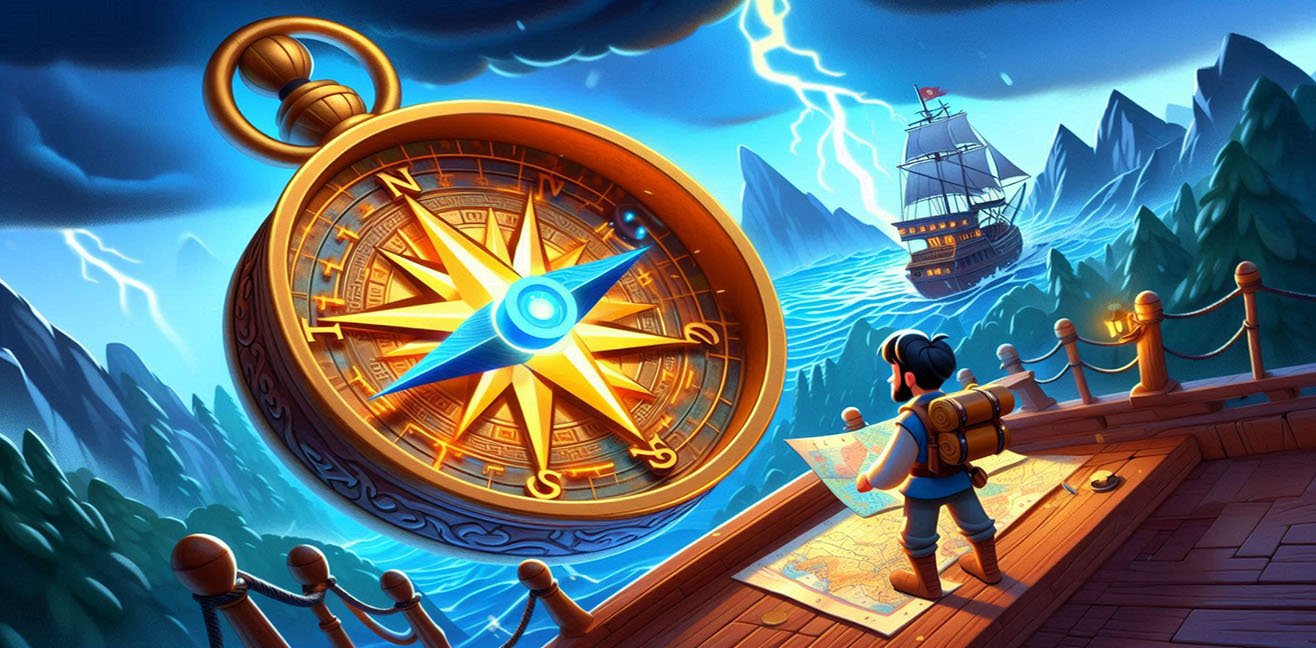
Think for a moment…
No GPS.
No Google Maps.
No road signs.
In front of you, only a vast, endless sea.
And in your pocket, a tiny needle.
That was exactly the thing that changed human history.
🌏 1. It All Began in China: The Discovery of Magnetism
The origins of the compass date back about 2,000 years to China. The first compasses were not used for navigation, but for divination and feng shui practices.
The Chinese discovered a natural magnetic stone called “lodestone” (magnetite). When freely suspended, this stone always pointed in the same direction.
What’s the scientific secret?
The Earth is a giant magnet.
The movement of liquid metals in our planet’s core generates a magnetic field.
Lodestone aligns itself with that field.
The earliest compass design was spoon-shaped and rotated on a bronze plate. The handle of the spoon always pointed south.
🎯 Practical Information:
- Magnetite can be found in nature.
- You can create a temporary compass by rubbing a simple needle against a magnet.
- If you place a magnetized needle on a leaf floating in water, it will show direction.
Science = the art of survival.
🚢 2. A Revolution for Sailors: The Journey to Europe
In the 12th century, the compass reached Europe through the Middle East. That’s when the real revolution began.
Because for sailors, direction = life.
When the sky is cloudy, the stars disappear.
In a storm, the coastline vanishes.
But the compass… always speaks.
This invention helped launch the Age of Exploration.
For example, Christopher Columbus relied on the compass while crossing the Atlantic.
🌊 Fun Fact:
During his voyage, Columbus noticed a difference between “true north” and “magnetic north.”
A compass does not point to geographic north, but to magnetic north.
This difference is called: Magnetic Declination
🎯 Practical Tip:
- When using a compass with a map, you must know the magnetic declination.
- In Turkey, magnetic declination is approximately a few degrees east (and it changes over time).
- When navigating with a map, adjust the compass bezel according to the declination.
Otherwise, you might miss your target by 5 km instead of just 1 km.
🧲 3. How Does a Compass Work? (Simple but Genius)
At the heart of a compass is a magnetized needle.
This needle:
- Rotates freely.
- Aligns with Earth’s magnetic field.
- One end points north, the other south.
Modern compasses are filled with liquid. Why?
Because:
- The needle becomes more stable.
- Vibrations decrease.
- The reading becomes clearer.
🎯 Golden Rules When Using a Compass:
- Stay away from metal.
Phones, watches, and belt buckles can disturb the reading. - Hold it on a flat surface.
- Align the map with the compass.
- Don’t rush — a compass requires patience.
🧭 4. Types of Compasses (And Which One Is for You?)
1️⃣ Magnetic Compass
The classic type. Used by campers and soldiers.
2️⃣ Liquid-Filled Compass
The most common modern version. Fast and stable.
3️⃣ Geological Compass
Used in land measurement and terrain analysis.
4️⃣ Digital Compass
Found in smartphones.
But beware: they rely on magnetic sensors.
For example, devices from Apple include magnetometer sensors. However, metal surfaces can interfere with measurements.
🎯 Survival Tip:
Phone batteries die.
A classic compass never does.
Real explorers carry analog.
🗺️ 5. Compass + Map = Superpower
A compass alone is not a miracle.
Combined with a map, it becomes a navigation system.
Simple Technique:
- Place the map on the ground.
- Position the compass parallel to the north lines on the map.
- Rotate the map until the compass north aligns with the map’s north.
- Set the angle toward your destination.
This is called “taking a bearing.”
Soldiers, mountaineers, and scouts learn this skill.
🏔️ 6. What If the Compass Had Never Existed?
Exploration would have been delayed.
Trade would have slowed.
World maps would have remained incomplete.
Perhaps the continent of America would have been discovered much later.
The compass may seem like a small invention.
But it changed the speed of civilization.
🧠 7. Extraordinary Facts
- Airplanes still carry magnetic compasses.
- Submarines use specialized magnetic navigation systems.
- The North Pole is not fixed; magnetic north moves every year.
- Earth’s magnetic poles switch places every few thousand years.
Yes, one day a compass could point the opposite way.
But that won’t happen for millions of years. We’re safe for now.
🔥 8. Make Your Own Compass at Home (Mini Experiment)
Materials:
- A needle
- A magnet
- A small leaf
- A bowl of water
Steps:
- Rub the needle in one direction against the magnet 30–40 times.
- Place the leaf on the water.
- Put the needle on top of the leaf.
The needle will rotate…
And point north.
You just made your own compass.
🎯 Conclusion: A Tiny Needle, A Massive Civilization
The compass:
- Was invented to avoid getting lost.
- Launched the Age of Exploration.
- Made the seas safer.
- Gave meaning to maps.
- Spread humanity across the globe.
Sometimes the greatest revolutions are hidden inside the smallest objects.
A needle.
A magnetic field.
And humanity’s desire to find direction.