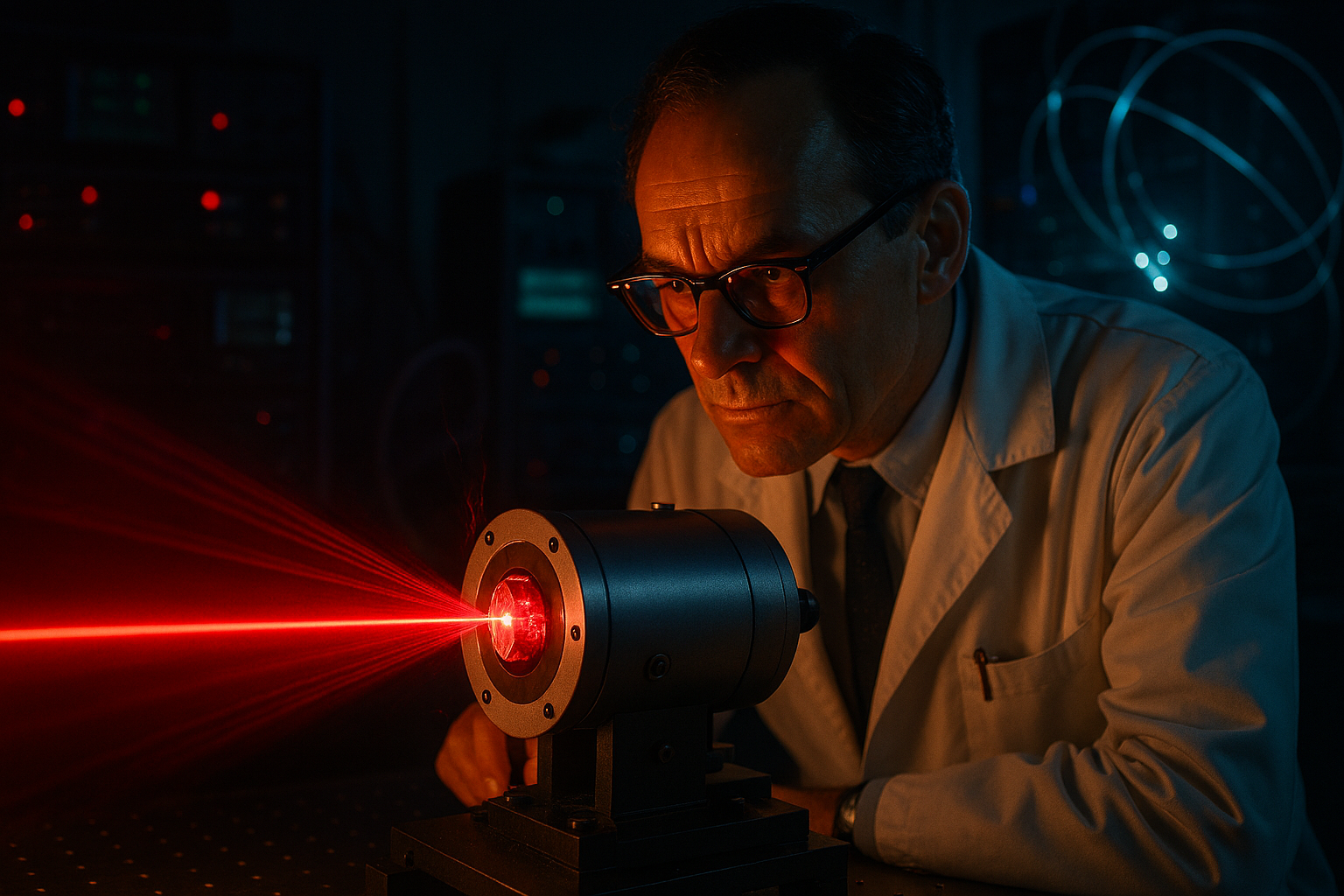
Imagine a beam of light in a dark room…
A single line moving forward without losing its path, hitting its target with incredible precision. That’s laser, the superhero version of light! ⚡✨
But lasers are not just something from science fiction. Behind them lie centuries of scientific theories, brilliant scientists, and technologies that have transformed our lives.
🔬 What Is a Laser? (A Scientific but Fun Definition)
The word laser comes from the phrase “Light Amplification by Stimulated Emission of Radiation.”
Let’s simplify that a bit:
- Normal light spreads everywhere like a party—colorful and chaotic. 🎉🌈
- A laser, on the other hand, is a focused, single-color, high-energy beam of light. 🎯🔴
- It travels in one direction with incredible precision.
In short, a laser is the “super version” of light. 💥
🧑🔬 How Was the Laser Invented? (A Journey Through History)
1️⃣ Einstein and Stimulated Emission (1917)
Everything began in 1917, when Albert Einstein studied the behavior of light.
Einstein suggested that photons (particles of light) could stimulate other photons, producing a stronger and more organized beam of light. 💭
This idea became the foundation of the laser principle known as stimulated emission.
2️⃣ Maiman and the Ruby Laser (1960)
The real breakthrough came thanks to Theodore Maiman.
In 1960, Maiman built the first working laser using a ruby crystal. 🔴
At the time, creating such a powerful and focused beam of light in a laboratory seemed almost like magic. 🪄
Who was Maiman?
- An engineer and experimental physicist
- Fascinated by light and technology
- Determined to harness the power of light for measurement, communication, and scientific experiments
When his ruby laser finally worked, the scientific world was stunned.
People asked in amazement:
“How can light be this precise and powerful?” 😲
💡 What Is a Laser Used For? (Magical but Practical Uses)
Lasers are not limited to laboratories—they are everywhere in modern life.
🔹 Medicine
- LASIK eye surgery: lasers reshape the cornea to correct vision problems. 👁️
- Skin treatments and surgical procedures: extremely precise and minimally invasive. ✂️💉
🔹 Industry
- Metal cutting and welding with incredible precision. 🏭
- 3D printing and manufacturing, where lasers help shape materials accurately. 🖨️
🔹 Communication
- Fiber-optic cables transmit internet and data using laser light. 🌐⚡
- Space and radar systems measure distances with extreme accuracy. 🛰️
🔹 Entertainment and Art
- Laser light shows used in concerts and events create spectacular visuals. 🎆
- Holograms that produce stunning three-dimensional images. 🌌
🔹 Security
- Barcode scanners and alarm systems rely on laser technology. 🛡️
- Used in stores, laboratories, airports, and many other places.
⚡ Advantages of Laser Technology
Laser technology offers many powerful advantages:
- Precision – can measure or cut extremely small details. 📏
- Speed – information can travel nearly at the speed of light. 💨
- Clean and sterile operations – especially important in surgery. 🧴
- Energy efficiency – controlled beams reduce energy waste. 🔋
🏛️ The Importance of Lasers in History
The 1960s were a time of intense technological competition during the Cold War.
Scientists quickly realized lasers could be used for:
- Military technologies 🪖
- Scientific research 🔬
- Communication systems 📡
By the 1970s, lasers and fiber-optic technologies started a telecommunications revolution.
In the 1980s, laser surgeries and industrial uses became widespread.
Today, lasers are considered one of the fundamental technologies of the modern world.
👨🎓 Practical Tips and Interesting Facts
Here are some useful things to know about lasers:
- Never point a laser directly into someone’s eyes. 👀❌
- Different lasers use different wavelengths and colors, depending on their purpose.
Examples:
- Ruby lasers – historically important for early scientific experiments.
- Green lasers – commonly used for astronomy and presentations.
- Infrared lasers – widely used in telecommunications and medicine.
Laser energy is extremely powerful, so precision and control are essential.
🤔 What If Lasers Had Never Been Invented?
Imagine a world without lasers.
- Fiber-optic internet would be much slower. 🌐🐢
- Laser eye surgeries would not exist. 👁️
- Industrial cutting technology would be less precise. 🏭
- Concert light shows would be far less impressive. 🎇
- Scientific measurements would be much harder.
In other words, lasers quietly created a technological revolution. 🌟
⭐ Conclusion: The Invisible Hero of Light
Lasers may seem like simple beams of light, but their impact is enormous.
- A precise expert cutting metal in factories… 🛠️
- A life-saving tool in eye surgery… 👁️
- A super-fast messenger carrying data across the world… 🌍⚡
Behind countless modern technologies stands one remarkable invention:
The laser — the invisible hero of light. 🔴🦸♂️