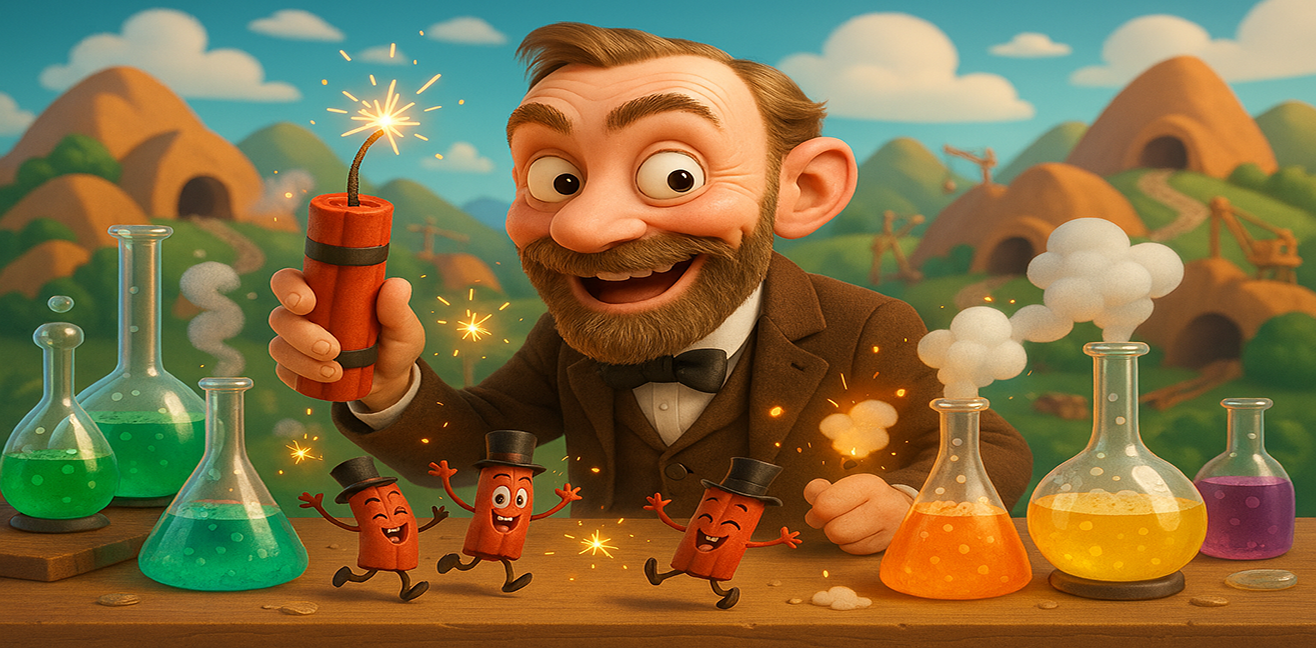
Some inventions seem simple or just dangerous at first glance. But after a while, they become indispensable in our lives. Dynamite is both dangerous and revolutionary. It can blast mountains, carve tunnels, and spark construction revolutions—but it also scares people and deeply influenced Alfred Nobel’s life.
Let’s dive into this explosive yet highly educational story together.
🏗️ How the World Operated Before Dynamite
In the early 1800s, miners used extremely risky methods to break rocks and dig tunnels:
- Controlled explosions using black powder, often deadly
- Manual chiseling and sledgehammering to break rocks
- Frequent accidents, injuries, and deaths
Mining sites back then were like adrenaline parks, but every step carried the risk of death. A miscalculated explosion could easily result in serious injury or worse. This was the point where Alfred Nobel stepped in.
👨🔬 Alfred Nobel: The Genius Behind the Bang
Alfred Nobel, born in Sweden in 1833, was a chemist and engineer. From a young age, he spent most of his time in laboratories and had a particular interest in explosive chemicals.
By the mid-19th century, Nobel was working with nitroglycerin, an extremely powerful but unstable and deadly explosive. Even a single drop could cause a catastrophic accident.
Nobel asked himself:
“Is there a way to make this power safe?”
And in 1867, the miracle happened: dynamite was born. Nobel mixed nitroglycerin with clay to form a paste. This made the explosive both portable and controllable. When testing his invention in his lab, Nobel may have chuckled at the repeated explosions and failed experiments:
“Sometimes changing the world is a bit noisy!” 😅
🧨 The Technical Structure and Practical Use of Dynamite
Dynamite worked on a simple yet brilliant principle:
- Primary ingredient: Nitroglycerin
- Stabilizer: Clay or other absorbent materials
- Form: Stick or small baton shape
Practical tips and facts:
- Modern construction engineers still follow Nobel’s principles
- Explosives are always used in controlled environments and in the correct quantities
- Blast directions are carefully calculated to avoid damage to surrounding buildings and the environment
- Modern dynamite is much safer and features precise detonation systems
🏗️ Uses and Benefits of Dynamite
Dynamite is not just an explosive—it’s a world-changing tool:
- Mining: Mountains can be blasted and mines opened much more easily
- Construction: Dams, bridges, and tunnels are completed faster
- Infrastructure: Railways and roads are built more efficiently
- Economy: Projects are completed faster, saving time and labor
- Safety: Controlled blasts reduce accidents
In short, dynamite saves labor, time, and costs.
⚖️ The Dangers of Dynamite and Nobel’s Conscience
The power of dynamite weighed heavily on Nobel. It wasn’t just for construction and mining; it could also be used in warfare. Disturbed by this, Nobel established the Nobel Peace Prize later in life to counterbalance the negative effects of his invention.
😄 The Humorous and Fascinating Side of Dynamite
Imagine Nobel in his lab:
- Testing explosions on one side,
- Taking notes on the other,
- And maybe thinking:
“One day this stuff will blast mountains and build bridges—but I hope it’s not used in wars!” 😅
His invention became a symbol of the art of controlled danger.
🌍 The Importance of Dynamite Today
Dynamite is still in use today, but far safer:
- Construction and mining projects are efficient and secure
- Dams, roads, and tunnels are built with precision
- Global infrastructure projects are made possible thanks to Nobel’s revolutionary invention
💣 Dynamite: A Big Revolution in a Small Stick
Dynamite entered our world as a big idea in a small stick. It’s both terrifying and revolutionary, leaving its mark in human history.
Alfred Nobel’s life and invention remind us:
“Sometimes the most dangerous inventions, when used responsibly, can change the world.”
And that’s why dynamite is not just an explosive substance—it’s a symbol of human ingenuity and intelligence. 💥✨