Throughout your life, you’ve probably struggled with eggs sticking to the bottom of a pan. Who knows how many times you’ve grabbed a spatula and muttered, “One day I’ll stop dealing with this”? Well, that nightmare vanished thanks to a laboratory accident and a scientist’s patience. This miracle is called Teflon.
But hold on! This isn’t just a pan coating. It’s a kitchen revolution born from coincidence, chemistry, and creativity.
🧪 A Chemist, a Chain of Accidents, and the Birth of Teflon
The mid-1950s, America… Chemistry labs were buzzing with industrial growth. Here, Roy Plunkett, a young chemist, was working on refrigerant gases and freons.
One day, a typical lab mishap occurred: a gas cylinder wouldn’t open. Plunkett checked it and discovered a big surprise: inside the cylinder was a white, slippery, non-stick substance.
This substance was polytetrafluoroethylene (PTFE), what we now know as Teflon.
🎯 Practical Tip: Teflon was originally developed as a byproduct of refrigerant experiments. In other words, a kitchen revolution was born from a laboratory accident!
🥘 What is Teflon and What Does It Do?
Teflon is a miracle beyond just non-stick pans. Its benefits include:
- Non-Stick Properties: Eggs, pancakes, and sauces slide off effortlessly.
- Less Oil Needed: Makes cooking healthier meals easier.
- Easy Cleaning: Pans and pots clean almost instantly.
- Energy Saving: Food can cook at lower heat, saving energy.
🎯 Practical Tip: Use silicone or wooden spatulas instead of metal on Teflon pans to extend the coating’s lifespan.
👨🔬 The Inventor: Roy Plunkett – Hero of Happy Accidents
Roy Plunkett, born in 1910, was an American chemist.
- Curious and Patient: He never gave up on experimenting.
- Chemistry Expert: Specialized in refrigerants, freons, and polymers.
- Turning Accidents into Opportunities: A cylinder mishap led to one of the greatest kitchen revolutions in history.
🎯 Pro Tip: Plunkett’s story teaches that in science, sometimes mistakes lead to the biggest discoveries.
🔬 Teflon’s Historical Importance and Development
Teflon revolutionized not only the kitchen but also industry:
- 1950s: First used in cookware.
- 1960s: Adopted in aerospace to reduce friction.
- Today: Essential in electronics, medicine, industry, and everyday kitchens.
🎯 Practical Tip: Teflon isn’t just for pans; it’s used in cables, machinery, and even space shuttles!
💡 Teflon’s Contributions and Benefits in Daily Life
1️⃣ Health: Less oil makes meals healthier.
2️⃣ Time-Saving: Cleaning time is dramatically reduced.
3️⃣ Energy Efficiency: Food cooks at lower heat.
4️⃣ Versatility: Revolutionized not just kitchens but also industry.
5️⃣ Culinary Compatibility: Perfect for pancakes, omelets, vegetables, and sauces.
🎯 Practical Tip: Avoid using empty Teflon pans on high heat; this extends their lifespan.
😄 Little-Known Fun Facts
- Teflon is so slippery that a ball can roll on it without falling.
- It was first discovered not in pans, but in refrigerant systems and laboratories.
- When it entered kitchens, everyone said, “This is like magic!”
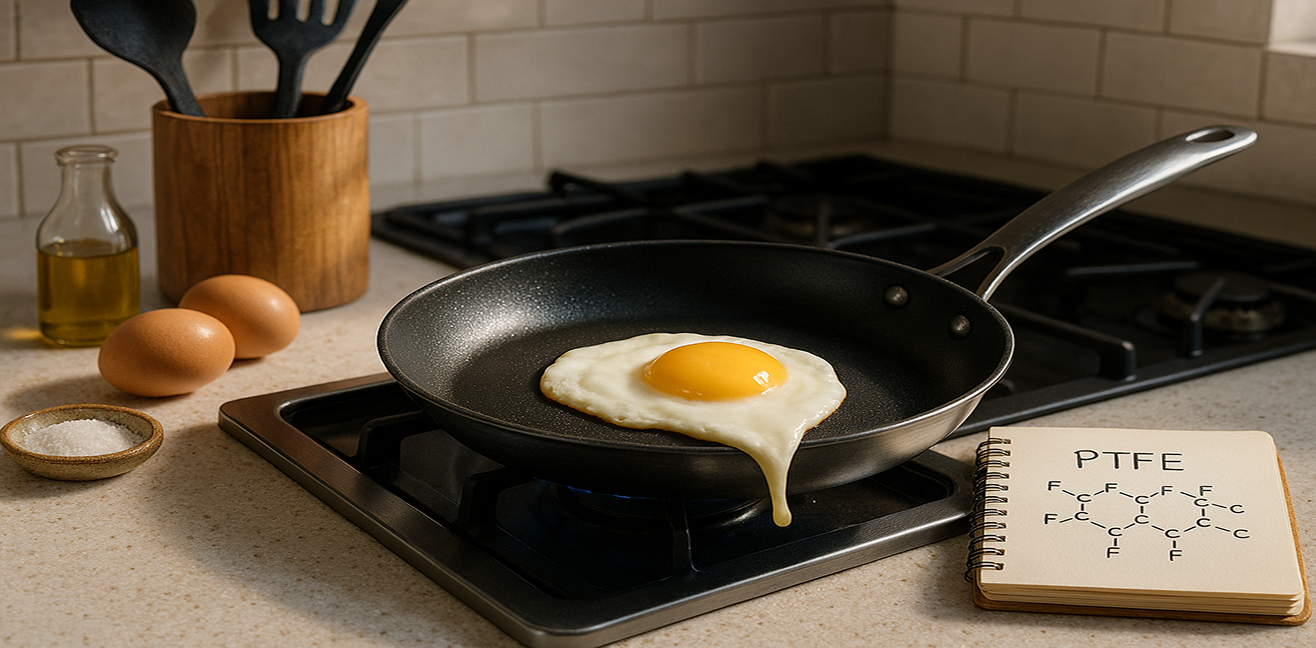
🎯 Scientific Tip: Teflon’s non-stick properties come from fluorine atoms attached to a hydrocarbon chain. Its chemical structure revolutionized cooking!
🧠 What Teflon Teaches Us
- Great inventions sometimes come from small laboratory accidents.
- Curiosity and patience are keys to scientific success.
- Even a simple substance can create revolutions that make our lives easier.
So, the next time you cook pancakes in your non-stick pan, remember: this comfort exists thanks to a chemist’s patience and a lab accident. 🍳✨