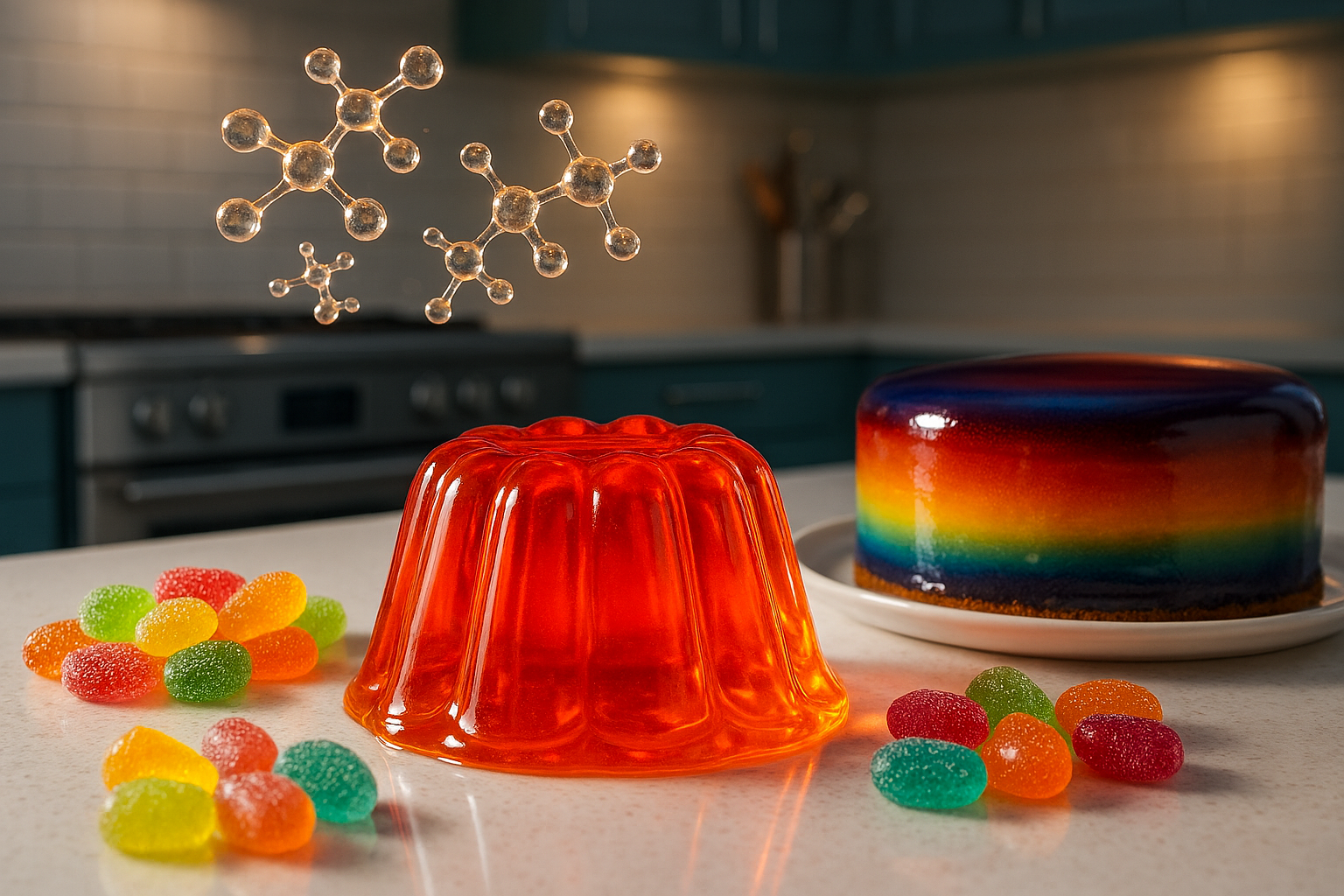
Let’s take a little peek into the kitchen… 👀
A wobbly jelly dessert, a shiny cake glaze, gummy candies that melt in your mouth… 🍬🍰
Behind all these scenes, there’s usually a quiet hero: gelatin.
In the kitchen, gelatin often works as a background assistant. It’s not the star of the show, but it’s what keeps the star standing.
Without gelatin:
🍰 Cheesecakes would struggle to hold their shape.
🍬 Gummy candies would just be ordinary candy.
🎂 Some cakes would collapse very easily.
In short, gelatin is the invisible architect of the kitchen. But the story of this amazing substance is far more interesting than you might think…
🔬 What is Gelatin? (A Scientific Yet Fun Definition)
Gelatin is actually a natural protein. It is made by processing collagen, a substance found in the bones, skin, and connective tissues of animals.
You can think of collagen as:
🏗️ the body’s natural scaffolding.
When bones are boiled for a long time, collagen dissolves, and as it cools, it turns into a gel-like substance. This is exactly when gelatin comes into play.
Scientifically, gelatin can:
🧊 Turn liquids into gel
🍮 Stabilize the structure of foods
☁️ Provide strength to foams and creams
In short, gelatin is the engineer of the kitchen. 👨🍳
🏺 The Story of an Almost Accidental Discovery
Gelatin wasn’t discovered as a result of a lab accident. Its history goes far back in time.
🏰 In the Middle Ages, people noticed something strange when boiling bones in large cauldrons:
The meat broth solidified into a jelly as it cooled. 🍲➡️🍮
At first, no one understood why. But chefs quickly began to take advantage of this property.
In European aristocratic kitchens, meat jellies and cold dishes became very fashionable. 👑
However, producing gelatin back then was a very time-consuming task.
To make gelatin, a chef had to:
🔥 Boil bones for hours
🧺 Strain the liquid
🍲 Concentrate it again
❄️ Then let it cool
In other words, today’s ready-to-use gelatin packets would have been a real luxury back then.
👨🔬 One of the First Scientists to Study Gelatin
In the 17th century, the scientific world began studying this gel-like substance.
One important scientist who studied it was Denis Papin. 🧪
Papin mainly worked on:
⚙️ Pressure cooking
🚂 Steam engines
But while boiling bones under high pressure, he noticed the formation of this dense, gelatinous substance.
Papin asked himself:
💭 “Can we produce a nutritious food from bones?”
At that time, Europe faced periods of famine, and Papin believed that bone-based gelatin soups could help feed the poor. 🍲
His research represented one of the first scientific steps toward gelatin production.
🍽️ Gelatin Enters the Kitchen (19th-Century Culinary Fashion)
By the 19th century, gelatin had become a true star in aristocratic kitchens. ✨
In France and England, chefs used gelatin to create spectacular dishes.
Popular preparations of the time included:
🥩 Meat jellies
🐟 Fish jellies
🍓 Fruit jellies
🍮 Molded cold desserts
Some chefs even made transparent food sculptures using gelatin. 🧊
The creative desserts we see on Instagram today were, in a way, already being made in those old kitchens. 📸
🏭 Industrial Production: The Great Culinary Revolution
Gelatin became truly widespread in kitchens at the end of the 19th century.
At that time, factories began producing gelatin in various forms:
⚪ Powder
🟡 Granules
📄 Sheets
This revolution allowed:
⏳ A significant reduction in preparation time
🏠 Making gelatin accessible to everyone
🎂 Advancing the art of pastry-making
By the early 20th century, gelatin desserts became a major trend in the United States. 🇺🇸
🌍 Where Gelatin is Used Today
Gelatin is used in many more areas than one might think.
🍬 Confectionery and Desserts
- Gummy candies
- Marshmallows
- Jelly desserts
- Cheesecakes
🎂 Pastry
- Cake glazes
- Mousses
- Cream stabilization
💊 Pharmaceutical Industry
Many medicine capsules are actually coated in gelatin.
🧴 Cosmetics
- Facial masks
- Skincare products
📷 Photography (Historical Use)
Old photographic films also used gelatin coatings.
👨🍳 Practical Tips for Using Gelatin
A little kitchen hands-on advice now.
How to Use Gelatin Correctly
1️⃣ Soak in Cold Water
Powdered or sheet gelatin should first be hydrated in cold water.
This “activates” it. 💧
2️⃣ Don’t Add Directly to Boiling Liquid
Adding gelatin directly to boiling liquid can cause clumping. ⚠️
3️⃣ Correct Temperature
The best temperature for use is around 50–60°C. 🌡️
4️⃣ Watch Out for Acidic Fruits
🍍 Pineapple and 🥝 kiwi can sometimes prevent gelatin from setting properly.
💪 Potential Benefits of Gelatin
Gelatin contains collagen and may offer some benefits.
🦴 Joint Health
Collagen is an important component of joints.
✨ Skin Health
It may contribute to skin elasticity.
🍗 Protein Source
Gelatin is a low-calorie source of protein.
🦠 Digestion
Some research suggests it can aid digestion.
Of course, as with all foods, moderation is key.
🤔 What if Gelatin Had Never Existed?
Imagine a world without gelatin.
Probably:
🍬 Gummy candies wouldn’t exist
🎂 Some cakes wouldn’t hold their shape
💊 Medicine capsules would be made from other materials
👨🍳 Some cooking techniques would never have developed
So gelatin is a discovery that may seem modest but has sparked a true culinary revolution.
⭐ Conclusion: The Kitchen’s Silent Miracle
Gelatin is never the star of the show. But it prevents the scene from collapsing.
The playful bounce of a gummy candy… 🍬
The perfect shape of a cake… 🎂
The delicate wobble of a dessert… 🍮
Behind it all is gelatin.
That’s why it can truly be called the “invisible hero” of the kitchen. 🦸♂️🍮