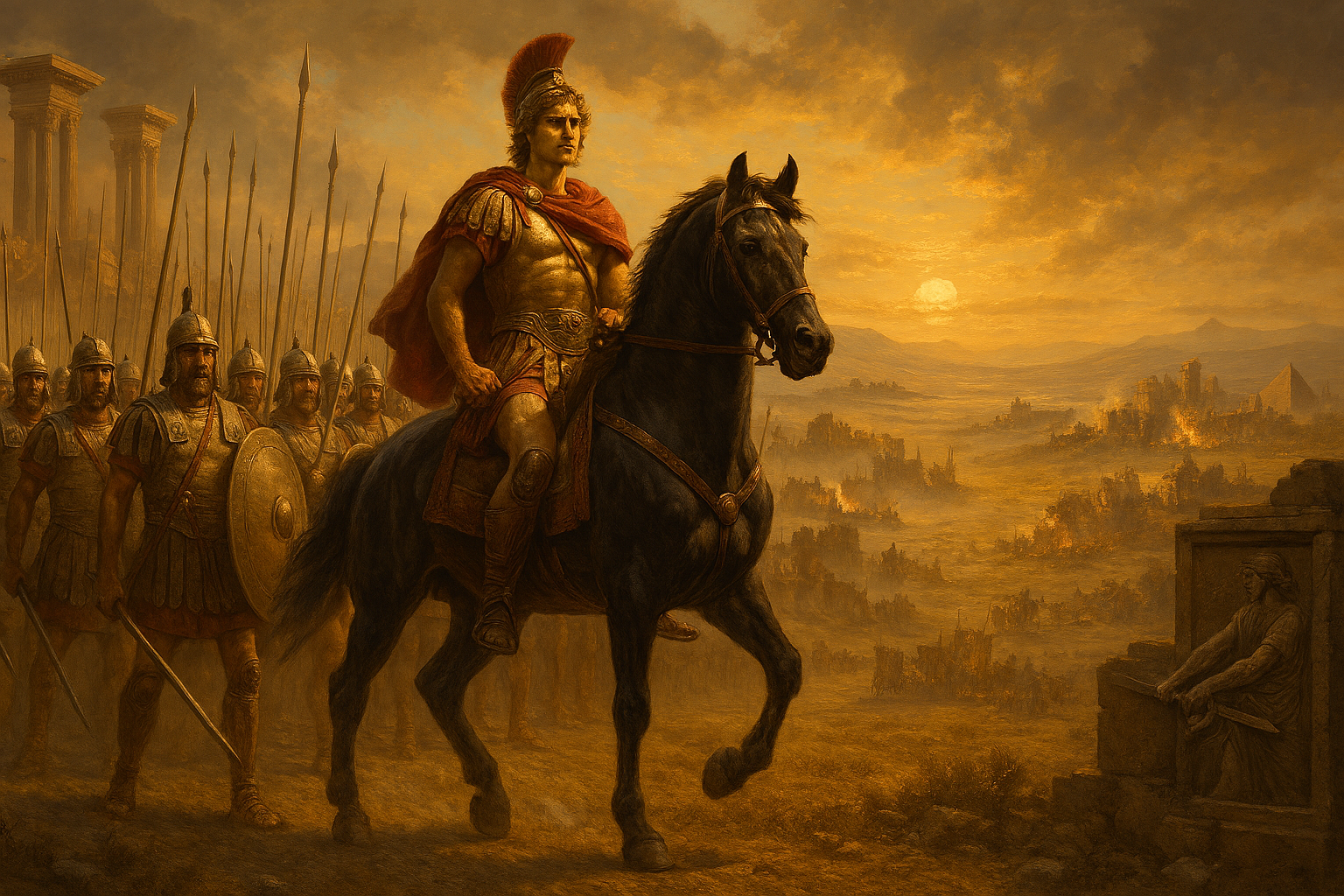
In 356 BCE, a child was born in Pella, Macedonia… Even at a young age, his intelligence, courage, and leadership ability impressed everyone around him. This child would one day be remembered as “Alexander the Great.” His father, Philip II, had transformed Macedonia into a powerful kingdom and disciplined its army. But Alexander’s ambitions went far beyond his father’s dreams.
“He will one day show his boundaries not just on a map, but across the whole world,” his young gaze seemed to say. And this gaze would drive him into one of history’s greatest military adventures.
🏛️ Alexander the Great: From Youth to Legend
Influence of His Parents 🏛️: Olympias’ strong beliefs and fascination with mythology made Alexander see himself as destined for greatness. Philip II’s military and diplomatic genius nurtured Alexander’s strategic thinking.
343 BCE – Education with Aristotle 🏺:
At 13, Alexander was tutored by Aristotle. This education didn’t just teach him philosophy, science, and literature; it also gave him deep insight into natural sciences, medicine, and ethics.
- Curiosity and Knowledge 🌐: Alexander was always eager to learn, a trait that would later encourage cultural exchange in the lands he conquered.
- Leadership Skills 🧠: Aristotle’s lessons developed his strategic thinking and understanding of human psychology.
Bucephalus – The Legendary Horse 🐴:
The young Alexander saw a horse at the Macedonian royal stables: Bucephalus, a horse no one dared to ride. Calmly understanding the animal’s fears, Alexander tamed and rode him. This event proved his courage, intelligence, and risk-taking ability.
Youth and Early Battles ⚔️:
- At 16, he was allowed to command the army.
- He suppressed uprisings in Macedonia, showing discipline and decisiveness at a young age.
- At 20, after his father’s assassination, he became the king of Macedonia.
Character Traits:
- Brave and Charismatic 💪: His soldiers were loyal because he led from the front, not from behind.
- Intelligent and Strategic 🧠: He planned every battle, considering the psychology of his enemies.
- Compassionate and Culturally Interested 🌍: He didn’t just conquer; he rebuilt cities and formed alliances with local populations.
A Quick Note:
As a young king, Alexander had the ability to influence not just his army, but everyone around him—laying the foundation for his future campaigns and empire-building.
🗺️ Eastern Campaigns: From Europe to India
Alexander’s Eastern Campaigns were not merely about conquest—they were efforts to unite cultures and build an empire.
1️⃣ Anatolia and the Persians:
In 334 BCE, he crossed the Hellespont (Dardanelles) into Anatolia. His first major victory was the Battle of the Granicus ⚔️, defeating the Persian army and boosting his troops’ confidence.
- Tactics 🧠: Phalanx formations, fast cavalry, and psychological warfare—early examples of modern military strategy.
- City Integration 🏗️: After victories, he rebuilt cities and formed alliances with local populations.
2️⃣ Syria and Phoenicia:
- Battle of Issus: He faced Persian King Darius III, who fled as Alexander won.
- Siege of Tyre: Lasted 7 months, showcasing engineering prowess and patience.
3️⃣ Egypt: Pharaoh and Alexandria:
In 332 BCE, he reached Egypt, became Pharaoh, and founded the city of Alexandria.
- Spread of Hellenistic Culture 🌐: Greek culture merged with Egyptian traditions, making Alexandria a center of science and art.
4️⃣ Persian Empire and Mesopotamia:
He decisively defeated the Persians at the Battle of Gaugamela and captured Persepolis, controlling the heart of the Persian Empire.
5️⃣ India Campaign and Army Fatigue:
Alexander’s army reached India, engaging in the Indian Wars ⚔️. They defeated massive war elephants but eventually, the soldiers demanded to return home.
- The Gordian Knot 🪢: Legend says, “To untie the knot, you don’t have to unravel every thread,” and Alexander cut it with his sword—a symbol of bold problem-solving.
🏰 Empire and Culture
Alexander’s campaigns were not just military—they were also cultural:
- Hellenistic Culture 🌐: Greek culture merged with Eastern cultures, giving new dimensions to art, science, and literature.
- Urbanization and Trade 🏙️: Cities, trade routes, and ports he established increased economic and cultural exchange.
- Language and Education 📚: Greek became the language of education and commerce, and his cities became centers of learning and culture.
Alexander became not just a conqueror, but a unifier and a bridge between cultures.
⚖️ Impacts, Benefits, and Drawbacks
Benefits ✅
- Cultural exchange and the spread of Hellenistic civilization.
- A new era in science, art, and philosophy.
- Development of cities and trade routes, boosting economic vitality.
Drawbacks ❌
- Thousands of deaths and destruction of cities.
- Political instability and pressure on local populations.
- Fatigue in the army and occasional mutinies.
🏁 Conclusion: The Youngest Emperor in History
Alexander the Great’s Eastern Campaigns were not only a story of military success but also of cultural unity, strategic genius, and imperial ambition. 🌍
Chasing great dreams requires courage.
War is not just about gaining territory; it is also about uniting cultures, science, and people.
History is shaped by intelligence, strategy, and determination ⚔️.
And yes… the dream of one young man continues to captivate people thousands of years later. ✨